Remote onboarding can make or break your team’s growth, especially for startups. Without a structured process, you risk losing talent early, facing compliance issues, and hindering productivity. Here’s a quick rundown of the five key steps to get it right:
- Preboarding: Prepare tools, compliance documents, and welcome packages before Day 1.
- First Day & Week: Mix live calls and self-paced tasks to avoid overwhelming new hires.
- Role-Specific Ramp-Up: Set clear 30-60-90 day goals and assign mentors for guidance.
- Team Connections: Facilitate informal interactions like virtual coffee chats and share company values.
- Feedback Loop: Use surveys and check-ins to improve your process continuously.
Why it matters: A well-planned onboarding process boosts retention by 82% and productivity by 70%. For startups, this can mean avoiding costly turnover and building a stronger, more aligned team.
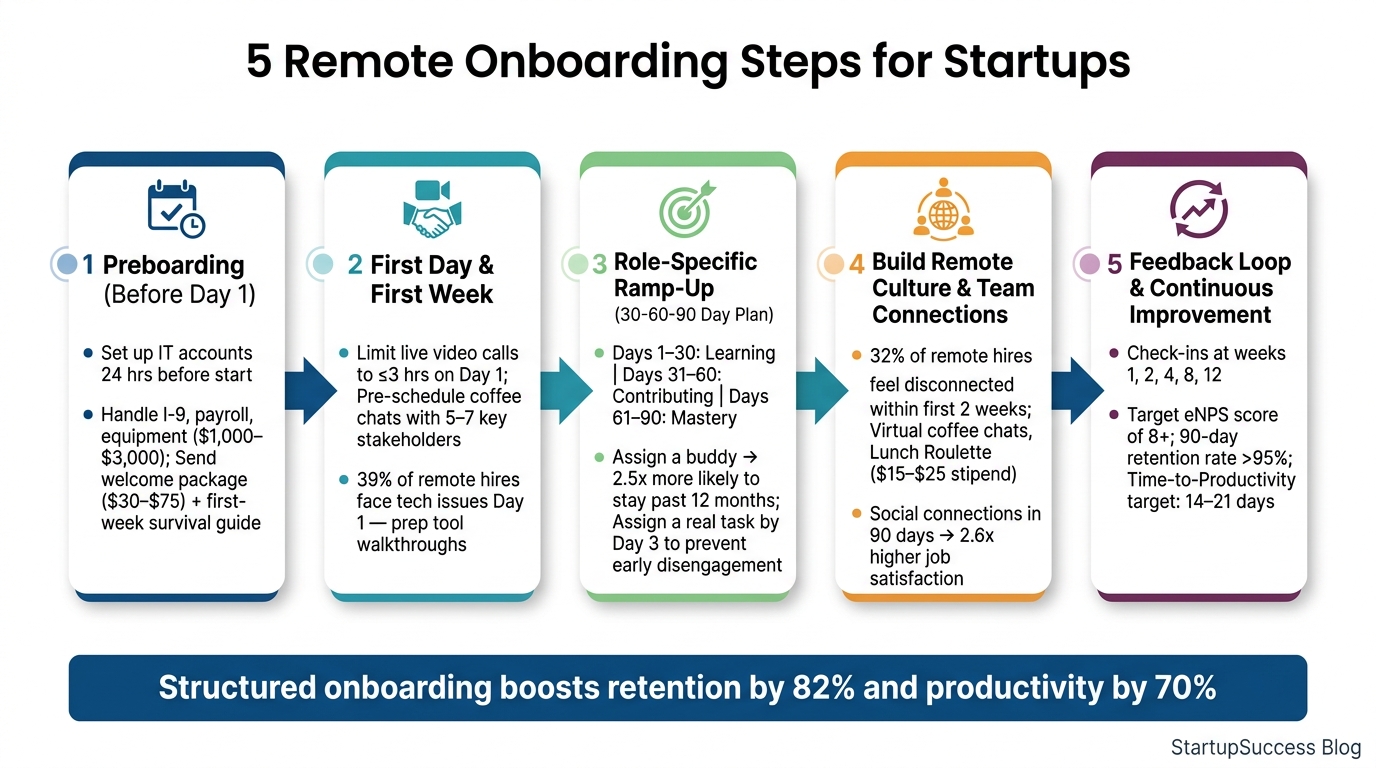
5 Remote Onboarding Steps for Startups
A 5-Step Framework for Remote Employee Onboarding in 2025
sbb-itb-772afe6
Step 1: Set Up Preboarding Before Day 1
Preboarding covers the period from when a new hire accepts the offer to their first official day. When done right, it eliminates confusion, builds enthusiasm, and sets a positive tone. As tinyteam explains:
"Recruiting convinces someone to join. Preboarding makes them glad they said yes."
This phase ensures a smoother first day and helps establish the startup’s remote work culture effectively.
Build a Preboarding Checklist
The main objective? Make sure no new hire starts Day 1 feeling lost about how to log in, where to go, or what to do. To streamline this, focus on four key areas simultaneously: legal/HR, payroll/finance, IT/security, and people/culture.
On the IT side, set up accounts for tools like email, Slack, Notion, Google Workspace, VPN, and SSO at least 24 hours before Day 1. Doing this ahead of time can resolve about 80% of the technical hiccups that often plague first days. For a personal touch, assign an onboarding buddy – someone outside the new hire’s direct team – who can help answer everyday questions without hesitation.
Handle Logistics and Compliance Early
When hiring in the U.S., compliance tasks are time-sensitive. Section 1 of Form I-9 must be completed on or before the first day, and Section 2 must be done within three business days of the start date. If you’re hiring in a new state, make sure to register with that state’s tax agencies for withholding and unemployment insurance before running payroll. Overlooking these steps can result in fines ranging from $252 to $2,507 per violation.
For equipment, order laptops and peripherals at least two weeks ahead of time. A basic setup typically costs $1,000 to $1,500, while a more advanced kit with monitors and extras can range from $2,000 to $3,000. Many startups also provide a home-office stipend between $500 and $1,000 to help new hires create a comfortable workspace. Send the tracking number and a note from the manager about a week before Day 1 to confirm everything is on track. With these logistics sorted, you can focus on creating a welcoming experience.
Send a Welcome Package and Starter Docs
A welcome package – featuring items like company swag, a handwritten note, or a branded mug – can cost $30 to $75 per hire but goes a long way in making new hires feel part of the team before they even start. Pair this with a digital "first-week survival guide" sent three days before their start date. This guide should include a Day 1 schedule, communication norms (e.g., when to use Slack vs. email), an org chart, and a roadmap for their first 30-60-90 days.
For an extra touch, share episodes from Code Story – a podcast where tech founders and CTOs discuss building digital products. These stories can help new hires connect with the startup’s mission and challenges, offering a simple yet meaningful way to immerse them in the company’s vision.
Step 2: Plan the First Day and First Week
After preboarding, setting up a well-structured and welcoming Day 1 is essential. Early experiences can have a major influence on long-term retention – up to 86%, according to research. Here’s how to craft a thoughtful plan for the first day and week.
Build a Balanced First-Day Schedule
Don’t overwhelm your new hire with back-to-back video calls on Day 1. Instead, aim for a mix of live interactions and self-paced activities. Harvard Business Review highlights this point perfectly:
"Remote onboarding is not simply putting your in-person process on a video call… [it is] treating remote onboarding like ‘radio shows on television’: taking a format designed for one medium and shoving it into another without adapting it."
Limit live video calls to no more than three hours on the first day. Alternate these with self-paced tasks, and always consider the new hire’s local working hours. Wrapping up the day early – around 4:00 PM – shows consideration and helps prevent burnout.
Here’s an example of a balanced Day 1 schedule:
| Time | Activity | Format |
|---|---|---|
| 9:00 AM | Welcome call with founder/manager (often featured in startup founder stories) | Live video |
| 10:00 AM | IT & tool walkthrough (Slack, Jira, etc.) | Live video |
| 10:45 AM | Self-paced product demo exploration | Async |
| 11:30 AM | Team welcome call & icebreakers | Live video |
| 12:00 PM | Lunch break | Break |
| 1:00 PM | Handbook review & benefits enrollment | Async |
| 2:00 PM | 1-on-1 with onboarding buddy (informal Q&A) | Live video |
| 3:30 PM | Manager check-in | Live video |
| 4:00 PM | Log off early | End of day |
This approach combines technical setup with cultural integration, ensuring new hires feel both prepared and welcomed.
Walk Through Tools and Workflows
Nearly 39% of remote new hires encounter technical problems on their first day. To avoid this, schedule a guided session to help them log in to essential tools like Slack and project management platforms (e.g., Jira or Asana).
But access alone isn’t enough – remote hires need clear guidance on communication norms. Unlike in-office settings, they can’t pick up these habits through observation. Be specific about:
- When to use Slack versus email
- Expected response times
- Task-tracking processes
A dedicated "#new-hire-questions" Slack channel can provide a judgment-free space for asking basic questions. For more complex workflows, short Loom videos (5–10 minutes) work well, giving hires a resource they can revisit as needed. These steps ensure technical readiness and create a foundation for meaningful team interactions.
Schedule Key Meetings in the First Week
First impressions matter, and the first week is your chance to solidify a positive experience. To do this, pre-schedule the new hire’s calendar before their start date. Include:
- Short 15–20 minute coffee chats with each immediate team member
- Cross-functional introductions with 5–7 key stakeholders
- At least one role-specific deep dive (e.g., a codebase walkthrough for engineers)
If your company offers equity, dedicate time to explain vesting schedules, cliffs, and dilution. Misunderstanding equity terms can be a retention risk, so clarity here is vital. Finally, managers should check in daily during the first week. Remote hires might hesitate to speak up in Slack, so these check-ins ensure they feel supported.
Step 3: Create a Role-Specific Ramp-Up Plan
After the first week of onboarding, the focus shifts to turning new hires into active contributors. This is where a structured ramp-up plan comes into play, offering a clear path for growth and eliminating the uncertainty of what success looks like in their role. Research shows that having a well-defined 30-60-90 day plan can increase new hire confidence and alignment with goals by 60%.
Set 30-60-90 Day Goals
The 30-60-90 day framework divides the onboarding process into three phases, each with a specific focus, making the transition more manageable.
| Phase | Focus | Key Activities | Success Measure |
|---|---|---|---|
| Days 1–30 | Learning | Tool setup, shadowing, 1:1s, culture immersion | Completion of all training; 30-day satisfaction score |
| Days 31–60 | Contributing | First independent project, cross-team meetings | First deliverable shipped; increased task autonomy |
| Days 61–90 | Mastery | Full task ownership, process improvement | On-track performance; 90-day retention confirmed |
It’s important to define three to five measurable goals for the first 30 days before the new hire’s start date. Vague objectives like "get up to speed" don’t provide clarity. Instead, focus on specifics: for example, "Complete the product walkthrough and shadow two customer calls by Day 14." To keep things on track, schedule formal check-ins at each milestone. These meetings not only evaluate progress but also ensure the role aligns with the expectations set during hiring.
Once goals are in place, pairing new hires with the right support system can significantly boost their progress.
Assign Mentors and Learning Resources
Support systems are critical for a smooth ramp-up. It’s helpful to distinguish between a buddy, who handles day-to-day questions, and a mentor, who focuses on long-term professional development.
"The buddy is the new hire’s safe channel for ‘dumb questions.’ This is arguably the most important relationship in the first two weeks." – Thomas Chung, TeamOps Blog
For remote employees, having a dedicated buddy makes a huge difference; they’re 2.5 times more likely to stay past 12 months if paired with one.
When it comes to learning, a centralized knowledge base is invaluable. Tools like Notion or Confluence can house architecture diagrams, process documentation, and recorded Loom walkthroughs of complex systems. These resources allow new hires to learn independently without constantly interrupting senior team members. Structured onboarding with mentors and accessible documentation has been shown to reduce early turnover by 82% while significantly shortening ramp-up time.
Give New Hires Early Wins
One of the biggest challenges for remote employees is the feeling of invisibility – spending weeks learning without contributing. About 30% of remote workers leave within 90 days, often because they don’t feel like they’re making an impact. That’s why assigning a real, achievable task by Day 3 is crucial.
This task doesn’t need to be complicated. For an engineer, it could be fixing a small bug or updating documentation, which also familiarizes them with the deployment process and coding standards. For other roles, a simple internal report or a minor UI copy update works just as well. The key is to give them something tangible to accomplish early on.
"Completing a real project in the first month gives the new hire a sense of competence and belonging that no training module can replicate." – Calvin Botez, HR
Make sure their contributions are acknowledged. A quick shout-out in a Slack channel or a team meeting can go a long way in reinforcing their sense of belonging. Many startup tech leaders emphasize that these early wins are the foundation of a strong engineering culture. These early wins don’t just build confidence – they set the stage for ongoing contributions and long-term success.
Step 4: Build Remote Culture and Team Connections
Once you’ve established role-specific ramp-up plans, it’s time to focus on creating meaningful team bonds. While early achievements and structured onboarding build confidence, they don’t automatically foster a sense of belonging. For remote hires, feeling part of the team requires deliberate effort. Research reveals that 32% of new remote hires feel disconnected from their team within the first two weeks, with isolation being a key reason for early departures. This highlights the importance of integrating cultural connection into the remote onboarding process, building on the groundwork laid during preboarding and ramp-up phases.
Share Company Values and Communication Norms
For remote teams, culture needs to be clearly defined and communicated. In a physical office, informal cues often guide behavior, but in a remote setting, these “unwritten rules” need to be explicit. Clear documentation helps new hires understand things like how to provide feedback, when to use Slack versus email, or whether it’s okay to challenge leadership ideas.
A Communication Cheat Sheet is a practical way to clarify these norms. For example:
| Tool | Purpose | Expected Response Time |
|---|---|---|
| Slack/Teams | Informal, non-urgent communication | Within 4 hours during working hours |
| Formal or external communication | Within 24 hours | |
| Zoom/Meet | Real-time decisions and complex discussions | During scheduled meetings |
| Jira/Linear | Task tracking and project updates | Updates live in the system |
In addition to tools, a recorded welcome presentation (30–45 minutes) can introduce the company’s story, values, and communication guidelines. This gives new hires a resource they can revisit anytime. Pair this with a cultural buddy – a seasoned team member (not their manager) – who can help navigate social norms and communication practices.
"Culture travels through behavior, stories, and repeated visible examples. Culture doesn’t travel through Notion docs and employee handbooks." – Alex Berman
With these foundational elements in place, the next step is to create casual opportunities for team interaction.
Create Space for Social Interaction
Building remote connections requires intentional social design. For instance, 78% of remote employees dislike mandatory virtual happy hours, so it’s better to focus on informal, purposeful interactions.
One effective approach is scheduling three or four 20-minute virtual coffee chats between the new hire and colleagues from other departments during their first two weeks. These quick, informal conversations help them build a wider network. Take Zapier’s "Zap Pal" program as an example – it automatically pairs new hires with experienced employees from different teams, encouraging cross-department relationships.
Another idea is Lunch Roulette, where small groups of three to four employees are randomly paired for a virtual lunch. To make it even better, offer a small stipend (around $15–$25) for the meal. Activities like this are low-pressure but highly effective – employees who form social connections within their first 90 days are 2.6 times more likely to report high job satisfaction.
Use Stories to Build Connection
Beyond structured interaction, personal stories can create deeper emotional bonds. While facts and organizational charts explain what a company does, stories reveal why it matters. Sharing the company’s founding story – its mission, early challenges, and pivotal moments – can help new hires connect on a more personal level.
Consider leveraging external storytelling platforms, like the Code Story podcast, which features in-depth interviews with tech leaders about their journeys. In May 2026, founder Anusha Iyer shared her inspiring path from naval research in Washington, D.C., to developing a machine identification platform, offering a glimpse into the challenges and triumphs of transforming a technical idea into reality. Including such stories during onboarding not only introduces your company’s background but also immerses new hires in the entrepreneurial spirit.
"Remote work strips away all the informal mechanisms that build connection in an office… You have to replace them with intentional, scheduled connection." – JobsByCulture
Step 5: Gather Feedback and Improve the Process
Creating a sense of connection and culture is important, but it’s not the whole picture. To truly understand if your onboarding efforts are effective, you need a feedback loop. Remember, 20% of new hires leave within the first 45 days – often due to unclear expectations or insufficient support. By actively seeking feedback and acting on it, you can fine-tune your onboarding process and prevent potential issues before they escalate. When combined with structured preboarding, role-specific training, and cultural integration, continuous feedback becomes a powerful tool for long-term success.
Run Check-Ins and Short Surveys
Schedule 15-minute check-ins at key intervals – weeks 1, 2, 4, 8, and 12 – to quickly identify any challenges or morale concerns. Pair these with milestone surveys at Day 7, 30, and 90. One key question to include is the Employee Net Promoter Score (eNPS): How likely are you to recommend this onboarding experience to a future colleague, on a scale of 0–10? Aim for a score of 8 or higher. Scores below this threshold signal areas that need immediate attention.
Once you’ve gathered feedback, act quickly. Use insights to update your onboarding materials and processes without delay.
Update Docs Based on Feedback
New hires often notice gaps or outdated information in onboarding materials. Make it a habit to revise your documentation after each new hire completes the process.
A helpful way to test clarity is through "onion-testing": ask an existing team member to follow the onboarding steps from start to finish without outside assistance. Any point where they struggle highlights areas in need of improvement.
"Startups that treat onboarding as a living document improve their process faster than those who build it once." – FirstHR
Track Onboarding Success Metrics
Feedback is valuable, but pairing it with concrete metrics ensures you’re making measurable progress. Focus on a few key indicators:
| Metric | What It Measures | Target |
|---|---|---|
| Time-to-Productivity (TTP) | Days until the new hire completes their first independent task | 14–21 days for individual contributors |
| Onboarding eNPS | New hire satisfaction with the onboarding process | 8+ on a 0–10 scale |
| 90-Day Retention Rate | Percentage of hires still employed after 90 days | >95% |
| Manager Confidence Rating | Manager’s assessment of the new hire’s progress | 4+ on a 1–5 scale by Day 90 |
If time-to-productivity stretches beyond 30 days, review your tool access, documentation, and initial task assignments. Likewise, if your 90-day retention rate drops below 95%, check whether managers are consistently holding weekly one-on-ones. Without that accountability, new hires are more likely to feel disconnected.
"If your onboarding dashboard only tracks completion, you are measuring paperwork – not performance." – Employees.info
Conclusion: Tie Remote Onboarding to Startup Growth
Remote onboarding can be a powerful tool for driving growth. The five steps highlighted – preboarding, first-day planning, role-specific ramp-up, culture building, and feedback loops – function as a cohesive system. Skipping even one of these steps can weaken the overall impact.
When done right, this process doesn’t just streamline integration; it also delivers measurable improvements in retention and productivity. For startups, this could be the difference between a team that builds steady momentum and one that struggles to start over repeatedly. As Alex Berman explains:
"Remote onboarding isn’t harder than in-person onboarding – it’s just different. It requires structure where the office used to supply it organically."
As your company scales, having documented and scalable processes becomes non-negotiable. While a hands-on, founder-led approach might work for a small team of five, larger teams of 30 or more need clear ownership and metrics to ensure success.
For those looking to refine their approach, resources like Code Story offer valuable insights. Through candid discussions with tech leaders, founders, and CEOs, they explore the real-world challenges of building and scaling teams.
"One of the few moments when startups have complete control over an employee’s first experience is remote onboarding. It’s best to make it count." – Nickie Louise, Tech Startups
A well-designed onboarding process not only integrates new hires but also reassures them that your startup is a place worth investing their time and talent.
FAQs
Who should own remote onboarding in a startup?
Remote onboarding works best when key roles collaborate to ensure a smooth process:
- HR takes care of employment paperwork, benefits enrollment, and shaping the overall onboarding experience.
- Hiring managers focus on setting clear role expectations, outlining goals, and providing team context.
- IT teams handle the logistics of hardware setup, granting system access, and ensuring security protocols are in place.
- Peer mentors play a key role in helping new hires adapt to the company culture.
- Founders and technical leaders align the onboarding process with company goals and strategy, which helps minimize early turnover.
This shared responsibility ensures that every aspect of onboarding is covered, from technical needs to cultural integration.
What’s the minimum onboarding plan if we’re moving fast?
To make remote onboarding smooth and efficient, start with pre-boarding. This means handling the basics before Day 1: completing paperwork, granting access to necessary tools, and setting up a schedule that works across time zones.
Day 1 should focus on introductions and clarity. Introduce the new hire to the team, clearly outline their role, and share your organization’s communication norms to set expectations.
During Week 1, assign a buddy to help them navigate their new environment, provide a small task to ease them into the workflow, and review any equity or benefits details to ensure transparency.
Keep the momentum going with weekly check-ins throughout the first month. Use these to address questions, provide feedback, and ensure they feel supported. Finally, schedule 30-60-90 day reviews to evaluate their progress and help them stay on track. This structured approach ensures a seamless transition for new remote team members.
How do we onboard across different U.S. states without compliance mistakes?
To ensure compliance when hiring employees across different U.S. states, it’s essential to follow the labor laws of the state where the employee will be working – not the laws of your company’s headquarters. Before their start date, make sure to handle key requirements like registering for payroll, unemployment insurance, and workers’ compensation in their state.
Using a state-specific checklist can help you stay on top of obligations such as paid leave policies and pay transparency regulations. If managing these complexities feels overwhelming, you might want to explore working with an Employer of Record (EOR). This option can simplify compliance processes and reduce the risk of penalties for worker misclassification.