Democratizing education means making quality learning accessible to everyone, regardless of income, location, or learning style. Edtech founders are tackling this challenge with tools that personalize learning, address local needs, and improve access for underserved communities. Here’s what they’re doing:
- Identifying Gaps: Founders like Sim Shagaya (uLesson) and Sumeet Mehta (LEAD School) address issues like overcrowded classrooms and language barriers with tailored solutions.
- Scalable Solutions: Platforms align with local standards (e.g., WAEC in Africa) and partner with schools to expand reach, like LEAD School’s "school-in-a-box" for private institutions.
- Tech for Access: Offline modes, SMS-based learning, and gamification help students in areas with limited internet or devices.
- Affordable Models: Freemium, micro-transactions, and institutional funding lower costs for learners while sustaining businesses.
- Ethical Focus: Founders prioritize data privacy, transparency, and tools that support neurodiverse learners and marginalized groups.
These strategies aim to close education gaps and enhance learning outcomes globally. Founders emphasize persistence, user feedback, and community-building as keys to success.
Key Lessons from Edtech Founders
Finding the Gaps in Education Systems
Some of the most successful edtech founders started by pinpointing weaknesses in existing education systems. For instance, in parts of Africa, the student-to-teacher ratio can skyrocket to 70:1, compared to the much lower ratios of roughly 15:1 or 16:1 seen in the U.S. or U.K.. These disparities make it nearly impossible to provide personalized instruction, leaving many students behind.
Sim Shagaya, the founder and CEO of uLesson, recognized this challenge in Nigeria:
"African governments spend more on education as a percentage of both government revenues and GDP compared to their OECD counterparts. Yet, the outcomes fall short… the pace of growth of the population continues to outpace the speed at which that spending can have a material impact."
In India, Sumeet Mehta, co-founder of LEAD School, identified another issue. Many students attended English-medium schools without having any real foundation in the language:
"We realized that basically these students who were coming from non-English families, they had no context to English. English was really foreign to them."
LEAD School addressed this by creating the ELGA (English Language and General Awareness) program, treating English as a foundational skill rather than just another subject. This approach enabled students to improve their English proficiency by 1.5 to 2.5 years in a single academic year.
These insights helped these founders design solutions tailored to the specific needs of their local communities. Many of these startup tech leaders share similar journeys of identifying and solving critical technical gaps.
Building Scalable, Localized Products
Spotting a problem is one thing; creating a solution that works across different languages, curricula, and income levels is a whole different challenge.
uLesson designed its content to align with local exam standards like WAEC (West Africa Examinations Council), incorporating relatable examples and over 18,000 quizzes and practice tests. This localization made the platform more relevant and accessible. As Shagaya highlighted: "One learner once told us that hearing a Nigerian explain photosynthesis changed her entire outlook on science."
LEAD School took a different scaling approach. Instead of owning schools, it adopted a "school-in-a-box" model, partnering with affordable private schools. By providing curriculum, teacher training, and management tools, LEAD School expanded its reach. As of January 2022, this strategy had driven the company’s valuation to $1.1 billion, with a presence in 8,500+ partner schools serving over 5 million students across 400+ cities in India.
These examples show how customization and scalability are key to addressing diverse educational needs.
Using Technology to Improve Access
After identifying gaps and creating scalable solutions, edtech founders used technology to expand access to underserved communities. Recognizing challenges like limited access to smartphones, unreliable internet, and high data costs, they adapted their platforms accordingly. For example:
- Platforms like uLesson and Afrilearn introduced offline download modes, allowing students to access lessons without needing a constant internet connection.
- DigiLearns, co-founded by Favour Chukwuedo in Nigeria, took it a step further by delivering curriculum-aligned content through SMS and USSD, making it accessible even without a smartphone. By 2026, DigiLearns had reached 1.1 million active users across Nigeria’s 774 local governments, offering education at 90% lower costs than traditional methods.
Gamification also emerged as a powerful tool for engagement. Afrilearn, founded by Isaac Oladipupo, revamped its platform with animated video lessons, gamified coins, and leaderboards – all optimized for low data usage. The impact was clear: 80% of consistent users reported better grades within a week, with an average improvement of 52% after eight weeks. As Oladipupo explained:
"At Afrilearn, we are the ecosystem closing the gap between Africa’s potential and its future, where no child is left behind because of where they live or how much their parents earn."
sbb-itb-772afe6
The Future of Education Is Not What Most EdTech Thinks | AI, LMS, Teachers & Vibe Coding
Pricing Models and Business Strategies for Affordable Education
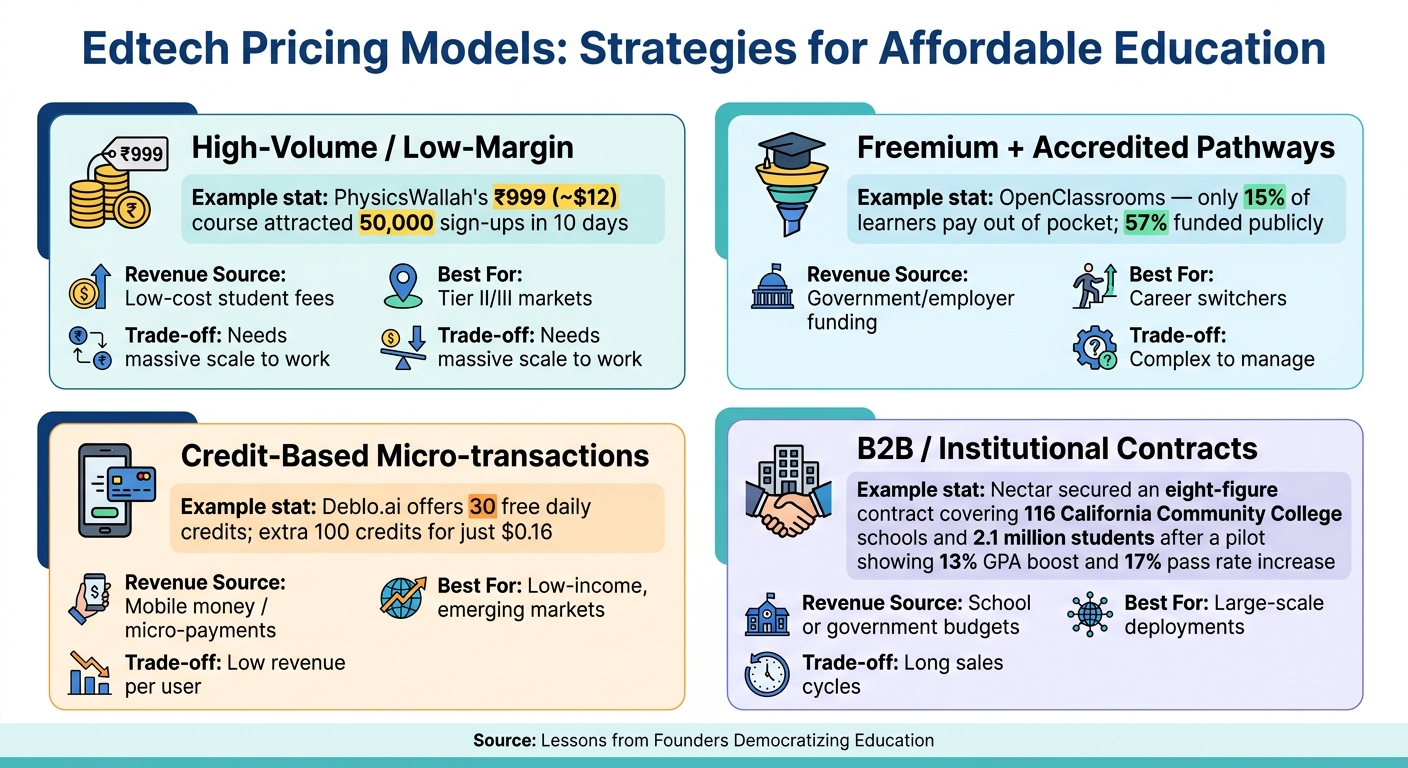
Edtech Pricing Models: Strategies for Affordable Education
Freemium and Subscription-Based Models
One of the smartest ways edtech startups can keep costs low while building a sustainable business is by offering free content first. Take PhysicsWallah as an example. They started by sharing free educational videos on YouTube, which helped them attract a large audience. Later, they launched a paid course priced at ₹999 (about $12). The result? Over 50,000 students signed up in just 10 days. This strategy drastically reduced their customer acquisition costs while still generating significant revenue.
Prateek Boob summed up this approach perfectly:
"Until the cost of learning comes close to the fees of filling the examination form, the market won’t be organized."
On a global scale, Duolingo has shown how effective freemium models can be. While most users stick to the free tier, 8–10% convert to the paid plan, generating substantial revenue. For startups in regions with lower purchasing power, micro-transaction models are another creative solution. Instead of pushing users toward subscriptions, these models remove that barrier altogether. For example, Deblo.ai offers users 30 free credits daily and charges just $0.16 for an extra 100 credits.
Freemium and micro-transaction models aren’t just about affordability – they also make learning accessible to a wide range of users. But beyond direct-to-consumer strategies, partnerships with institutions can further reduce costs for learners.
Partnerships with Schools and Governments
Some of the most impactful edtech companies focus on shifting the financial burden away from learners by collaborating with schools, governments, or employers. A great example of this is OpenClassrooms, where only 15% of learners in accredited programs pay out of pocket. The rest benefit from public funding (57%), apprenticeships (13%), or employer support (5%). Guillaume Parrou, Senior Director of Strategy at OpenClassrooms, highlighted the value of this model:
"A third-party funding model is more complex to operate, but it offers an amazing value proposition – it means that the learner can access really high quality learning for low to no cost."
Institutional partnerships can also achieve massive scale quickly. For instance, Nectar secured an eight-figure contract with the California Community College system, covering 116 schools. This deal came after a successful pilot program that showed a 13% GPA boost and a 17% increase in student pass rates. The takeaway? Before pursuing large-scale contracts, start small and prove your value with a pilot program.
These strategies – whether consumer-focused or institution-driven – work together to break down financial barriers to quality education.
Here’s a quick look at these pricing strategies and their trade-offs:
| Model | Revenue Source | Best For | Key Trade-off |
|---|---|---|---|
| High-Volume / Low-Margin | Low-cost student fees | Tier II/III markets | Needs massive scale to work |
| Freemium + Accredited Pathways | Government/employer funding | Career switchers | Complex to manage |
| Credit-Based Micro-transactions | Mobile money/micro-payments | Low-income, emerging markets | Low revenue per user |
| B2B / Institutional Contracts | School or government budgets | Large-scale deployments | Long sales cycles |
Challenges and Ethical Questions in Democratizing Education
Reaching Marginalized and Underserved Learners
Accessing education remains a challenge for many, especially in marginalized and underserved communities. Even the most advanced edtech platforms lose their effectiveness without reliable infrastructure. In rural and low-income areas, access to the internet, electricity, and personal devices is often limited. For example, in India, over 300 million children under the age of seven live in regions with unreliable or no internet access. To address these barriers, platforms like DigiLearns have reimagined their approach, cutting costs per student by 90% to make education more accessible in low-resource settings.
Device sharing further complicates the situation. In many households, a single smartphone is shared among multiple family members, making consistent learning difficult. Companies like Thinkarium in India are stepping up with offline-first hardware – standalone devices that operate without an internet connection. Similarly, GlobeDock Academy in Ethiopia has seen that designing for offline access can have a meaningful impact, particularly for women and girls, who make up 43% of their users in areas where connectivity gaps are most severe.
Language barriers also present a significant hurdle. Many AI-powered tools are developed with English as the primary language, which creates additional challenges for students who are more comfortable learning in their native tongues. Studies show that students learn 40% faster when taught in their first language. Platforms like Ivy AI Tutor in Ethiopia are addressing this by fine-tuning their AI to support local dialects and code-switching, enabling smoother learning experiences.
Another often-overlooked group is neurodiverse learners, including children with autism, ADHD, or other conditions. Historically, edtech has not adequately served these students. However, platforms like CogniQuest in Nigeria are working to change that by offering AI-powered tools specifically designed for neurodiverse learners, initially provided at no cost.
These infrastructure and accessibility challenges are only part of the equation. As platforms scale, ethical considerations become even more pressing.
Data Privacy and Student Safety
Scaling an edtech platform brings significant responsibilities, especially concerning the handling of student data. Unfortunately, some companies fall short. Recent legal cases involving platforms like Curriculum Associates and PowerSchool highlight the risks of poor data practices. For instance, the i‑Ready platform, used by over 13 million K–8 students in the U.S., faced allegations of sharing sensitive behavioral and demographic data with third-party marketing companies without parental consent.
"i‑Ready’s alleged practices mimic a predatory dynamic in consumer tech that schools may be unintentionally replicating: high data extraction, limited transparency, weak independent evidence of benefit, and adoption ahead of safeguards and testing." – Kelly Stonelake, Federal Whistleblower and Tech Accountability Advocate
For edtech founders, the takeaway is unmistakable: security and transparency must be integral to the platform from the outset, not added later. Implementing independent audits, conducting human reviews of AI-generated content, and using private offline networks to protect student data are practical steps that can safeguard trust.
Another challenge lies in the over-reliance on general AI models, which can sometimes produce flawed educational responses. To counter this, Coursemojo CEO Dacia Toll has developed a system trained by expert teachers. Instead of simply providing answers, the platform offers scaffolded hints, such as asking, "How would this poem be different without lines 6 and 7?" This approach encourages deeper thinking and engagement.
"Am I supposed to teach the rigor of the curriculum or the kids in front of me? The answer is both." – Dacia Toll, CEO, Coursemojo
Lessons for Tech Leaders and Aspiring Entrepreneurs
Edtech founders demonstrate what it means to lead with purpose, offering valuable insights for anyone aiming to create technology that prioritizes people.
Staying Committed to a Long-Term Mission
Successful edtech founders start with a clear vision for the future but remain adaptable in their approach. Sam Chaudhary, co-founder and CEO of ClassDojo – a platform now used in 95% of U.S. schools and over 180 countries – sums up this mindset perfectly:
"The only reason that startups fail is because the founders stopped trying. If the founders are trying, you can basically figure out every problem." – Sam Chaudhary, Co-founder and CEO, ClassDojo
This kind of persistence often stems from hands-on experience. Sumeet Mehta, co-founder and CEO of LEAD School, spent three years running a small village school in Areri, India, with just 14 students in 2012. During this time, he discovered that students weren’t struggling with subjects like math or science – their main challenge was English proficiency. This insight inspired the LEAD ELGA program, a cornerstone of a platform now serving over 5 million students across 8,500+ schools. The takeaway? Start by addressing the immediate needs of your users.
Mehta’s sense of urgency also stands out:
"I am admittedly impatient because I feel that every year we don’t reach more students, we are losing generations." – Sumeet Mehta, Co-founder and CEO, LEAD School
This kind of long-term commitment, paired with real-time insights, creates a foundation for meaningful impact.
Using User Feedback to Improve Products
User feedback plays a critical role in shaping effective products. The best edtech platforms don’t just collect data – they dive deep into understanding it. Neeru Khosla, co-founder of the CK-12 Foundation, highlights the importance of uncovering how students think, rather than simply determining if their answers are right or wrong:
"Just knowing that the answer is right or wrong doesn’t tell anybody anything. It is most useful when it helps surface the learner’s internal process." – Neeru Khosla, Co-founder, CK-12 Foundation
CK-12’s Flexi AI tutor has analyzed over 150 million student questions, refining its ability to trace knowledge effectively. By focusing on how students approach problems, the platform ensures its tools feel intuitive and genuinely helpful – a direct result of listening to real users rather than relying on assumptions.
This approach is echoed by Kavita Guy, CEO of Nectar. Instead of pitching blindly, she ran a pilot program with 8,000 students in the California Community College (CCC) system. The results? A 13% increase in GPA and a 17% rise in pass rates. These outcomes led to a contract covering all 116 CCC schools and 2.1 million students in November 2025. Testing, proving value, and scaling strategically are essential, particularly when working with large public systems.
Gathering feedback naturally ties into fostering engaged communities.
Building Community and Collaboration
Technology alone isn’t enough to keep learners motivated – the human element makes the difference. Tade Oyerinde, founder of Campus, built his platform around this principle:
"Motivation is primarily social. That’s why we started Campus as synchronous online learning… people motivate people." – Tade Oyerinde, Founder, Campus
Campus ensures this connection by maintaining a ratio of one success coach for every 50 students. Similarly, Codingal brings students together through hackathons and live instruction, transforming them from passive learners into active creators. By 2025, the platform had facilitated $1.8 million in payments to instructors – 90% of whom are women working from home – while delivering over 7 million minutes of live classes monthly across 135+ countries. Building a strong instructor network isn’t just a nice-to-have; it’s a key driver of growth and engagement.
For founders seeking advice and camaraderie, platforms like Code Story offer a chance to learn directly from other tech leaders. Hearing how others navigate challenges like scaling or balancing mission priorities can be an invaluable resource for any entrepreneur.
Conclusion: The Road Ahead for Accessible Education
The founders highlighted in this article share a common goal: tackling deep-rooted challenges in education. From SMS-based platforms connecting underserved communities to data-driven tools that secure large-scale institutional contracts, their efforts showcase how localized solutions can create real change. What began as a focus on access has now expanded to ensuring that educational tools promote meaningful learning experiences.
The next big challenge isn’t just about providing access – it’s about fostering inclusion and achieving measurable learning outcomes. Platforms are evolving, shifting from merely delivering content to understanding how students think. They aim to catch misconceptions early, before they solidify into learning gaps. Neeru Khosla captures this shift perfectly:
"Attention is what taught the machines. But now, in this AI world, we need to have intention and judgment. Intention is what we need." – Neeru Khosla, Co-founder, CK-12 Foundation
This evolution is crucial because the road ahead is complex. Neurodiverse learners, students in low-resource environments, and those preparing for an AI-driven job market need tailored solutions. The edtech leaders who will make the greatest impact are those designing with the most overlooked in mind. History shows that building for those with limited options often results in stronger, more adaptable tools that benefit everyone. Whether it’s addressing data security or customizing learning for specific communities, the future of education depends on constant reinvention.
The blueprint for success is already clear: start by solving a real problem, use data to prove the impact, prioritize the underserved, and keep improving. For tech leaders and entrepreneurs, staying mission-driven and persistent will always matter more than any single feature.
FAQs
What does ‘democratizing education’ actually mean?
Democratizing education is about tearing down systemic barriers to ensure high-quality learning is within reach for everyone – not just an exclusive group. It prioritizes bridging opportunity gaps by shifting away from passive learning methods and embracing active, hands-on approaches. Tools like AI-driven tutoring and diagnostic assessments play a big role here, enabling education to scale globally and connect with students from all walks of life, no matter their background or location.
How can edtech work with limited internet or devices?
Edtech has the potential to succeed even in areas with limited internet access by prioritizing offline-first designs. This approach involves pre-loading educational materials onto local devices such as tablets, servers, or SD cards, eliminating the need for continuous internet connectivity.
To tackle hardware constraints, platforms optimize and compress AI models, making them functional on basic smartphones or affordable devices like Raspberry Pi. Additionally, solar-powered libraries and charging stations provide reliable energy solutions, making interactive tools and personalized learning accessible in regions where electricity is scarce. This combination of thoughtful design and resourceful technology ensures that education can reach even the most underserved communities.
How should student data be protected in edtech?
Protecting student data in edtech means school districts need to carefully evaluate a platform’s cybersecurity measures and privacy policies. It’s also crucial to establish clear agreements outlining responsibilities in the event of a data breach.
Some key steps include conducting regular risk assessments, keeping offline backups of important data, and providing cybersecurity training for both staff and students. Having a well-prepared response plan for potential data breaches is equally important. Additionally, being open about how data is collected and used helps build trust with students, parents, and the wider school community.