Adopting new technology isn’t just about the tools – it’s about leadership. Companies that excel in this area see measurable results, like increased revenue, faster workflows, and better team performance. But most organizations struggle, with 95% of generative AI pilots failing to deliver financial results. Why? Weak leadership and poor alignment with business goals are often to blame.
Here’s what leading tech executives recommend:
- Focus on outcomes, not usage. Measure success by business results, like faster response times or fewer errors – not login counts.
- Lead by example. Leaders who actively use new tools inspire teams to follow. Actions matter more than words.
- Start small. Pilots with focused teams allow early wins and reduce risks before scaling.
- Empower teams. Provide hands-on opportunities to experiment, like hackathons or peer-led demos.
- Align with workflows. Make new tools part of daily routines to ensure long-term adoption.
- Track results. Measure business impact, not activity, and balance speed with quality.
- Think system-wide. Optimize processes across teams, not just individual tasks.
The bottom line: Success in tech adoption comes from clear goals, strong leadership, and a focus on results – not the technology itself.
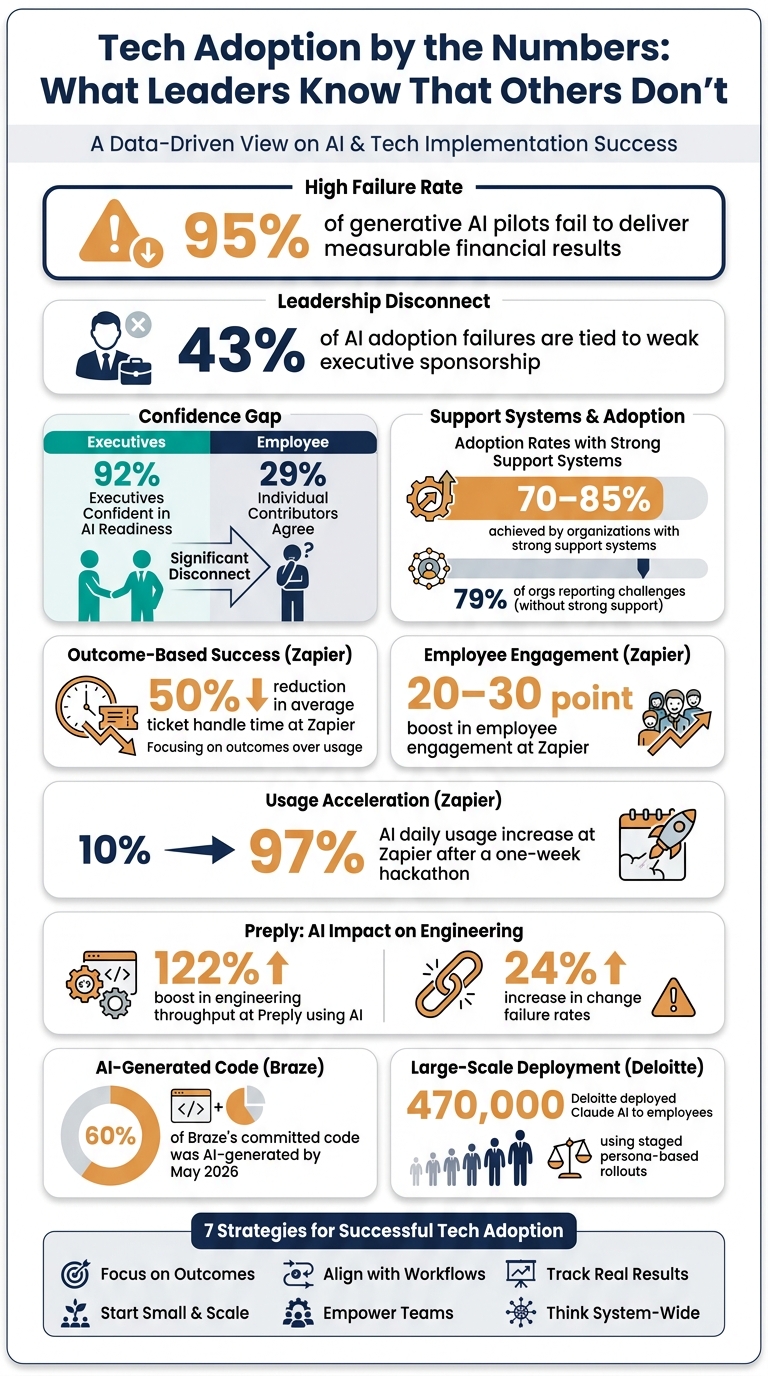
Tech Adoption by the Numbers: What Leaders Know That Others Don’t
1. Outcome Alignment
Measure Performance, Not Just Usage
Here’s a key insight from tech leaders: focusing solely on adoption metrics can lead to false progress. If success is measured by login counts or AI competency scores, employees may engage with tools just to check a box. This phenomenon, often called "compliance theater", results in surface-level usage without meaningful improvements in work outcomes.
"We used to pay attention to adoption, now we just pay attention to performance." – Katy George, Senior Partner, Microsoft
The real question isn’t how often tools are used – it’s how they improve outcomes. Shifting the focus to what employees can achieve with the technology – like enhanced customer satisfaction, higher work quality, or measurable business growth – creates a more impactful approach.
Zapier’s Chief People Officer, Brandon Sammut, demonstrated this in 2026. Instead of tracking AI tool usage, the company zeroed in on customer support outcomes. The result? A 50% reduction in average ticket handle time and a 20 to 30-point boost in employee engagement. It wasn’t the technology itself that drove these results, but the clear alignment with performance metrics.
"Don’t teach AI. Teach how to improve the business using AI." – Jonathan Marek, COO, Guild
The message for leaders is clear: define success before implementation. Tie new technology to specific goals, like faster response times, fewer errors, or improved collaboration, and measure those outcomes – not just tool adoption rates. This results-oriented strategy sets the stage for the next step: leading change effectively.
sbb-itb-772afe6
2. Change Leadership
Lead by Action, Not Words
When it comes to driving adoption, actions speak louder than any memo or directive. If CEOs and leadership teams actively incorporate new technology into their daily routines, it sends a powerful message. Employees are far more likely to take notice of what leaders do rather than what they say.
But simply being visible isn’t enough. Data reveals that 43% of AI adoption failures are tied to weak executive sponsorship, and a staggering 95% of pilots fail to deliver measurable P&L impact.
"AI is as much about building new habits as it is about the technology. Without structured change management, most organizations settle for cosmetic adoption." – HatchWorks
To ensure success, it’s essential to engage skeptics early in the process. These individuals can help identify risks and blind spots that overly enthusiastic early adopters might miss. This approach also fosters trust – an essential ingredient for long-term adoption. After all, a 2026 report found a striking disconnect: while 92% of executives expressed confidence in their AI readiness, only 29% of individual contributors felt the same.
3. User-Centric Rollouts
Start Small, Then Scale
One of the most common missteps organizations make during a rollout is treating it like a full-scale product launch. Successful tech leaders take a different approach: they begin with a small, focused group and expand gradually.
Running a pilot program with just 20–50 people in a single department allows you to secure early wins while identifying potential challenges. Including both skeptics and enthusiasts in this group ensures you uncover real issues early on. Once the pilot demonstrates success, it naturally builds momentum for a broader rollout. These initial victories not only validate the approach but also instill confidence for scaling up.
This gradual approach has proven effective. For instance, Deloitte adopted this strategy in 2026 when deploying Claude AI to its 470,000 employees. Instead of a single mass rollout, they identified specific user personas based on roles and implemented the deployment in stages over several months. This method ensured that governance and support systems grew in tandem with increased usage.
"Successful AI adoption starts with understanding user needs, daily workflows, and business outcomes before introducing tools." – Carina de Vries, MVP and Adoption Specialist
Another effective strategy is to frame the rollout as an experiment rather than a mandate. When employees feel they are part of a trial rather than being forced into a permanent change, resistance tends to decrease significantly.
"If you’re facing resistance, start with something small. Call it an experiment, not a change. Show early wins, share stories, and make the value obvious." – Egil Osthus, CEO, Unleash
The statistics back this up. Organizations that invest in strong support systems – like role-specific training, champions programs, and structured feedback mechanisms – achieve adoption rates of 70–85%. This stands in stark contrast to the broader industry, where 79% of organizations report challenges with AI adoption.
4. Enablement Strategies
Show, Don’t Tell
When it comes to encouraging adoption, actions speak louder than words. Gradual rollouts paired with strategic enablement foster organic and lasting change. The key? Trusted peers demonstrating real, tangible results – not a dry training manual or a generic company-wide email. These peer-led examples pave the way for meaningful transformation.
"You can’t tell them a better way; you need to show them. And the person showing them needs to be an existing trusted peer." – Tyler McConnell, Staff Software Engineer, Carta
Take IBM’s approach, for instance. Neel Sundaresan, the company’s General Manager, introduced an internal coding tool called "Bob" by focusing on teams already equipped with strong testing practices. The results were game-changing: one team reduced a four-week data lake task to a single day, while another cut a 30-day compliance project down to just two days. These early successes won over skeptics, turning them into enthusiastic advocates. Without any formal directive, the tool gained traction among tens of thousands of developers.
"That kind of authentic testimony travels faster inside an engineering culture than any slide deck I could make." – Neel Sundaresan, General Manager of Automation and AI, IBM
Zapier took a different but equally effective route. CEO Wade Foster saw daily AI usage jump from 10% to 50% after hosting a one-week, company-wide hackathon. By giving employees dedicated time to explore and experiment – without the usual pressure of day-to-day tasks – adoption soared to 97%.
"Telling people to use AI does nothing. Giving them a dedicated week to play with it changes behavior permanently." – Wade Foster, CEO, Zapier
The takeaway is straightforward: simply providing access to tools isn’t enough. Adoption thrives when tools are paired with structured opportunities for experimentation, targeted pilot programs, and measurable outcomes. This combination, driven by leadership and peer influence, creates lasting organizational change.
5. Cultural Transformation
Make It Part of Who You Are
For technology adoption to stick, it has to become a natural part of daily work. This requires more than just announcements or policies – leaders need to actively engage and lead by example.
Cultural transformation builds on structured enablement by weaving technology into the fabric of everyday operations. Take Kapwing as an example. In Q1 2026, CEO Julia Enthoven spearheaded the rollout of AI coding agents across their 25-person team. To set the tone, the Head of Product publicly merged the first AI-generated pull request. This wasn’t just a technical exercise – it was a team-wide effort. Every single team member, including those in sales and design, contributed code to production.
"The boundary between ‘technical’ and ‘non-technical’ is blurring in ways that are good for speed, for morale, and for the quality of the work." – Julia Enthoven, CEO, Kapwing
What made this work? It wasn’t about enforcing change – it was about leaders visibly embracing it. When leaders openly use new tools, share their experiences (both successes and challenges), and model the behavior they want to see, it creates a ripple effect. Employees feel more comfortable experimenting and learning when they see their CEO navigating the same challenges. This kind of leadership not only lowers resistance but also aligns with user-focused practices, ensuring that adoption feels inclusive and lasting.
A simple yet effective way to encourage this cultural shift is by embedding AI tools into routine workflows. For instance, adding AI-generated prompts to recurring documents like status reports or product requirement documents can make adoption feel seamless. Over time, these small adjustments help normalize the use of technology and reinforce its role in driving meaningful change.
6. Metrics and Feedback
Measure Outcomes, Not Just Activity
Once a new tool or technology is introduced, it’s crucial to evaluate its actual impact, not just its initial usage. Instead of focusing solely on basic metrics like activation rates, leaders should dig deeper to see if the technology is genuinely advancing business goals. True adoption happens when users seamlessly incorporate the tool into their daily workflows – not just when they try it out once.
Take Zapier as an example. Under CEO Wade Foster, the company increased its internal AI adoption rate from 10% to 97%. Impressive, right? But the real win wasn’t the adoption rate itself. The key metric was that AI now processes 50% of all customer support tickets while maintaining strong customer satisfaction scores.
"Stop measuring AI productivity. Measure business outcomes instead. AI for the sake of AI is just expensive experimentation with no accountability." – Wade Foster, CEO, Zapier
However, focusing only on speed can backfire if quality is overlooked. Preply’s engineering team learned this firsthand. By leveraging AI, they achieved a 122% boost in throughput and reduced PR cycle time by 22%. Yet, they also saw a 24% increase in change failure rates – a clear sign that speed came at the cost of stability. As Bogdan Brindusan, a leader on Preply’s engineering team, noted:
"The key insight is that measuring AI impact requires balancing speed metrics with quality signals, otherwise organizations risk optimizing for throughput at the expense of stability." – Bogdan Brindusan, Preply Engineering
These examples highlight the importance of setting outcome-focused goals right from the start. One effective strategy is to establish a 90-day baseline before rolling out any new technology. During this period, track metrics like velocity, defect rates, and bottlenecks. This baseline helps validate whether the technology is truly delivering value. To maintain trust within teams, measure performance at the team level rather than singling out individuals – this avoids creating a culture of surveillance.
7. Scalability and Evolution
Build for the Whole System, Not Just the Team
Focusing solely on individual team performance won’t necessarily speed up your organization as a whole. True progress happens when you optimize the entire development process, not just isolated parts.
Take Spotify’s internal framework, "Honk", as an example. Instead of requiring individual teams to manually update their codebases, Honk automates large-scale changes across thousands of repositories at once. It’s like replacing a single leaky pipe versus upgrading the entire plumbing system. By addressing the broader system, localized improvements can have a much bigger impact.
Braze provides another compelling example. By May 2026, CTO Jon Hyman revealed that 60% of their committed code was AI-generated, following a shift that began in February 2025. But this transformation came with a crucial realization:
"We’re realizing just how expensive AI inference is… engineering must rapidly optimize inference costs relative to output." – Jon Hyman, CTO, Braze
This highlights a key challenge for scaling: balancing rapid adoption with the rising costs of AI inference. Managing these expenses becomes critical for sustaining long-term growth.
The lesson here for startup tech leaders? Build systems that can evolve, not just launch. Develop tool-agnostic standards, keep a close eye on inference costs, and view adoption as a continuous process. Scalability isn’t a one-time achievement – it’s an ongoing commitment to engineering excellence.
Conor Grennan: Why AI Adoption Is a Leadership Problem
Conclusion
The takeaway is straightforward: adopting technology successfully is more about leadership than just the tools themselves. Companies that thrive in this area see real performance and growth by aligning their goals, empowering their teams, and scaling in a way that works. These examples highlight the strategies that make tech adoption work.
A few key lessons stand out: focus on the basics and measure what truly matters. As Wade Foster, CEO of Zapier, pointed out, diving into AI or any technology without a clear purpose often leads to costly experiments with no real accountability. True progress comes from starting with clear business goals and working backward to achieve them.
Empathy, strong communication, and team buy-in are just as important. Iteration plays a big role in success, and the best leaders see challenges as opportunities to learn rather than failures.
For more stories and lessons from industry leaders, check out Code Story, a podcast that dives into real-world experiences from tech innovators.
FAQs
How do I choose outcome metrics before an AI rollout?
When incorporating AI into your business, start by setting clear objectives that directly tie to measurable outcomes. Focus on outcome metrics – such as increased revenue, reduced costs, improved efficiency, or enhanced customer satisfaction. Avoid getting sidetracked by activity metrics like the number of lines of code written, which don’t directly reflect business value.
Begin by establishing baseline performance to understand where you stand. From there, define measurable KPIs that align with your strategic goals and track progress over time. Be prepared to adjust these metrics if needed, ensuring they consistently measure real-world impact and support your broader business objectives.
What does a “small pilot” look like in practice?
A "small pilot" usually refers to brief, informal tests of new tools or processes, typically lasting around two weeks. These trials are carried out with small, close-knit teams where trust is high, and decisions are heavily influenced by developer feedback. The process is often broken into phases with a defined scope and clear milestones, making it easier to evaluate progress and keep the steps manageable.
How do we scale AI adoption without hurting quality or costs?
To expand AI usage effectively while keeping quality high and costs under control, concentrate on integrating one secure AI tool that aligns well with your workflows. This approach helps sidestep inefficiencies and minimizes security concerns. Make AI a natural part of your processes by establishing clear workflows, maintaining decision logs, and setting up quality checks.
Encourage your team to experiment with AI, but back it up with proper training so everyone knows how to use it effectively. Track progress by measuring adoption rates and using dashboards to monitor AI’s impact on your operations. To ensure standards don’t slip, enforce human reviews at critical points. Build a workplace culture that views AI as a tool to amplify human efforts – not as a shortcut to bypass hard work.