Resistance to digital transformation isn’t about technology – it’s about people. Employees often resist due to fear of job loss, mistrust, or exhaustion from repeated failed initiatives. Ignoring this resistance can lead to significant value loss, with nearly 70% of transformation efforts failing because of human and process issues. Here’s how leaders can address it:
- Understand Resistance: Surface resistance (visible concerns) is easier to manage with support and communication. Deep resistance (silence, disengagement) requires rebuilding trust and addressing emotional concerns.
- Build Buy-In: Communicate the purpose of changes clearly, tailored to different teams. Involve employees early to reduce skepticism.
- Empower Change Champions: Identify advocates within teams to lead by example and bridge leadership goals with daily operations. Many startup tech leaders share similar stories of overcoming these cultural hurdles.
- Pilot Programs: Start small, gather feedback, and demonstrate measurable results to win over skeptics.
- Training and Experimentation: Offer role-specific training and create safe spaces for employees to test new tools without fear of failure.
- Sustain Momentum: Track meaningful engagement metrics and pace changes to avoid burnout.
Where Resistance to Digital Transformation Comes From
Common Reasons Employees Push Back
Resistance to digital transformation often stems from a mix of fear, skepticism, and exhaustion. One major concern is fear of incompetence – longtime employees may feel that new systems threaten their expertise. Add to that the reality of transformation fatigue, where repeated promises of "game-changing" initiatives that ultimately fail leave teams disillusioned and less willing to engage with the next rollout.
Another layer to this resistance is a lack of trust. As Ron Carucci, Co-founder and Managing Partner at Navalent, explains:
"All resistance is meaningful data. As a leader, your job isn’t to determine whether it’s valid; it’s to understand what it’s telling you."
Middle managers often resist when data-driven tools seem to undermine their authority or decision-making. For frontline workers, the issue is usually more straightforward: they simply don’t have the time to learn new systems while juggling their daily workload.
How Leaders Identify the Type of Resistance
Not all resistance is created equal, and assuming it is can lead to missteps. Successful leaders distinguish between surface resistance and deep resistance.
- Surface resistance is visible and vocal. It shows up as questions, requests for help, or comments like, "This seems too complicated." These employees are signaling a willingness to adapt – they just need better support or clearer communication.
- Deep resistance, on the other hand, is harder to detect. It manifests in silence during meetings, minimal participation, or private grumbling. These are signs of deeper issues, often rooted in mistrust or emotional concerns.
Charles Galunic, Professor of Organizational Behavior at INSEAD, highlights the importance of understanding these dynamics:
"Digital leaders need to be careful not to confuse personal threat and rigidity ‘resistance’ with honest ‘questioning’ of the value proposition behind a new digital initiative."
A helpful way to gauge resistance is to observe how openly concerns are raised. When employees feel safe to express doubts publicly, the resistance is often practical and solvable. But when feedback is overly positive in meetings yet critical behind the scenes, it points to low trust – a more significant challenge to address.
| Resistance Type | How It Looks | What Leaders Should Do |
|---|---|---|
| Surface | Questions, requests for support, "too complicated" comments | Offer training, explain benefits, and tackle technical barriers |
| Deep | Silence, passive compliance, private complaints, workarounds | Rebuild trust, include employees in planning, and address emotional concerns |
These distinctions help leaders address resistance in a way that builds collaboration rather than deepening divides.
How Resistance Shows Up in Teams
Resistance rarely looks like outright defiance. Instead, it’s often subtle. For example, teams may use a new tool just enough to avoid scrutiny while secretly sticking to outdated methods. These shadow systems, where employees revert to legacy processes, signal that the new solution isn’t meeting their actual needs.
Another common behavior is compliance without commitment. Metrics might look fine on the surface, but genuine engagement remains low. Priscilla McKinney, CEO of Little Bird Marketing, explains why this happens: Similar insights from startup tech leaders suggest that human-centric design is often the missing link in digital adoption.
"So many digital initiatives fail because people never asked whether their people were willing to work differently, think differently, or let go of the way things used to be."
A great example of overcoming this comes from marine engineering company Capax in Šibenik. In early 2026, they involved technicians in designing a mobile app to replace handwritten logs. This approach cut administrative time per person by 20% and boosted task completion rates by 10%. When employees have a hand in shaping the tools they use, they’re far more likely to embrace them, reducing the chances of workarounds or disengagement.
sbb-itb-772afe6
How to Build Buy-In and Overcome Resistance
Communicating the Vision and the ‘Why’
Getting buy-in starts with crafting messages that resonate with different groups. For executives, focus on the big picture – how the transformation boosts growth, opens up new revenue streams, and strengthens the company’s position in the market. For frontline workers, emphasize how the change will improve their daily routines and make their jobs easier. Addressing these specific concerns helps reduce resistance right from the start.
Timing your communication is just as important as the content itself. A practical plan might look like this: begin at least 30 days before launch with a leadership message explaining the strategic direction. Two weeks before, brief managers with clear talking points. Then, in the final week, send out employee-facing messages with detailed examples of how workflows will change. You’ll know your message is hitting home when employees stop asking "Why is this happening?" and start asking "How do I do this in the new system?"
Julia Dhar, Managing Director and Partner at BCG, offers straightforward advice:
"The best thing that you can do is to ask yourself, is this story honest and specific?"
Honesty and specificity win over polished but vague messaging every time. Leaders who acknowledge what employees stand to lose – like familiar routines or hard-earned expertise – before discussing the benefits of change tend to build more trust. This approach also paves the way for creating internal advocates who can help rally others.
Building Change Champions Inside the Organization
Top-down mandates often fall flat. What works better? Finding people already frustrated with outdated systems and empowering them to experiment with new tools openly.
The secret lies in combining technical know-how with deep understanding of business processes. A change champion who grasps both the new technology and the old way of doing things can explain the benefits in a way that makes sense to their peers. And when these champions share their successes with the team – rather than leadership taking the spotlight – it builds credibility and inspires others to get on board. As Kelsey Hightower, a respected technical leader, puts it:
"The most successful parts of my career was the understanding that I am better off helping other people look like superstars, than I am doing that on my own."
Change champions not only drive adoption but also act as a bridge between leadership’s strategy and the practical needs of day-to-day operations. For long-term success, it’s smart to embed these champions within different departments rather than centralizing expertise in IT. This approach keeps momentum going and reduces the strain on support teams over time. In fact, giving employees a real voice in how changes are implemented can increase adoption success by 24%. With internal advocates in place, pilot programs can help validate and accelerate the transition.
Using Pilot Programs to Show Early Results
A well-executed pilot can make or break an initiative. The difference often comes down to whether early results feel tangible or just like another slide deck.
Testing with skeptics can provide the most valuable data – like faster build times or fewer deployment issues – and help turn doubters into supporters. Digital strategist Abdul Vasi sums it up well:
"If you can get your skeptics to adopt the tool, you have a strategy for technology adoption that will scale. If you only prove it works with enthusiasts, you have learned nothing useful."
Concrete results can be a game-changer. For example, in January 2026, Cirrus Bridge, a technology consultancy, ran a pilot using GitHub Actions for a CI/CD pipeline. Build times dropped from 20 minutes to under 5, and deployment-related incidents significantly decreased. This success turned even the most vocal skeptics into advocates. Similarly, a mid-sized insurance firm, with guidance from PwC, piloted an automated claims intake system. Over eight weeks, they cut average case-handling time by 35% and saw a sharp rise in employee satisfaction as repetitive tasks were reduced.
To maximize learning, try piloting with about 10% of your team for 30 days. This allows for quick adjustments before scaling up. And as Tory Bjorklund, CTO and transformation advisor at Victoria Fide, wisely points out:
"Go-live is really only the beginning of your journey. That is not the end of your journey."
Overcoming Organizational Resistance in Digital Transformation
Building Skills and a Learning Culture
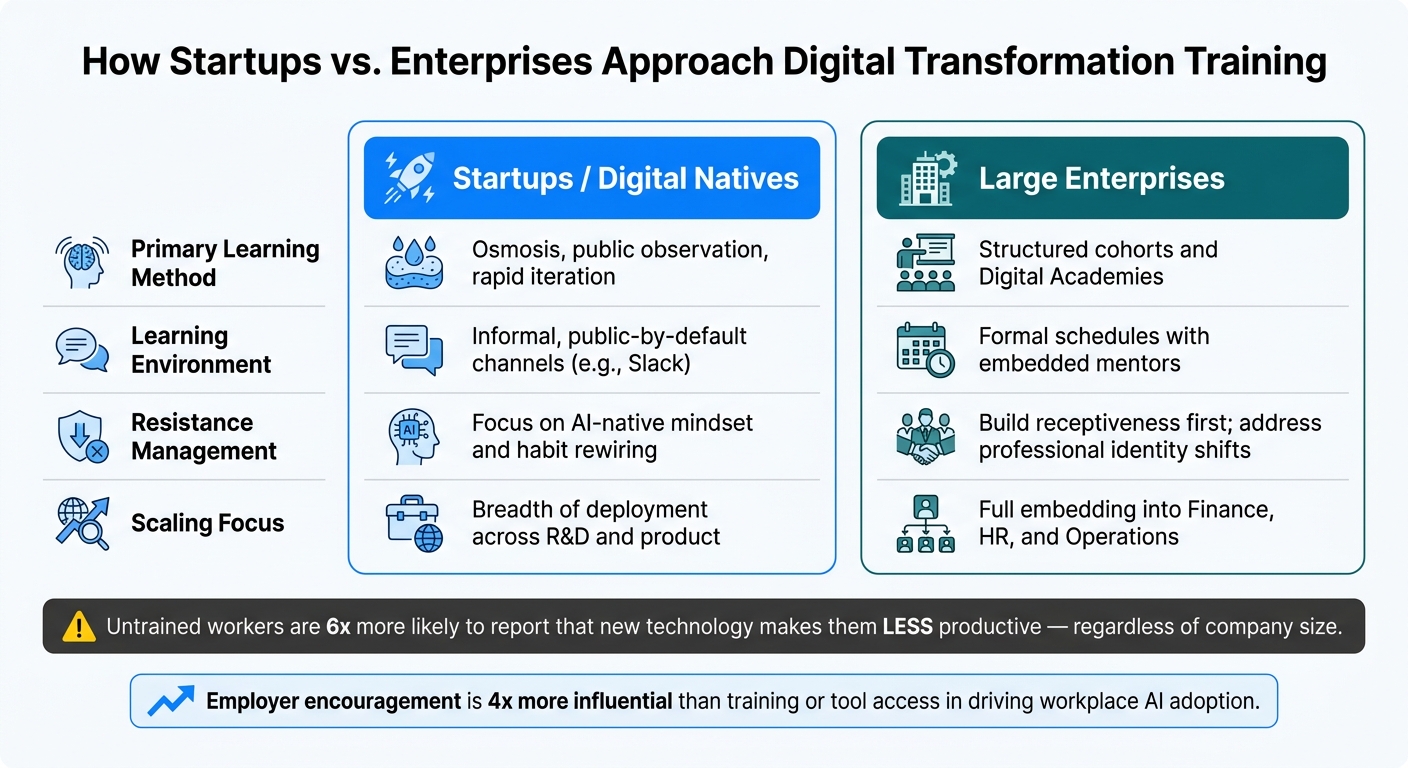
Startup vs. Enterprise Digital Transformation Training: Key Differences
After achieving early successes, the real challenge of digital transformation lies in maintaining momentum by cultivating strong skills and a mindset geared toward continuous learning.
Role-Based Training Approaches
Once initial pilots show the benefits of change, the next step is equipping everyone with the right skills to sustain progress. The trick? Focus training on how people actually work rather than on the technology itself.
A good first step is assessing skill levels before diving into instruction. Take Odevo, a Swedish real estate management firm worth $3 billion. In February 2026, CTO Daniel Jones teamed up with re:cinq to transition over 100 developers to autonomous coding. Before launching the training, the team analyzed Jira stories and CI/CD pipelines to understand each developer’s starting point. They then rolled out a six-week program that began by addressing AI model weaknesses – like hallucinations and context pollution – before exploring strengths. This approach built what experts call "calibrated confidence." The results? Agent usage shot up by 500%, and a mobile app stuck in development for 18 months was completed in just three days.
Another effective approach is the "train-the-trainer" model, which often outperforms top-down methods. For example, Toyota Financial Services, under CIO Vipin Gupta, created a "Digital Academy" between 2018 and 2021. Internal experts led the initiative, with leaders committing to 100 hours of teaching annually – a system Gupta dubbed "Teach 100." This effort resulted in over 1 million learning hours over three years, all without additional costs. It also enabled the launch of the first multi-tenant auto finance platform for Mazda Financial Services in less than a year. Gupta summarized the philosophy perfectly:
"Training is transactional. Teaching is transformational."
This kind of structured, role-focused training lays the groundwork for a culture that embraces experimentation.
Creating Space for Experimentation and Mistakes
Training alone isn’t enough – people need room to apply their skills without fear of failure. The biggest hurdle isn’t access to tools but the fear of looking incompetent in front of others.
Todd Gagne, CEO of Wildfire Labs, tackled this issue with a phased AI adoption program from March to May 2026. Every team member received 3 to 5 hours of protected time weekly to experiment with Claude, an AI tool. Leadership set the tone by openly sharing both their successes and failures. For example, one operational lead used this time to automate half of her manual tasks, which led to her being promoted to a new growth role overseeing event operations. Gagne didn’t mince words about what kills experimentation:
"The moment someone on your team feels like their failed experiment will be held against them, they stop experimenting."
Research backs this up: employer encouragement is 4 times more influential than training or tool access in driving workplace AI adoption. Zocdoc‘s Senior Staff Engineer Eugene Yao highlighted what real psychological safety looks like during training:
"The real thing [psychological safety]: sharing your screen when something was broken and watching your whole team lean in to fix it with you."
How Startups and Enterprises Approach Training Differently
The way organizations approach learning depends heavily on their size and structure. Startups often rely on informal, fast-paced learning, while enterprises need more structured systems to scale effectively.
For instance, Shopify introduced "River", an internal AI agent, in May 2026. Nearly 6,000 employees used River, and all interactions took place in public Slack channels like #tobi_river. This setup created what CEO Tobi Lutke calls a "Lehrwerkstatt" – a teaching workshop where the entire company learns by observing individual prompts and debugging sessions. In just two months, River’s merge rate jumped from 36% to 77%. Lutke’s guiding principle is clear:
"The company moves at the speed of its slowest secret."
Larger organizations, on the other hand, often require formal cohorts and discovery phases before training begins. Here’s a breakdown of how startups and enterprises differ in their learning cultures:
| Feature | Startups / Digital Natives | Large Enterprises |
|---|---|---|
| Primary method | Osmosis, public observation, rapid iteration | Structured cohorts, Digital Academies |
| Learning environment | Informal, public-by-default channels | Formal schedules with embedded mentors |
| Resistance management | Focus on "AI-native" mindset and habit rewiring | Build receptiveness first; address professional identity shifts |
| Scaling focus | Breadth of deployment across R&D and product | Full embedding into Finance, HR, and Operations |
Despite their differences, both approaches share a common truth: untrained workers are 6 times more likely to report that new technology makes them less productive. Whether you’re running a small startup or a massive enterprise, investing in structured, role-specific learning is essential. It’s the difference between a transformation that thrives and one that falters.
Keeping Momentum Going Without Burning Out Your Team
The initial excitement of a pilot program can fizzle out if not properly nurtured. In any digital transformation, keeping that momentum alive is just as critical as starting the journey. But how do you do that without stretching your team too thin?
Tracking Adoption and Employee Engagement
It’s tempting to equate metrics like seat licenses or login counts with success, but they often don’t tell the full story. A better approach is to focus on deeper engagement signals – things like how often tools are being used, how quickly new hires can produce meaningful work, or role-specific KPIs such as PR-to-merge time for engineers or ticket resolution rates for customer support teams.
Take Preply, for example. Under Bogdan Brindusan’s leadership, the company achieved over 90% adoption of AI coding tools across 35 engineering teams. By February 2026, they moved from manual tracking in spreadsheets to using a developer intelligence platform. This allowed them to monitor over 500,000 AI-generated lines of code accepted each month. The result? Heavy users saw a 122% boost in productivity, saving an average of 4.88 hours per week per engineer.
"Adoption metrics are useful, but only as signals. Turning them into goals would optimize for the wrong thing." – Bogdan Brindusan, Preply Engineering
To get a fuller picture, combine data like tool usage with employee sentiment. Research shows that companies actively measuring and acting on engagement data enjoy 21% higher profitability and 30% lower turnover during change initiatives. Simple bi-weekly pulse surveys – just five quick questions – can reveal frustrations or obstacles that raw data might miss, helping you manage the pace of change effectively.
Pacing Change to Avoid Overloading Teams
What looks like resistance to change is often just exhaustion. Teams can only handle so much at once, and when leaders push harder, it often leads to burnout, not progress.
One way to avoid this is by building stabilization windows into your rollout plan. These are intentional pauses that give teams time to absorb new tools and processes before moving to the next phase. A phased approach works well: focus on foundational changes and early wins in the first 6–9 months, scale up from months 9–18, and then aim for more advanced goals between months 18–36. While detailed plans are crucial for the early phases, later stages should remain flexible to adapt to real-world challenges.
Middle managers play a key role here. By empowering them to adjust the timing of initiatives for their teams, they act as “shock absorbers,” preventing any one group from being overwhelmed.
"The real issue is rarely speed. It is unmanaged intensity." – Sean Hanly, TRIA Recruitment
Using Feedback to Improve as You Go
Keeping the rollout on track isn’t just about pacing – it’s also about listening. Feedback loops are essential to catch small issues before they snowball into major problems.
For instance, Klarna’s bold AI rollout in 2024 saw 90% of staff using AI daily, leading to a 152% increase in revenue per employee and $40 million in annual cost savings. But by early 2026, feedback revealed a drop in customer satisfaction for complex support cases. Acting on this insight, Klarna scaled back AI use in those areas, showing how proactive feedback can guide smarter decisions.
To stay ahead of potential issues, hold short, weekly retrospectives – 30-minute Friday sessions designed to surface problems like permission errors or tool discovery challenges as they happen. Pair these with a dedicated adoption lead who can group feedback into actionable themes and ensure it gets to the right decision-makers quickly.
The goal isn’t to eliminate every challenge – some friction can be a helpful signal – but to ensure that signal reaches the right people in time to act. Diagnosing resistance early is the key to preventing small hiccups from derailing the entire transformation.
Conclusion: What Tech Leaders Have Learned About Overcoming Resistance
Key Lessons from the Leaders Interviewed
Digital transformation thrives when people – not just technology – embrace new ways of working. While the tools themselves often perform as expected, the real challenge lies in helping teams adapt their habits and workflows.
Resistance, as it turns out, isn’t about defiance – it’s feedback. Chris Cancialosi of gothamCulture captures this idea perfectly:
"Resistance isn’t a character flaw. It’s a survival response. And it’s actually intelligent feedback if you’re willing to listen to it."
Leaders who take this feedback seriously engage their teams early, weaving employee insights into the transformation process. Those who succeed build trust before introducing tools, involve employees in crafting solutions, and clearly communicate the why behind the change – not just the how. Research supports this approach, showing that giving employees meaningful input increases successful adoption by 24%.
It’s also worth remembering that the go-live phase is just the beginning. From initial pilot programs to ongoing adoption efforts, leaders must stay committed to the long haul.
Advice for First-Time CTOs and CIOs
For new tech leaders, trust-building should be a top priority. Start by explaining the why before diving into the how. A surprising 39% of employees resist change simply because no one explained why it’s happening, while 41% cite lack of trust in leadership as their reason for pushing back. Both issues can be addressed with early, thoughtful action.
Practical steps include initiating Organizational Change Management (OCM) before any technical work begins – often referred to as "Phase Zero". Understanding the organization’s history with past initiatives and pinpointing genuine areas of disagreement can also make a big difference. And don’t overlook the marketing team. Christina Smith, Chief Transformation Officer at RGP, highlights their unexpected value:
"Most people don’t think of the CMO as a partner in organizational change management, but they should."
Another key takeaway: avoid rushing. Shannon Bell, CIO at OpenText, sums it up well:
"The technology is good enough. The real hurdle now is people, fear, and change management."
How These Lessons Connect to Broader Industry Conversations
These lessons reflect a larger truth in the industry: transforming technology is as much about people as it is about systems. The shift from viewing transformation as a one-time project to treating adaptability as an ongoing organizational skill is gaining traction across industries.
Platforms like Code Story dive into these challenges, sharing conversations with CTOs, founders, and software architects who have tackled the human side of scaling technology. A recurring theme in their stories is that innovation often starts with identifying a real problem and addressing it with a blend of smart tech and strong leadership.
Joe Atkinson, Global Chief AI Officer at PwC, puts it best:
"If you are in a leadership position of any kind, I actually think that this moment is the leadership challenge of our generation."
For today’s leaders, this is the ultimate test: to lead with empathy, communicate openly, and keep people at the heart of every decision. Insights like these, often spotlighted on platforms like Code Story, are vital for anyone striving to drive meaningful digital change.
FAQs
How can I spot deep resistance early?
Identifying deep resistance often requires observing subtle changes in communication and behavior. For instance, watch for signs like prolonged silence, limited participation, or surface-level feedback during group discussions, while more genuine concerns are voiced in private settings. You might notice employees steering clear of active involvement during training sessions or resorting to workarounds instead of following new processes.
Another key area to monitor is informal networks, where behind-the-scenes conversations can influence decisions and foster resistance. To address this early, create feedback loops that encourage open dialogue. This allows you to catch these signals and address concerns before resistance becomes deeply rooted.
What should a 30-day pilot measure?
A 30-day pilot program should focus on measuring actual adoption and real-world impact. Pay attention to usage patterns that go beyond simple logins – look for how the tool is being used day-to-day. Track improvements in key outcomes, such as time saved and increases in accuracy. Additionally, schedule weekly interviews with users to uncover insights: What challenges arose? What got easier? And what would encourage them to completely move away from their old methods? These insights are crucial for refining the solution.
Which adoption metrics matter most?
When measuring adoption, steer clear of vanity metrics like the number of logins or licenses activated. These figures might look impressive, but they don’t tell the full story. Instead, prioritize metrics that show real engagement and impact:
- Daily active usage: How often are people actually using the tool or system?
- Workflow changes: Are processes becoming more efficient or streamlined?
- Time saved per task: Is the new approach helping employees work faster or smarter?
Beyond numbers, pay attention to qualitative changes as well. A clear sign of meaningful adoption is when employee questions evolve. Early on, you might hear resistance like, “Why is this change happening?”. But over time, these should shift to capability-driven questions such as, “How do I perform this task?”. This change in mindset reflects growing comfort and confidence with the new system.