
Exit interviews are often overlooked as a retention tool. While 91% of Fortune 500 companies conduct them, only 29% use the data effectively. Yet, this feedback can reveal patterns behind employee departures – like pay issues, poor management, or lack of growth opportunities. Addressing these problems can cut turnover costs and improve retention.
Here’s a 7-step framework to make exit data actionable:
- Define the Problem: Focus on specific issues, e.g., reducing senior engineer turnover by 10%.
- Refine Questions: Use a mix of ratings and open-ended questions to uncover deeper insights.
- Standardize the Process: Collect consistent feedback across roles with neutral interviewers.
- Organize Data: Clean and tag responses to identify recurring themes.
- Spot Trends: Link exit data to other metrics like promotions or engagement scores.
- Take Action: Assign issues (e.g., pay gaps) to relevant teams and set timelines for solutions.
- Track Progress: Embed exit insights into leadership reviews to measure improvement.
Key takeaway: Companies that combine exit data with predictive analytics see up to a 38% drop in regrettable turnover. By focusing on structured feedback and actionable insights, you can address avoidable departures and create a workplace where employees want to stay.
How to Build a Reliable Exit Data Collection Process
Setting Clear Objectives
Before diving into data collection, it’s crucial to define the exact problem you’re trying to solve. For example, instead of a vague goal like "improve retention", aim for something specific, such as "reduce senior engineer turnover by 10% within the next year." A clear focus like this will guide the questions you ask and the metrics you prioritize.
Different goals call for different types of data. For instance, if you’re assessing management effectiveness, you’ll need both qualitative feedback and numerical ratings linked to specific managers. On the other hand, benchmarking compensation requires hard data to compare against market standards. Here’s a quick guide to matching objectives with the right data types:
| Objective | Specific Goal Example | Data Type Needed |
|---|---|---|
| Retention | Reduce turnover in Engineering by 10% | Quantitative ratings |
| Leadership | Identify managers with high attrition | Qualitative & quantitative |
| Culture | Assess alignment with company values | Qualitative open-ended |
| Compensation | Compare salary/benefits to competitors | Quantitative benchmarks |
| Compliance | Detect harassment or unethical behavior | Qualitative confidential |
To ensure the data you collect drives action, involve senior leaders and department heads early in the process. When your objectives are aligned with the company’s broader priorities, the insights you gather are more likely to influence meaningful decisions.
Once your goals are clear, the next step is to create a consistent and standardized process for collecting feedback.
Standardizing the Exit Interview Process
Turning well-defined objectives into actionable insights requires a consistent approach to exit interviews. Without a standard process, comparing responses or identifying trends becomes nearly impossible. The solution? Use a core questionnaire with the same set of questions for every departing employee, regardless of role or seniority.
It’s also important to avoid having direct managers conduct these interviews. Employees are generally more comfortable being honest with neutral HR professionals or external interviewers, particularly on sensitive topics like leadership or workplace culture.
"The value of exit interviews lies not in any one conversation but in the aggregate patterns they reveal over time." – Harvard Business Review
Timing matters, too. Schedule the interview 1–2 weeks before the employee’s last day. This timing ensures emotions have settled while the experience is still fresh in their mind. To get the most out of these interviews, combine quantitative tools (such as Likert-scale ratings) with open-ended questions. This approach captures both measurable trends and the deeper reasons behind them.
Protecting Employee Data and Staying Legally Compliant
Once you’ve established a standardized process, safeguarding the data becomes critical. Employees need to trust that their feedback will remain confidential. Be transparent about how their data will be stored, accessed, and used. Anonymizing responses before sharing them with managers or leadership can help employees feel safe enough to provide honest feedback. Plus, secure processes lend credibility to your retention efforts and the insights they produce.
From a security standpoint, offboarding should include revoking access to internal systems immediately. Alarmingly, 48% of companies report that former employees can still access internal systems after leaving, and 20% have experienced data breaches caused by ex-employees. Using a secure HR information system to house exit data, rather than scattered spreadsheets, greatly reduces this risk.
On the legal side, U.S. employers must ensure departing employees receive COBRA health insurance notifications and 401(k) paperwork during offboarding. Exit interviews also serve as a chance to uncover compliance issues, such as harassment or discrimination, that may have gone unreported. This makes them a valuable tool not just for improving retention but also for addressing potential legal vulnerabilities.
sbb-itb-772afe6
The Exit Interview Process: Best Practices for HR
The 7 Steps to Turn Exit Data into Retention Insights
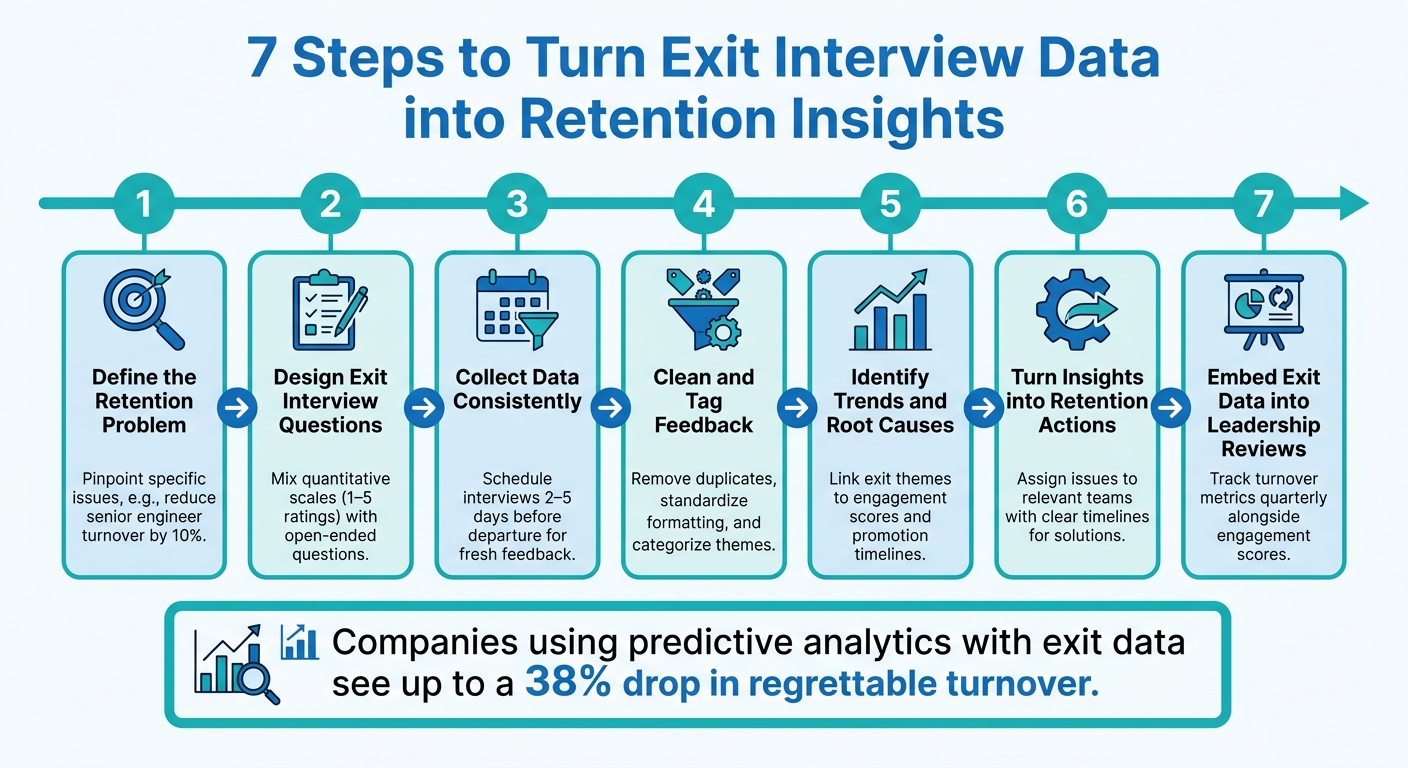
7 Steps to Turn Exit Interview Data into Retention Insights
Once you’ve established an effective way to gather data, the next challenge is transforming that information into actionable strategies to reduce employee turnover. The steps below outline a practical approach that works across different industries and company sizes.
Step 1: Define the Retention Problem
Before diving into the data, you need to pinpoint the exact issue you’re trying to address. Vague goals won’t lead to meaningful solutions. As HR expert Andrea Boatman explains:
"The first step in the process of analyzing exit interview data is to know what you’re trying to accomplish."
Start by working with department heads to create a clear problem statement. For instance, if you notice an uptick in turnover among engineers, your problem might be: "Top engineers are leaving within 18 months of joining." From there, refine this into a focused question, such as "How can we retain senior engineers for at least two years?"
Also, make sure to differentiate between regrettable exits (when high-performing or critical employees leave) and non-regrettable exits (like underperformers or those who weren’t a great fit). Concentrating your efforts on regrettable departures often delivers the best results.
Step 2: Design or Refine Exit Interview Questions
Your questions will set the foundation for meaningful insights. A strong exit survey should mix quantitative scales (like 1–5 ratings on pay, workload, or management) with open-ended questions that provide context behind the numbers. Organize your questions into categories, such as:
- Demographics (e.g., role, tenure)
- Satisfaction ratings
- Reasons for leaving
- Suggestions for improvement
Make sure your questions are neutral and consistent. For example, keep in-person interviews between 30–60 minutes and online surveys under 10 minutes. Standardizing your questions across departments ensures you can compare responses over time.
Step 3: Collect Data Consistently
Consistency drives reliable insights. Schedule exit interviews or surveys 2–5 days before an employee’s departure to capture fresh, thoughtful feedback. Use a neutral, straightforward script like: "Your feedback will help us improve the experience for future team members."
Offer both live interviews and anonymous digital surveys to accommodate different preferences. Once you’ve gathered the data, organize it systematically to prepare for analysis.
Step 4: Clean and Tag Feedback
Raw data can be messy, so before analyzing it, clean it up. Remove duplicates, standardize formatting, and discard incomplete responses. Then, categorize qualitative feedback into themes like compensation, career growth, or work-life balance.
For smaller organizations, a simple spreadsheet works well. Each row can represent one employee’s exit, with columns for ratings, demographic details, and theme tags. This structure makes it easier to filter and analyze the data by department or tenure.
Step 5: Identify Trends and Root Causes
Now it’s time to look for patterns. For example, you might find that employees in a particular department frequently mention "limited advancement opportunities."
Use real-world examples as inspiration. Cleveland Clinic, for instance, reduced its nursing turnover rate from 18% in 2017 to 12% by 2020 by addressing burnout and improving career paths. Similarly, NetApp cut employee turnover by 23% in a year by focusing on career development and better management communication.
Linking exit themes to other data – like engagement survey results, performance reviews, or promotion timelines – can help you spot early warning signs before employees decide to leave.
Step 6: Turn Insights into Retention Actions
Data is only useful if it leads to action. Assign specific themes to relevant teams or leaders. For example:
- Workload concerns: Department directors
- Pay gaps: Collaboration between HR and Finance
- Promotion fairness: People & Culture teams
Use a tiered approach: address smaller, department-level issues locally, while escalating larger, systemic problems (like pay structures) to senior leadership with supporting data. Set clear timelines for implementing solutions to ensure progress.
Step 7: Embed Exit Data into Regular Leadership Reviews
Exit data isn’t a one-and-done exercise. Make it a regular part of leadership discussions, whether during quarterly business reviews, annual strategy meetings, or monthly HR updates.
Present recent exit trends alongside engagement scores to help leaders see if retention efforts are working. Track key metrics like voluntary turnover rates, the percentage of regrettable exits, average tenure at exit, and recurring themes. By integrating these insights into ongoing reviews, you can turn exit data into a powerful tool for long-term decision-making.
Tools and Metrics for Tech Leaders
Exit Interview Templates and Question Structures
Using a standardized template for exit interviews ensures you can gather consistent, comparable feedback. For tech roles, these templates should address specific concerns like the adequacy of tools, remote work flexibility, and career growth opportunities – key priorities for tech teams. The focus of the questions can also vary depending on the role. For instance, senior leaders often care more about strategic alignment and executive visibility, while engineers may prioritize delivery support and career progression.
One of the most insightful questions to include is: "What would have made you stay?" Unlike the more traditional "Why are you leaving?", this question looks forward, helping uncover specific, actionable ways to improve retention. Keep live interviews concise and online surveys short, building on earlier guidance for effective question design.
Customizing your exit surveys for tech roles can highlight trends that directly inform retention strategies, tying into the seven-step framework previously discussed.
Retention Metrics to Track
Once you’ve collected standardized feedback, the next step is to quantify retention challenges through the right metrics. These metrics transform exit feedback from passive data into actionable insights. Here’s a breakdown of the key metrics every tech leader should monitor:
| Metric | What It Tells You |
|---|---|
| Regrettable Attrition Rate | Identifies if you’re losing top talent or hard-to-replace employees |
| Retention Rate per Manager | Highlights leaders or departments with higher exit rates |
| Time Since Last Promotion | Detects if career stagnation is a factor in departures |
| First-Year Attrition Rate | Flags potential issues with onboarding or hiring processes |
| Exit Interview Completion Rate | Measures the reliability and trustworthiness of your offboarding process |
| Likelihood to Rejoin | Serves as a gauge of your employer brand among departing employees |
Companies that integrate predictive analytics with exit data have been shown to reduce regrettable turnover by 38%, compared to those relying on basic reporting. Attaching a financial perspective to these metrics can further emphasize their importance. For example, replacing an employee can cost anywhere from 50% to 200% of their annual salary. If six engineers left in Q2, you now have a clear financial figure to support discussions about retention strategies.
Tables for Organizing and Presenting Exit Data
Defining metrics is just the first step – how you present the data matters just as much. Organized tables can make insights more actionable. Consider these formats:
- Root Cause Mapping Table: Links exit themes (e.g., "limited advancement opportunities") to specific departments, the frequency of mentions, and the individual accountable for addressing the issue. This approach ensures accountability and prevents insights from being overlooked.
- Metric Tracking Table: Displays key metrics like regrettable attrition, exit interview completion rates, and average tenure at the time of departure, tracking changes quarter over quarter to highlight trends.
- Role-Level Comparison Table: Breaks down exit reasons by seniority. For example, senior engineers might leave due to limited leadership opportunities, while junior developers might cite inadequate mentorship.
Tools like Excel or platforms such as Qualtrics XM and SurveySparrow can automate dashboards and provide sentiment analysis to make tracking and visualization easier.
"Raw answers don’t improve retention. Segmenting responses by role, tenure, or function… is what turns a list of comments into a retention signal you can act on." – Engagesoft
Whether you rely on spreadsheets or advanced analytics platforms, consistent updates and maintenance are crucial for ensuring the reliability of your data.
Conclusion: Building a Culture That Retains People
Key Takeaways
Exit interview data only makes an impact when it leads to action. By applying the seven-step framework – from identifying your retention challenges to incorporating insights into quarterly leadership discussions – your organization can shift from simply gathering data to driving meaningful, measurable change.
Here’s the reality: nearly 42% of voluntary turnover can be avoided, and a structured approach to analyzing exit data can reduce turnover by 15–25%. But achieving this requires more than just data collection – it demands a cultural shift. When leadership treats exit data as a strategic tool rather than a compliance task, decision-making transforms. For instance, NetApp used career development and management communication insights from exit feedback to lower turnover by 23% in just one year. Similarly, Google’s "Project Oxygen" initiative revealed that poor managerial practices were a leading cause of employee exits. By addressing these issues, Google improved leadership effectiveness and significantly reduced turnover. These are not isolated success stories – they demonstrate what’s possible when feedback is turned into action.
The results speak for themselves and are echoed by shared experiences across the tech industry.
Learning from the Tech Community
The tech world offers valuable lessons for building a culture focused on retention. Many of the most effective strategies align with the seven-step framework outlined here, emerging from leaders who’ve faced and overcome similar challenges.
For example, Code Story, a podcast featuring tech founders, CTOs, and software architects, dives into the real-world struggles of building and scaling teams. Topics often include culture, hiring, and the tough realities of losing key talent – directly supporting the retention strategies discussed in this guide. For tech leaders seeking practical advice and peer insights, it’s a resource worth exploring.
FAQs
What should I ask in an exit interview?
When conducting an exit interview, it’s essential to ask open-ended, neutral questions that allow the employee to share their experience honestly. The goal is to gain insights into why they’re leaving and identify areas for improvement. Focus on these key areas:
- Reasons for Leaving: What motivated their decision to move on? Was it a specific issue or a combination of factors?
- Role Expectations: Did the job align with what they were initially told? Were there any surprises or unmet expectations?
- Likes and Dislikes: What aspects of their role or the company did they enjoy? What did they find challenging or frustrating?
- Training and Onboarding: Did they feel adequately prepared when they started? Was the onboarding process effective and supportive?
- Pay and Benefits: Were they satisfied with their compensation and benefits package? Did they feel it was competitive?
- Growth Opportunities: Did they see a clear path for advancement? Were there enough opportunities for personal and professional development?
- Management Support: Did they feel supported by their manager? Were their concerns heard and addressed?
- Team and Culture Fit: Did they feel a sense of belonging within the team? How would they describe the company culture?
Finally, give them a chance to share any additional feedback or suggestions they might have for reducing turnover or improving the workplace. This open-ended space can often provide the most unexpected and valuable insights.
How do I keep exit feedback anonymous but useful?
To keep exit feedback both anonymous and useful, it’s best to group responses into broader themes rather than spotlighting individual accounts. A neutral third party, such as an HR representative, can handle interviews and should clearly explain confidentiality measures at the start. Organize the feedback into categories like leadership, career development, or workplace culture. Share the findings in a way that avoids revealing identities, and emphasize to departing employees that their feedback will help shape positive changes within the organization – all while safeguarding their anonymity.
Which exit metrics should leaders track each quarter?
Leaders looking to strengthen retention strategies should regularly assess key metrics like turnover rates, employee satisfaction scores, and industry benchmarks for salaries and benefits. Reviewing this data quarterly – and breaking it down by role, department, and tenure – can help pinpoint potential attrition risks. Pair these numbers with qualitative feedback about management, workplace culture, and opportunities for growth to better understand the underlying causes of turnover. Regular evaluations like these are essential for refining strategies and driving consistent progress.