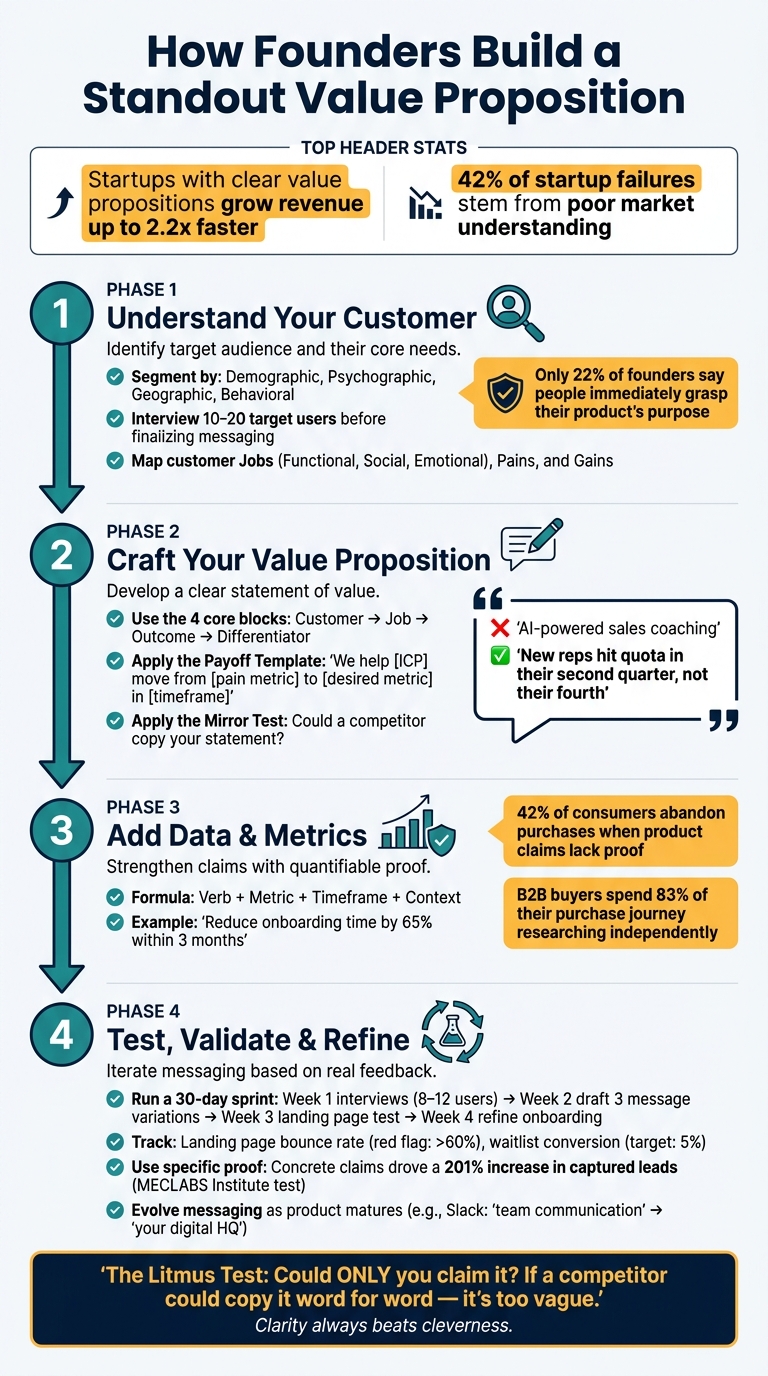
A strong value proposition can make or break a startup. It’s the answer to "Why should I pick you?" and directly impacts customer decisions, investor interest, and overall growth. Many startup tech leaders share how they navigated these early hurdles. Startups with clear value propositions grow revenue up to 2.2x faster, while 42% of failures stem from poor market understanding.
To craft one that works, focus on:
- Identifying your target audience and their specific pain points.
- Highlighting outcomes your product delivers, not just features.
- Using simple, outcome-driven templates like:
"We help [customer] move from [problem] to [result] in [time]." - Testing your messaging with real users and refining based on feedback.
The key? Be specific, measurable, and customer-focused. A clear, actionable value proposition sets you apart and drives results.
How to Build a Standout Value Proposition: A Step-by-Step Framework
Value Props: Create a Product People Will Actually Buy
sbb-itb-772afe6
Understanding Your Target Customer and Their Problem
To create a strong value proposition, you need to start by identifying your target customer and understanding the challenges they face.
Defining Your Customer Segment
Zeroing in on a specific audience is key. Focus on a group that shares common frustrations, behaviors, and goals. You can categorize potential customers into four main groups:
- Demographic: Characteristics like job title, age, or income.
- Psychographic: Values, interests, and habits.
- Geographic: Location or time zone.
- Behavioral: Actions such as requesting demos or abandoning carts.
The best way to define your segment? Talk to them directly. Most successful founders interview 10 to 20 target users before finalizing their value proposition. These conversations help capture the exact words customers use to describe their problems. If you can’t describe your target customer in one sentence without saying "anyone", your audience is too broad. Narrowing your focus to a niche often leads to better early traction.
Once you’ve defined your audience, the next step is understanding their specific challenges and goals.
Mapping Customer Pains, Jobs, and Desired Outcomes
The Jobs-to-be-Done (JTBD) framework is a great way to understand what your customers are trying to achieve. Chandler Supple, Co-Founder & CTO of River, explains it well:
"A job is the progress a customer wants to make in a particular situation. It’s not about what the product does. It’s about what the customer wants to accomplish."
During interviews, listen carefully to how customers describe their needs. Map out their jobs in three categories:
- Functional: Tasks they need to complete.
- Social: How they want others to perceive them.
- Emotional: How they want to feel.
Next, identify their pains – undesired outcomes, obstacles, or trade-offs. For instance, they might be spending 10 hours a week on tasks that could be automated. On the flip side, look at their gains. Separate what they need from what they want, and consider what might pleasantly surprise them. Then, rank these by importance. In B2B tech, "blatant and critical" problems are more valuable to solve than "latent and aspirational" ones.
A simple way to test your thinking is the "So What?" test. For every feature, ask "So what?" until you uncover a tangible human benefit. For example, "Automated invoicing" might lead to "Get paid faster", which ultimately means "Never worry about making payroll." That final benefit is the one that should shine in your value proposition.
These insights help you craft a clear and focused problem statement.
Writing a Clear Problem Statement
A concise problem statement is the foundation for your messaging, pitch, and product strategy. Use this template to get started:
"For [target customer] who [specific pain], [Product] is a [category] that [key outcome]."
The best problem statements are specific, name a real person, and highlight why current solutions – whether spreadsheets or doing nothing – aren’t enough.
Take Warby Parker as an example. In 2010, the founders identified a single, clear problem: "Glasses are too expensive." This pain point resonated because one company dominated the eyewear market, driving up prices. That sharp focus helped them hit their first-year sales goal in just three weeks.
How to Build a Standout Value Proposition
The Core Components of a Value Proposition
To craft an effective value proposition, start with a clear problem statement and build on these four key blocks:
| Block | What It Answers | Example |
|---|---|---|
| Customer | Who is this for? | "For revenue leaders running a 50+ rep team" |
| Job | What are they trying to do? | "who need to know which deals will close" |
| Outcome | What changes? | "Gong shows you in real time which calls are deals and which are stalls" |
| Differentiator | Why you, not them? | "by analyzing every interaction, not just CRM fields" |
Notice that this framework avoids listing features. A value proposition isn’t about detailing product specs – it’s about clearly showing the benefits and the outcomes your product delivers. The Differentiator block is where many struggle. A simple way to test yours is the Mirror Test: if a competitor could use your value proposition on their homepage without raising eyebrows, it’s not distinct enough.
Using Simple Templates to Structure Your Message
Templates can help you stay specific and focused. Two popular options for tech founders are: (who often share their startup stories on podcasts like Code Story)
Geoffrey Moore’s template:
"For [target customer] who [job to be done], [product name] is the [category] that [unique outcome] – unlike [alternative], we [point of difference]."
The Payoff template:
"We help [ICP] move from [pain metric] to [desired metric] in [timeframe] so they can [strategic goal]."
For B2B, the payoff template is especially valuable because it ties your product to measurable business outcomes. If your statement doesn’t connect to something your buyer can see in their profit-and-loss statement, you’re still talking about features, not value.
Keep the language simple and focus on outcomes. Here’s an example:
- ❌ "AI-powered sales coaching."
- ✅ "New reps hit quota in their second quarter, not their fourth."
The second version speaks directly to a sales leader’s concerns, highlighting a clear and relevant outcome. These templates set the stage for adding hard data to reinforce your message.
Adding Data and Metrics to Build Credibility
Without evidence, even the best value proposition is just a claim. Specific metrics give your promise weight. In fact, 42% of consumers abandon purchases when product claims lack proof. For B2B buyers, who spend 83% of their purchase process researching independently, your value proposition often needs to do the heavy lifting before a sales conversation even begins.
A good metric follows this formula: Verb + Metric + Timeframe + Context. For example, "Reduce onboarding time by 65% within 3 months" is far more convincing than "faster onboarding." Numbers like "cut reporting time by 50%" or "add $700,000 to annual gross margin" build immediate trust.
In B2B pricing, a common benchmark is to capture 10–30% of the customer’s net gain as annual subscription revenue. This works only if you’ve already quantified the gain, which is why data-backed value propositions aren’t just effective marketing – they’re a smart business strategy.
How to Test and Refine Your Value Proposition
Running Validation Experiments
A value proposition is essentially a hypothesis – until customer actions confirm its value.
Take Dropbox’s early days in 2007, for example. Drew Houston tested its value proposition with a simple demo video showing the "before and after" of file syncing. The result? Dropbox’s waitlist skyrocketed from 5,000 to 75,000 sign-ups practically overnight.
Customer actions come with varying levels of commitment. For instance, signing up for an email list is a low-commitment action, while booking a calendar appointment shows a deeper level of interest. Even more telling? A deposit, which signals a willingness to pay. The higher the friction, the stronger the customer commitment.
"Your landing page has one job: make the problem and value proposition legible enough that the right people self-select." – Ashley Nielsen, Entrepreneurship Writer
Here’s a quick way to test your value proposition: run a 30-day sprint. Spend one week conducting interviews with 8–12 users, another week drafting three variations of your messaging (e.g., outcome-focused, workflow-focused, or risk-focused), a third week testing these on a landing page, and the final week refining your onboarding process based on a predetermined success metric – like achieving a 5% waitlist conversion rate.
Once you’ve piqued interest, it’s time to back up your promises with real customer proof.
Using Customer Proof to Strengthen Your Claims
When your value proposition starts gaining traction, customer proof becomes a powerful tool to convert skeptics. Consider an experiment by the MECLABS Institute, led by Daniel Burstein. They tested two landing pages for an SMB market solutions provider. The original page used vague claims like "most accurate mailing lists", while the updated version featured concrete details such as "access to 210 million U.S. consumers" and "a team of 600 researchers making 26 million verification calls annually." The result? A 201% increase in captured email leads. The product itself didn’t change – what changed was the credibility of the message.
Similarly, testimonials and case studies can work wonders. But generic praise won’t cut it. Specific, measurable outcomes add a layer of trust that a catchy headline alone can’t achieve.
Refining Your Value Proposition Based on Feedback
Once you’ve validated your experiments and collected customer insights, it’s time to refine your messaging further based on real-world feedback.
Value propositions aren’t static; they need to evolve as your market and product mature. A great example is Slack. Initially, it positioned itself as a tool for "team communication." Over time, it shifted to "your digital HQ", reflecting how its users began to rely on it for much more than just messaging.
One overlooked source of valuable feedback? Lost deals and customer churn. When prospects walk away or customers cancel, it often highlights a gap in your value proposition. Regularly reviewing objections from sales calls and analyzing exit surveys can reveal what’s missing. Ask questions like, "What almost stopped you from buying?" to uncover disconnects between what you’re offering and what buyers actually need.
Another red flag to watch for is a homepage bounce rate above 60%. This often means your headline isn’t resonating with your target audience. Specific, quantifiable claims – like "reclaim 11 hours per week" – can significantly outperform vague promises like "save time." The ultimate goal? Craft a message so clear and memorable that a buyer can recall and repeat it after just one exposure.
Common Mistakes Founders Make With Value Propositions
Founders often stumble with their messaging, making errors that can hurt conversions and dilute their value proposition.
Using Vague or Generic Language
Buzzwords like "AI-powered", "seamless", or "intelligent" might sound impressive, but without proof, they’re just empty phrases. Buyers have seen these terms so often that they’ve lost their impact.
Here’s a quick test: if reversing your claim sounds ridiculous, it’s probably too generic. For instance, "faster software" doesn’t work because no one would advertise slow software. On the other hand, "The CRM with zero manual data entry" is effective – it addresses a specific and real problem. Specificity is what makes a message memorable.
"A value proposition is not better when it is more clever. It is better when it is more specific." – Swapnil Biswas, Product Marketing & Growth Strategist
Airtable offers a perfect example. Early on, their tagline "Connect everything, achieve anything" was too broad and failed to communicate the product’s purpose or audience. They later refined their messaging to make it clearer and more direct. The takeaway? Clarity always beats cleverness.
Another common pitfall? Trying to appeal to everyone.
Targeting Too Broad an Audience
Casting a wide net with phrases like "teams of all sizes" or "businesses everywhere" can dilute your message. Instead of resonating with everyone, it ends up connecting with no one.
Focusing on a specific audience isn’t a weakness – it’s an advantage. A value proposition tailored to a niche feels personal and credible. For example, "Mid-market CFO offices in professional services" is far more engaging than something as vague as "enterprise companies". The more narrowly defined the audience, the more believable your promise becomes.
Listing Features Instead of Outcomes
Another misstep is focusing on what the product does rather than what it delivers. Founders, being so close to their product, often highlight features instead of the real-world benefits those features provide. As Amra Zacina, Co-founder of Ministry of Programming, explains:
"Many software products blur together when founders emphasize features over tangible benefits. When buyers can’t tell products apart… they default to price."
Buyers don’t just want features – they want results. They’re looking for saved time, increased revenue, reduced risk, or less hassle. Translate features into outcomes: instead of saying "automated invoice processing", say "reduce billing cycles from 5 days to 2 hours". Connecting features to measurable benefits ensures your value proposition stands out and motivates action.
Conclusion: A Simple Framework for Building a Strong Value Proposition
Creating a strong value proposition takes time, effort, and a commitment to constant improvement. It’s not a one-and-done process; it requires research, testing, and ongoing refinement. The approach outlined here is straightforward: start by deeply understanding your audience, clearly define the problem they face, connect your product’s strengths to measurable results, and continuously adapt as the market changes. This framework helps ensure your value proposition resonates – rooted in customer needs, focused on outcomes, and distinct from competitors.
Here’s a telling statistic: only 22% of founders say people immediately grasp their product’s purpose. That disconnect – between what you intend to communicate and what your audience actually hears – is exactly where a well-crafted value proposition can make all the difference.
As your startup evolves, so must your messaging. Think of it in three interconnected layers: your brand (the "why" behind your company), your product (the specific problem it solves), and your features (what sets your solution apart). These layers should work together seamlessly, reinforcing your message without contradictions. Use this structure as a foundation for testing and refining your value proposition.
A key litmus test for your value proposition is this: Could only you claim it? If a competitor could copy your statement word for word, it’s too vague. Add details – include the buyer’s role, company size, or the exact result they can expect.
"If I could give you only one piece of conversion optimization advice, ‘test your value proposition’ would be it." – Peep Laja, Founder, Wynter
Once you’ve validated your initial messaging, keep a close eye on how it performs. Treat your value proposition as a dynamic tool, not a static statement. Look for real-world feedback – landing page performance, ad click-through rates, and the language your customers use. When those signals align, you know you’ve landed on a value proposition that truly works.
FAQs
How do I pick a tight customer segment?
Identify a specific, measurable group of customers whose challenges your product solves more effectively than the competition. To evaluate the importance of the problem your product addresses, consider using the 4Us framework:
- Urgency: How pressing is the issue for your target customers?
- Unavoidability: Is this a problem they can’t ignore?
- Unsolvability: Are existing solutions failing to meet their needs?
- Underserved status: Are these customers overlooked by current market offerings?
Once you’ve assessed the problem’s relevance, create a crystal-clear ideal customer profile (ICP). This helps you focus on the right personas – those who will benefit most from your product. Targeting a well-defined segment with significant, unmet needs boosts your chances of achieving product-market fit and driving meaningful growth.
What’s a simple way to turn features into outcomes?
When showcasing a product, it’s not enough to simply list its features. Instead, emphasize how those features benefit the customer. Focus on the specific results or value your product delivers. This way, potential customers can clearly see how your solution addresses their challenges or fulfills their needs. It’s about making the connection between "what it does" and "what it does for them."
How can I test my value proposition fast?
The quickest way to evaluate your value proposition is to gather real-world feedback and refine it step by step. Begin by pinpointing your core offering – what sets you apart. Then, put it to the test through direct customer interactions, such as sales calls or targeted marketing efforts. Keep a close eye on metrics like engagement rates or conversion numbers, and tweak your messaging based on what works (and what doesn’t). This method emphasizes quick action and ongoing adjustments rather than getting bogged down in lengthy research or chasing perfection.