Great startup leadership isn’t about having all the answers – it’s about creating an environment where teams can experiment, learn, and grow. Effective leaders focus on building trust, encouraging calculated risks, and fostering team collaboration. Here’s how they do it:
- Trust and Psychological Safety: Leaders build trust through transparency and actions that encourage open communication. This creates a space where teams feel safe to share ideas and learn from mistakes.
- Encouraging Risk-Taking: By distinguishing between low-cost, learning-focused failures and critical mistakes, leaders empower teams to take smart risks.
- Structured Experimentation: Frameworks like Spotify’s hack weeks or Netflix’s blameless postmortems help teams learn from experiments and failures systematically.
- Growth Mindset: Recognizing learning over outcomes encourages curiosity and reduces burnout in teams.
- Collaboration: Cross-functional teams, clear decision-making frameworks, and diverse input drive better results.
- Tools and Frameworks: Methods like design thinking, lean startup practices, and AI-powered tools streamline innovation and decision-making.
- Recognition and Rewards: Celebrating both successes and the learning process keeps teams motivated and aligned with company goals.
From TaskRabbit’s calculated platform overhaul to Spotify’s experimentation culture, these strategies show how intentional leadership drives success. Many of these startup tech leaders have shared their personal journeys of scaling innovation. Leaders who focus on trust, learning, and collaboration create teams that thrive under pressure and deliver meaningful results.
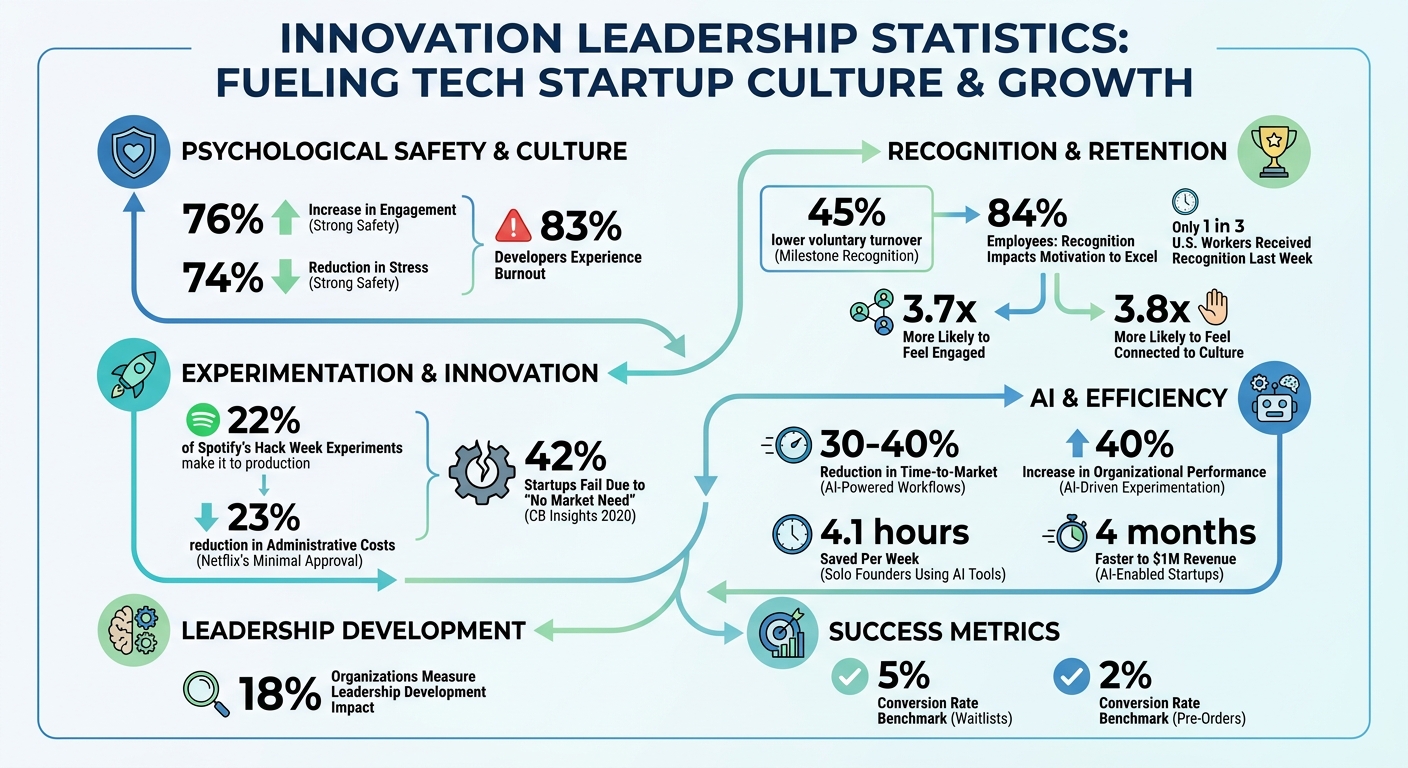
Key Statistics on Innovation Culture and Leadership Impact in Tech Startups
Role of The Leader in Building an Innovation Culture | Scott Pollack | TEDxAEBS
sbb-itb-772afe6
Building a Culture That Supports Innovation
Creating a workplace where innovation thrives isn’t just about saying, "It’s okay to fail." It takes deliberate systems that encourage thoughtful experimentation while steering clear of reckless decisions. Research shows that strong psychological safety boosts engagement by 76% and reduces stress by 74%. But achieving this balance requires more than words – it demands action.
The best leaders know how to distinguish between types of failure. Small, low-cost failures – those that test a hypothesis – are crucial for learning and growth. On the other hand, existential failures, like running out of resources due to poor planning, can sink an entire company. By making this distinction clear, leaders empower their teams to take calculated risks without jeopardizing the organization’s future. Leadership coach Beth Steinberg sums it up perfectly:
"Culture isn’t what companies say, it’s what they do".
Take TaskRabbit as an example. In 2014, founder Leah Busque Solivan faced a risky platform overhaul. Instead of rushing into a full-scale launch, she tested the new mobile-first app in London before introducing it to 50,000 U.S. users. Though the U.S. rollout initially struggled, the insights from London’s success provided the confidence to move forward. The result? IKEA acquired TaskRabbit in 2017.
Promoting Risk-Taking and Experimentation
Encouraging innovation means normalizing failure. One way leaders achieve this is through "sunshining", where teams openly discuss mistakes as opportunities to learn. But this approach works best when paired with clear, disciplined processes.
A structured learning loop – Hypothesis, Test, Result, Decision (ship, iterate, revert, or stop) – ensures that experiments aren’t just busy work. Without this framework, post-mortems risk becoming empty exercises where teams "reflect" without gaining real insights.
Spotify offers a great example of structured experimentation. During their quarterly hack weeks, engineers try out new ideas, and 22% of these experiments make it to production. The company keeps a detailed experiment log, documenting what was attempted, the outcomes, and the specific changes in behavior resulting from the trials.
Another tool that supports innovation is the blameless postmortem. When projects fall short, the focus should be on identifying systemic issues – unclear roles, poor monitoring, or missed customer signals – rather than pointing fingers. Every action item from these reviews should have a clear owner, deadline, and verification plan. Leaders who respond to failures with curiosity ("What did we learn?") instead of defensiveness create an environment where teams feel safe to innovate.
Netflix takes this philosophy even further with its "minimal approval" expense policy, which has lowered administrative costs by 23%. Their guiding principle?
"We hire adults and treat them like adults".
This level of autonomy extends to technical decisions, where teams own the entire process, avoiding unnecessary layers of approval. Such freedom helps foster a culture of experimentation and growth.
Developing a Growth Mindset in Your Teams
Structured experimentation sets the stage for a growth mindset, where the focus shifts from outcomes to the learning process. Instead of only celebrating big wins, recognize teams that identify weak ideas early or conduct experiments that yield clear, actionable data. This shift encourages people to approach their work with curiosity, moving from "I need to look smart" to "I need to figure out what works."
Burnout affects 83% of developers, and cultures that punish mistakes only add to the pressure. Leaders can counter this by lowering the cost of experimentation. Modern prototyping tools make it easier and faster to test ideas, reducing the stress and expense of failure. When teams can quickly turn ideas into testable outcomes, they’re naturally more willing to experiment.
Squire‘s founders, Songe LaRon and Dave Salvant, embraced this mindset in 2016. They used over 50% of their seed funds to buy a barbershop, gaining hands-on insights that helped them pivot from a failing B2C app to a thriving B2B SaaS platform. Their commitment to learning has since attracted $165 million in funding.
Mentorship also plays a key role in fostering a growth mindset. Unfortunately, only 18% of organizations measure the impact of their leadership development efforts, leaving many companies without a clear sense of what works. Structured mentorship programs pass on not just technical skills but also the values and thought processes that drive innovation.
The Duke-NUS Health Innovator Programme is a great example of this in action. Over nine months, student teams worked with clinical mentors to develop solutions to real-world problems. The program culminated in five teams presenting prototypes, with the top team earning $50,000 to fund a medical device for kidney stone removal. This initiative translated practical healthcare needs into viable business concepts through mentorship and structured funding.
Strengthening Team Collaboration
Innovation flourishes when teams with diverse skills and perspectives work together. Leaders play a key role in creating an environment where different viewpoints are welcomed and encouraged. This kind of collaboration builds on the innovative culture rooted in taking risks and embracing growth.
Encouraging Cross-Functional Teamwork
A truly collaborative approach goes beyond the traditional "assembly line" method, where each department works in isolation – engineering builds, design refines, and marketing promotes. This kind of sequential process often waters down the original vision. Instead, cross-functional teams that unite engineering, product, design, and marketing from the beginning can drive projects more effectively. These teams take full ownership of outcomes, working together from start to finish.
A standout example is the development of the original iPhone at Apple. Hardware, software, and design engineers worked side-by-side, iterating in real time to create a product that felt cohesive and seamless. By organizing teams into "squads", companies can reduce delays from handoffs, align everyone around the customer experience, and focus on shared goals. Using OKRs (Objectives and Key Results) instead of siloed departmental metrics ensures everyone is accountable for the same objectives.
Creating Space for Every Team Member’s Input
Diversity in a team won’t lead to innovation if only a few voices dominate the conversation. To truly harness the power of collaboration, every team member needs to feel safe sharing their ideas – even the rough, unpolished ones. One way to encourage this is by starting meetings with open-ended prompts like, "What perspective might we be missing?" or "What bold idea could we try?"
Clear decision-making frameworks, such as DACI (Driver, Approver, Contributor, Informed), can also help avoid "collaboration drag" by clarifying roles and responsibilities. Even small changes, like holding meetings outdoors or rearranging the room setup, can encourage fresh thinking and creativity.
Mike Peng, CEO of IDEO, highlights the importance of creating the right environment for collaboration:
"Once you know people as humans, they become more than just coworkers. Good meetings happen when people are in the right mindset, and a simple change of context can spark fresh thinking".
Taking the time to understand each other’s backgrounds builds trust and encourages constructive debates. Practices like a "rose-thorn-bud" reflection at the end of a project or sprint can help maintain momentum and ensure quieter team members have a chance to contribute. These approaches, combined with structured innovation processes, ensure that every idea gets the attention it deserves.
Using Frameworks and Tools to Drive Innovation
Once collaborative practices are in place, the next step is adopting structured approaches to channel team efforts into measurable outcomes. Frameworks help teams test ideas more efficiently, solve problems faster, and iterate without wasting resources. By offering clear guidelines, they ensure innovation stays focused and aligned with strategic goals.
Applying Design Thinking to Solve Problems
Design thinking emphasizes solving problems with a human-first approach. It starts by understanding user needs, followed by rapid experimentation and ongoing refinement. The process is non-linear, encouraging teams to move between discovery, ideation, and validation until they find what works best.
Dr. Prabhjot Singh sums up this philosophy:
"We spend a lot of time designing the bridge but not enough time thinking about the people who are crossing it".
To avoid shallow research that reinforces existing biases, tech leaders can use empathy mapping through one-on-one meetings and workshops to uncover both user challenges and team needs.
A practical tool is a decision matrix that allows teams to focus on high-impact choices while decentralizing smaller decisions. This can be paired with rubric-driven reviews using criteria such as "Is the interaction predictable?" or "Does it scale?" to reduce subjective debates. Research following five startups over 18 months found that consistent use of design processes, rather than sporadic attempts, embeds innovation more effectively.
For implementation, consider a 90-day roadmap:
- Audit design artifacts in the first 30 days.
- Launch a basic design system by day 60.
- Set measurable KPIs by day 90.
Key metrics like task completion time, design debt tickets, and conversion rates tied to design changes can help track progress.
Working with Lean Startup Methods
The lean startup method focuses on testing assumptions quickly and efficiently. Its Build-Measure-Learn loop – create a minimum viable product (MVP), measure its impact, and iterate or pivot – helps teams validate ideas without overcommitting resources.
Eric Ries, author of The Lean Startup, defines an MVP as:
"that version of a new product which allows a team to collect the maximum amount of validated learning about customers with the least effort".
The goal is to test the riskiest assumption first, not to launch a polished product. Dropbox, for example, used an explainer video as their MVP, which took their waiting list from 5,000 to 75,000 overnight.
Break your idea into two core assumptions:
- Value hypothesis: Do users find it valuable?
- Growth hypothesis: Can it scale?.
A 2020 CB Insights study revealed that 42% of startups fail due to "no market need". Lean methods help identify this issue early, when it’s easier to address.
Track meaningful metrics like retention and conversion rates instead of vanity metrics. Tools like the "Five Whys" can help uncover the root causes of failed experiments, while engaging directly with users ensures data reflects real-world insights.
Founders are also leveraging AI-powered tools like Bolt.new, Lovable, and Replit to create prototypes from plain English descriptions at minimal cost. While agencies might charge $10,000 to $150,000 for MVP development, using free tools like Carrd or GitHub Pages can reduce costs to almost nothing.
Using AI and Scenario Planning
AI is reshaping how startups identify opportunities and make informed decisions. Beyond task automation, AI now plays a role in market analysis, competitive research, and prioritizing product roadmaps. High-performing teams often use DORA metrics – deployment frequency, lead time for changes, change failure rate, and recovery time – to measure AI’s impact on software delivery.
Before committing to a product, consider "fake door" tests where AI creates a landing page to gauge user interest through signups or pre-orders. Success benchmarks include a 5% conversion rate for waitlists and 2% for pre-orders. AI can also assist with MoSCoW prioritization, helping define a "Won’t Have" list for MVPs to prevent feature creep and speed up development.
AI-powered workflows are estimated to reduce time-to-market by 30–40%, and startups using these tools often reach $1 million in annual revenue four months faster than traditional SaaS businesses. Teams that embrace AI-driven experimentation have shown a 40% increase in organizational performance.
For solo founders or small teams, AI tools can save an average of 4.1 hours per week. The focus isn’t just on saving time but on maximizing the impact of every hour. By setting up plan-execute loops – such as generating a TODO.md file, reviewing the blueprint, and executing in sprints – you can ensure AI resources align with your goals.
AI also keeps technical costs low. While traditional hiring can cost over $15,000 per month, AI-focused startups often spend under $500 monthly. Essential tools for a lean startup launch range from $35 to $75 for a 30-day sprint, including subscriptions like Claude Pro or ChatGPT Plus ($20/month), Plausible analytics ($9/month), and Carrd for landing pages ($9/year). These affordable options make it easier to integrate AI into broader innovation strategies.
Keeping Teams Motivated Through Recognition and Rewards
For tech leaders who have built cultures focused on continuous progress, keeping that momentum alive is critical. Recognition plays a key role in retaining talent. Companies with strong milestone recognition programs experience a 45% lower voluntary turnover rate. Additionally, nearly 84% of employees say that recognition directly impacts their motivation to excel at work.
Acknowledging Contributions to Innovation
Startups often celebrate major milestones like securing Series A funding, launching products, or landing key clients. But focusing only on these big moments can mean overlooking the smaller, yet vital, achievements that fuel ongoing innovation. Recognizing technical breakthroughs or market validations along the way helps teams stay energized.
Take Zappos, for example. They run a "Co-Worker Bonus Program", allowing employees to award monetary bonuses to peers who go above and beyond. This peer-driven recognition approach is 35.7% more likely to positively impact financial outcomes compared to recognition solely from managers. Buffer, on the other hand, emphasizes radical transparency. By sharing their challenges and wins in monthly public blogs, they engage their community while validating their team’s efforts internally.
Tangible gestures like crystal trophies or public shout-outs for problem-solving achievements can also create a sense of shared pride and ownership.
Yet, only 1 in 3 U.S. workers strongly agree they’ve received recognition in the past week. Making recognition part of everyday culture – not just a quarterly event – can keep the spark alive. Tools like Bonusly encourage daily acknowledgment, making employees three times more likely to align with innovation goals.
The key is to ensure that recognition ties back to meaningful business objectives, so every reward pushes innovation forward.
Connecting Rewards to Company Objectives
Recognition works best when it’s tied to clear strategic goals. The most impactful reward systems connect individual efforts to broader business objectives. Management by Objectives (MBO) frameworks help ensure that every team member sees how their work contributes to the company’s innovation goals. When employees strongly believe that recognition is a core part of their organization’s culture, they are 3.7 times more likely to feel engaged and 3.8 times more likely to feel connected to that culture.
Companies like Microsoft recognize the importance of supporting innovation early on. Through their Startups Founders Hub, they offer up to $150,000 in Azure credits, helping founders develop ideas without the financial strain. Similarly, Adobe’s Kickbox Program provides employees with a $1,000 prepaid credit card and resources to test new ideas, cutting through red tape. Meanwhile, 3M encourages employees to dedicate 15% of their time to passion projects, rewarding successful outcomes with its "Golden Step Award".
Salesforce takes a structured approach with its "V2MOM" process, which ensures continuous feedback and alignment with company goals. This tailored approach recognizes that different roles are motivated by different rewards. For instance, a developer might appreciate extra time off for a personal project, while a designer might value opportunities for professional growth, like attending a conference.
It’s also important to reward the effort, not just the results. Startups that celebrate the lessons learned from failures – not just immediate wins – create an environment of psychological safety. This encourages teams to tackle tough problems and experiment, rather than sticking to the safe route. Recognizing both successes and the process behind them builds trust and keeps teams motivated to pursue the next big breakthrough.
Lessons from Successful Tech Leaders
What You Can Learn from Code Story Interviews
Code Story has hosted over 790 interviews with tech founders, CTOs, and product leaders, offering a behind-the-scenes look at their journeys from writing code to building scalable businesses. These conversations dive deep into pivotal decisions – like early engineering choices and overcoming infrastructure challenges – that define a company’s trajectory.
Take Sarah Lucena, for example. In December 2025, she shared her experience founding Mappa on Code Story, inspired by her realization that traditional recruiting methods failed to foster genuine team chemistry. As she explained:
"The solutions for recruiting were supremely focused on the wrong signals for these types of connections".
This insight led her to create a platform that prioritizes behavioral signals and team dynamics to build stronger, more cohesive teams.
In March 2026, Vadim Dedov, CEO of Catchers, reflected on a critical moment during his company’s growth. Faced with rapid scaling, he paused feature development to redesign the system architecture, ensuring it could handle increasing demands. His story highlights how leaders recognize and tackle "operational pains" – those inefficiencies that manual solutions simply can’t fix.
Similarly, Catalina Turlea, in April 2026, talked about launching Lovelaice after observing that AI tools reliant solely on prompts often missed the mark in delivering lasting value to users. These interviews provide a roadmap for turning challenges into actionable strategies through visionary leadership.
Startup Success Examples
The success stories of startups further illustrate how strategic leadership transforms ideas into reality. These examples highlight how innovative thinking and calculated decision-making drive progress.
In August 2023, Ably’s CEO Matthew O’Riordan and Co-Founder Paddy Byers spent three years – far longer than their initial nine-month plan – building their MVP. Their goal? To create a globally distributed edge infrastructure capable of maintaining latency under 100ms, a critical standard for real-time applications. O’Riordan shared his guiding principle:
"Do something you’re really interested in. Don’t start a business just to make money… Building a business you care about makes everything else easier because you have the passion".
Canva offers another compelling example. In May 2025, Adam Schuck, Senior Engineering Director, led a team of 220 engineers within a massive organization of over 2,000. Under his leadership, Canva scaled to 230 million monthly active users while staying profitable.
Cost efficiency can also be a catalyst for innovation. In October 2024, Claire Fautsch, CTO of Joblift, managed to slash monthly cloud expenses from €100,000 to €30,000 (roughly $108,000 to $32,400) without sacrificing platform performance.
Meanwhile, in September 2025, Solal Raveh, CTO of Product Infrastructure at Wiz, shared how the company maintained startup-level agility while scaling into a $32 billion security firm. By implementing 3-hour threat response cycles and evolving the CTO office into an innovation hub, Wiz stayed ahead in a competitive market.
These stories emphasize the importance of thoughtful strategy, calculated risks, and fostering team engagement to sustain innovation and growth. Each leader’s journey offers lessons on how to navigate the complexities of scaling a business while staying true to their vision.
Conclusion
Encouraging innovation in startups isn’t about having all the answers – it’s about creating an environment where discovery thrives and where admitting "I don’t know" is seen as a strength, not a weakness. Great tech leaders focus on explaining the "why" behind decisions, not just the "what", giving engineers the clarity and confidence to make smarter, independent choices.
Innovation that lasts comes from robust systems, not individual heroes. Strong leaders ensure processes are well-documented, teams are cross-trained, and the organization can weather challenges. They dedicate time for experimentation – like following the 10% rule – to keep ideas flowing and avoid stagnation.
Practical tools and frameworks also play a big role. Decision-making models, such as the 70% confidence rule, help teams maintain momentum and avoid overthinking. Tracking meaningful metrics like cycle time, deployment frequency, and defect rates gives a clear picture of engineering performance. And when integrating AI, the priority should always be solving real business problems, not chasing trends. These approaches work together to build a culture that can handle adversity and thrive.
Culture truly shows its colors under pressure. It’s not about flashy perks; it’s about how teams respond when resources are tight and deadlines are looming. Organizations driven by a clear mission consistently outperform those chasing short-term wins because they prioritize purpose over profit. As highlighted in The Art of CTO:
"Technical leadership isn’t about being the smartest person in the room – it’s about understanding and empowering the people around you".
FAQs
How do I make teams feel safe to share bold ideas?
To build a space where bold ideas can flourish, it’s crucial to create an atmosphere rooted in openness, transparency, and trust. Make it clear that diverse perspectives are not just welcome but valued. When team members feel psychologically safe, they’re more likely to share their thoughts without worrying about being judged.
Leaders play a key role here. By focusing on clear communication, fostering collaboration, and aligning everyone with a shared purpose, they can help ensure that individuals feel comfortable voicing their ideas. Actively championing these values lays the groundwork for a culture where creativity and innovation can truly take off.
How can we encourage smart risks without risking the company?
Encourage smart risks by promoting a mindset of thoughtful experimentation and well-planned decision-making. Use tools like prototypes, pilot projects, or small-scale trials to explore ideas while keeping potential failures manageable. Focus on decisions guided by data and ensure that risks align with the company’s objectives. Creating an environment of open communication and psychological safety allows teams to voice ideas and concerns, transforming risks into opportunities while maintaining the organization’s stability and long-term growth.
Which innovation frameworks should a startup use first?
Startups thrive when they use frameworks that center on customer-focused innovation, quick testing, and iterative progress. Approaches such as Lean Startup and Design Thinking stand out because they emphasize solving genuine customer challenges, creating feedback loops, and testing ideas early on. These strategies encourage flexibility, trial-and-error, and ongoing learning, enabling startups to reduce risks and develop solutions that truly meet market demands.