Crowdfunding can be a powerful way to fund projects, but success requires more than just a good idea. Based on insights from startup tech leaders, here’s what works:
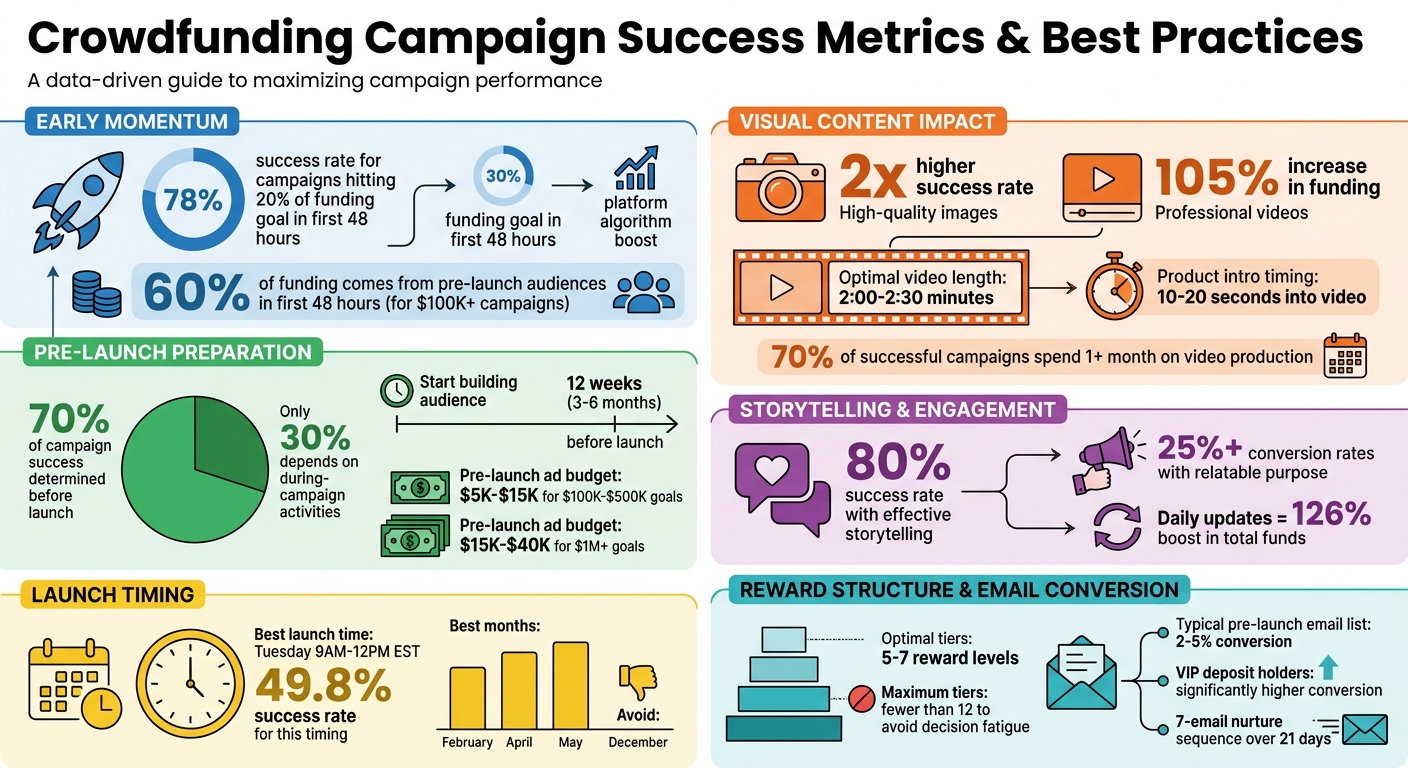
- Early Momentum Matters: Campaigns that hit 30% of their funding goal in the first 48 hours are far more likely to succeed, with a 78% success rate for those reaching 20% early.
- Pre-Launch Preparation is Key: About 70% of a campaign’s success is determined before launch. Build an audience, create a compelling story, and set realistic goals.
- Storytelling Drives Backer Support: Emotional connections are critical. Frame the problem, introduce a solution, and align your product with a larger vision.
- Visuals and Videos Build Trust: High-quality images and videos double success rates. Keep videos under 2:30 minutes and highlight the problem your product solves.
- Set Realistic Goals and Rewards: Start with achievable funding targets and use 5-7 reward tiers to engage backers without overwhelming them.
- Use Data to Improve: Monitor metrics like conversion rates and funding speed. Adjust strategies quickly based on performance.
Success comes from strong preparation, clear messaging, and ongoing adjustments. Plan ahead, focus on early traction, and use data to guide decisions.
Key Success Metrics for Crowdfunding Campaigns
How I Made $439K in 31 Days (my Kickstarter crowdfunding strategy)
sbb-itb-772afe6
Building a Clear Campaign Story
Your campaign story plays a crucial role in securing backer investment. In fact, campaigns with effective storytelling see success rates soar to 80%. The trick? Frame the problem, introduce your solution, and connect your backers to a larger vision.
How Storytelling Affects Backer Decisions
Backers aren’t just buying a product – they’re investing in the change you’re promising. Neuroscience reveals that emotions, not just facts, drive decisions, especially financial ones. This makes storytelling essential. Your goal is to make backers feel the problem before you pitch the solution.
"Your video and campaign copy should make a backer cry, laugh, or get angry at the problem before you ever mention your product’s dimensions."
If your story doesn’t connect emotionally in the first 30 seconds, you risk losing potential backers. Start by painting a vivid picture of a specific frustration your audience faces. For example, instead of saying, "our battery lasts longer", quantify the pain: "You’ve wasted 120 hours a year charging devices multiple times a day." This approach builds empathy and positions your product as a must-have.
Campaigns with a relatable and well-defined purpose often see conversion rates jump to over 25%. Take Kode Dot as an example. When they launched their all-in-one maker device from November 4, 2025, to December 23, 2025, they initially aimed to raise $500,000. Ten days into the campaign, they surveyed backers and found a strong demand for NFC functionality. By adding NFC as a $300,000 stretch goal, they created a sense of co-creation. This shift helped them become Kickstarter’s top project for an entire week, ultimately raising $2,745,921 from 13,317 backers.
A structured and engaging narrative like this can elevate your campaign’s appeal even further.
Core Components of an Effective Campaign Story
A strong campaign story follows a clear structure. Start by defining the problem, but don’t just describe it – quantify it. Highlight the time or money your audience is losing. Then, present your solution in terms of benefits, not just technical specs. For instance, instead of saying "5,000 mAh battery", say, "It powers your device for three full days."
Next, tie your project to a broader movement. This transforms backers into co-creators, giving them a sense of purpose. Finally, establish credibility by showcasing your team’s expertise or personal investment. Highlighting your experience or commitment helps reduce any perceived risk.
| Story Component | Focus | Purpose |
|---|---|---|
| The Problem | Quantifiable Pain | Builds empathy and shows market need |
| The Solution | Benefits over Features | Demonstrates value and solves the pain |
| The Vision | Long-term Impact | Creates an emotional connection |
| The Team | Expertise & Commitment | Builds trust and reduces uncertainty |
This structure aligns with data-driven strategies, proving that a clear and compelling story can significantly boost your campaign’s performance.
Transparency also plays a big role in building trust. Share details about how funds will be used, your milestones, and potential risks. For example, Pebble Technology raised over $10.2 million in April–May 2012 by keeping early adopters engaged with regular updates. They demonstrated how their smartwatch would seamlessly sync with smartphones, solving everyday connectivity issues. Their open approach to development turned interest into unwavering support.
Growing Your Audience Before Launch
Once you’ve crafted a compelling story, the next big move is building an engaged audience before your official launch.
The Importance of Pre-Launch Preparation
Did you know that about 70% of a campaign’s success is determined before it even goes live? Only 30% hinges on what happens during the campaign itself. That’s why pre-launch momentum is so crucial.
Crowdfunding platforms like Kickstarter and Indiegogo reward campaigns that hit the ground running. If you can reach 30% of your funding goal within the first 48 hours, their algorithms will give your campaign a visibility boost. On the flip side, starting with a low percentage – like 0% or 1% – can deter potential backers. A campaign that’s already 30% funded signals credibility and encourages others to join in.
"Pre-launch marketing isn’t a phase that happens before your campaign. It’s the foundation that determines whether your campaign succeeds or fails."
- Michael Raven, Founder, Blazon Agency
Here’s a telling stat: In the 2025 fiscal year, campaigns that raised over $100,000 got an average of 60% of their funding from pre-launch audiences within the first 48 hours. That early momentum does more than just look good – it’s what helps you ride the algorithm wave instead of struggling to gain traction. Let’s dive into some strategies to make this happen.
Proven Pre-Launch Tactics
Start building your audience at least 12 weeks before launch. The first two weeks are all about laying the groundwork. Set up a dedicated pre-launch storefront on a custom domain, create a landing page, and implement tracking tools. This way, you’ll own your audience data instead of relying entirely on the crowdfunding platform.
Next, focus on gaining early commitments. One of the most effective methods is the VIP deposit model. By asking for a small deposit – usually $1 to $5 – you can identify serious early adopters. These micro-commitments not only filter out casual interest but also lead to higher conversion rates. While a typical pre-launch email list might convert at 2% to 5% on launch day, VIP deposit holders are far more likely to back your campaign since they’ve already invested.
Take Glowforge’s 2015 pre-launch as an example. To build buzz for their 3D laser printer, they used KickoffLabs to create a viral referral system. Leads could earn discounts for referring friends – just one referral got them $100 off. Over eight weeks, they amassed 10,000 email leads with a 21% landing page conversion rate. When they launched in October 2015, they hit their $2 million goal in just 2.5 days and ultimately raised $27.9 million in 30 days.
Email marketing is the backbone of conversions, even if social media helps generate awareness. A well-planned email sequence can make all the difference. Here’s a proven 7-email nurture timeline to follow, starting 21 days before launch:
- Day -21: Teaser email
- Day -14: Product reveal
- Day -10: Social proof
- Day -7: Early bird offer
- Day -3: FAQ
- Day -1: VIP reminder
- Day 0: Live announcement
To further incentivize early backers, create a pricing ladder. Offer VIP deposit holders the best price, followed by “Super Early Bird” for the first 24 hours, “Early Bird” for the first week, and then the full MSRP.
Finally, consider your pre-launch ad budget. If your goal is between $100,000 and $500,000, plan to spend $5,000–$15,000. For campaigns aiming for $1 million or more, budgets typically range from $15,000 to $40,000. These investments can help you build the momentum needed to hit your targets early.
Using Visuals and Video Effectively
You’ve built your pre-launch audience – now it’s time to show them what you’re creating. With an engaged pre-launch audience, compelling visuals are key to turning interest into backing. High-quality visuals and videos play a big role in making your campaign a success.
Why Visual Quality Matters
Backers often skim through campaign pages quickly, so your images need to grab their attention right away. First impressions count, and your visuals should convey professionalism and trust. Here’s a telling stat: campaigns with high-quality images are twice as likely to succeed compared to those with lower-quality visuals.
Think of your visuals as a trust builder. Clear product photos and lifestyle shots showing your product in everyday use help backers feel confident about what you’re offering.
"It’s crucial that you include photos, mock-ups, even sketches of your product and business… all improve your odds of catching the reader’s attention"
- Laura Moller, Fundable
The technical quality of your visuals matters too. Use images that are at least 1,000 pixels wide and shoot videos in a 16:9 aspect ratio with a minimum resolution of 720p (though 1080p or 4K is even better). One important tip: avoid embedding text directly into your images. This can hurt SEO, make it harder for screen readers to interpret, and lead to poor scaling on mobile devices.
Alongside strong images, a well-thought-out campaign video is just as important.
Creating Effective Campaign Videos
Data shows that the sweet spot for campaign videos is between 2:00 and 2:30 minutes. Videos longer than 4 minutes tend to see a sharp drop in success rates. Timing within the video also matters – a successful campaign typically introduces its product between 10 and 20 seconds in.
What sets high-performing videos apart? First, 70% of successful campaigns spend at least a month producing their video. Rushing the process – like producing a video in under a week – can reduce your success rate by 25%. Second, narration is critical. Videos without voiceovers tend to underperform. Lastly, include yourself or your team in the video, even briefly.
"A nice video inspires trust, at a time when backers are growing weary of crowdfunding busts"
A brief founder cameo can add a layer of authenticity that third-party videos often lack.
When it comes to budgeting for your video, scale it to match your funding goal. Here’s a quick breakdown:
- For a $25,000 campaign, allocate under $3,000 for a simple founder interview with b-roll.
- A $100,000 goal may require $2,000–$6,000 for an experienced director and small crew.
- At $500,000, expect to spend $5,000–$20,000 for professional scriptwriting and location scouting.
- Campaigns aiming for $1 million or more often budget $20,000–$100,000 for high-end production.
"Make sure you set up the problem, then show how your product is the solution. It sounds simple, but it is critical that the current problem and how you’ve solved it is clearly shown, otherwise people won’t understand why they need your product"
- Ember
Your video should clearly outline the problem your product solves and how it does so. Structure it with a clear narrative arc – highlight the pain point, introduce your solution, and demonstrate the positive outcomes. This approach helps viewers quickly grasp your product’s value while reinforcing the strategies that drive successful crowdfunding campaigns.
Setting Goals and Designing Rewards
When planning your campaign, setting a realistic funding target and crafting appealing rewards are key to keeping the momentum going. These steps help you structure your campaign financially while ensuring it resonates with your backers.
Finding the Right Funding Target
The best way to set your funding goal? Keep it simple: base it on your actual costs. This means accounting for everything – manufacturing, shipping (both to warehouses and to customers), packaging, platform fees, and a 10–15% contingency. For example, your goal should include your Bill of Materials multiplied by the Minimum Order Quantity (MOQ), along with any licensing or certification fees.
Here’s why this matters: campaigns that hit 20% of their funding within the first 48 hours are 78% more likely to succeed. A lower, achievable target can help you build momentum quickly. Take UVMask, for instance. Guided by Campaign Strategist Ivo Kalburdzhiev, they set a modest $20,000 goal. Within hours, they hit it, creating immediate social proof. The campaign ultimately raised $100,000 in 48 hours and an astonishing $5.5 million across Kickstarter and Indiegogo in just six months.
"I guarantee you will not get any meaningful funding if you start high in the first place!"
- Ivo Kalburdzhiev, Campaign Strategist and CEO of CreatorClub.com
On the flip side, campaigns like Ubuntu Edge prove the risks of overly ambitious goals. They set a $32 million target but fell short despite raising $12 million – a crowdfunding record at the time. The result? No funds were collected because they didn’t meet their goal. The takeaway? Stick to achievable, data-backed targets. It’s easier to scale up from a smaller goal – like raising $100,000 when you start at $20,000 – than to start high and miss entirely.
Once you’ve nailed down your funding goal, focus on designing rewards that encourage backers to contribute.
Structuring Reward Tiers That Work
A well-thought-out reward structure can boost your campaign’s credibility and guide backers toward meaningful pledges. Successful campaigns often use 5-7 reward tiers, starting with an affordable entry-level option (like a digital thank-you or early access) and scaling up to premium rewards. This keeps things simple and avoids overwhelming backers with too many choices.
To kickstart funding, include early-bird specials that create urgency. Highlight your "best value" tier visually to steer backers toward it. Each tier should offer a clear, tangible upgrade in value. For example, UVMask leveraged add-ons and accessories to increase their average order value to $300, even though their core product started at less than $99. Bundling digital perks with physical rewards at higher tiers can further enhance perceived value without driving up production costs.
Keep in mind: fewer than 12 tiers is ideal to avoid decision fatigue. A streamlined, strategic reward structure ensures backers feel confident and excited about their contributions.
Lessons from High-Performing Campaigns
How Data Informs Campaign Strategy
Once you’ve built your story and connected with your audience, using real-time data becomes essential to keep your campaign on track. Successful crowdfunding campaigns rely heavily on data to monitor key metrics. For instance, conversion rates – the percentage of visitors who actually become backers – serve as a quick indicator of how well your campaign pitch is working. Another critical metric is funding velocity, which measures how quickly funds are coming in, either hourly or daily. This helps identify momentum spikes and slow periods, giving you a short window to make adjustments.
Engagement metrics like shares, comments, and email click-through rates are also closely tracked to ensure the messaging hits the mark with your audience. Take UVMask, for example. By analyzing their Google Analytics data in 2020, they discovered an unexpected audience segment: people interested in "Astronomy." By targeting Facebook ads to similar groups, they achieved a 9 ROAS (Return on Ad Spend) and raised $5.5 million in total funding.
Pebble Smartwatch used a similar approach by leveraging real-time data. When they saw high engagement but low conversions from Facebook ads, they shifted their budget to email marketing, which was performing better. This strategic pivot helped them exceed $10 million in funding. These examples show how keeping a close eye on data can lead to smarter, more effective decisions.
Practical Steps for Your Next Campaign
Using the lessons from data-driven campaigns and earlier pre-launch strategies, here are actionable steps to fine-tune your next campaign. Start by setting a modest initial funding goal that you can hit within the first 48 hours. Early momentum is crucial – it boosts platform algorithms and builds social proof.
Timing matters, too. Launch your campaign on a Tuesday morning, ideally between 9:00 AM and noon EST. This time slot aligns with peak user activity and has been linked to a 49.8% success rate. Avoid December launches; instead, aim for February, April, or May, which tend to perform better seasonally.
Once your campaign is live, monitor your data daily. Be ready to act quickly, and update ad creatives every four to five days during high-spend periods to avoid ad fatigue. For example, Kode Dot noticed a drop in conversions 10 days into their November 2025 campaign. They surveyed early backers and found demand for NFC functionality. By restructuring their stretch goals to include NFC at $300,000, they doubled their weekly sales and ultimately raised $2,745,921 from 13,317 backers, maintaining a 3.77 ROAS.
Finally, prioritize platforms that deliver actual backers, not just surface-level engagement. As the Crowdfundly Team wisely points out:
"Surface-level metrics are often misleading as they don’t always directly correlate with funding success"
- Crowdfundly Team
In other words, focus on what drives real results, not just what looks impressive on a dashboard.
Conclusion
Crowdfunding success relies on thorough planning, smart use of data, and timely actions. The most successful campaigns go beyond selling a product – they spark a movement around an idea. As Glow Reports aptly states:
"The most successful campaigns don’t just meet their goals, they create movements."
Consider this: campaigns with professional videos see a 105% increase in funding, while providing daily updates can boost total funds by 126%. These numbers highlight the value of a well-thought-out strategy. Strong pre-launch efforts and ongoing data analysis are crucial to achieving crowdfunding goals. Examples like Glowforge and Kode Dot show how a mix of careful preparation and mid-campaign adjustments, based on backer feedback, can deliver outstanding results.
To set yourself up for success, aim for a realistic funding goal that you can surpass quickly. Launch your campaign on a Tuesday morning between 7:00 and 9:00 AM EST, and start building your audience 3 to 6 months in advance. Monitor key metrics daily – such as conversion rates, funding speed, and engagement – and be ready to shift gears if something isn’t working. Reallocate resources to strategies that bring in backers. Ultimately, the campaigns that thrive are those that plan ahead, let data drive decisions, and adapt quickly when needed.
FAQs
How do I estimate a realistic funding goal?
To determine a practical funding goal, start by analyzing data from campaigns similar to yours that have succeeded. Look into their funding patterns and benchmarks to understand what resonates with your target audience. Use tools like polls or dedicated landing pages to gauge interest and validate demand for your project. Your target should reflect the actual scope of your project while staying aligned with market interest. Striking the right balance between ambition and attainability can significantly boost your chances of hitting your goal.
What should I do if conversions drop mid-campaign?
If you notice a dip in conversions during a campaign, act fast. Start by reviewing your messaging, incentives, and overall approach. The most successful campaigns often make critical adjustments within the first 48 hours to regain traction. Use data to guide your next steps – this might mean fine-tuning your target audience or improving your offers to get things back on track.
Which metrics matter most during the first 48 hours?
During the first 48 hours of your campaign, there are three key metrics to focus on:
- Hit at least 30% of your funding goal: This milestone creates early momentum and builds credibility for your campaign.
- Build a high-intent lead list: These are potential backers who are genuinely interested and likely to contribute.
- Keep your cost per lead between $1.50 and $3.00: Staying within this range ensures you’re acquiring leads efficiently without overspending.
These benchmarks are crucial for driving early success and setting a strong foundation for your campaign.