
Robotic Process Automation (RPA) simplifies repetitive tasks, saves time, and boosts efficiency across industries. From reducing manual errors to cutting costs, RPA is transforming workflows in banking, healthcare, retail, and beyond. This guide explores how organizations like Swiss Re, Royal Mail Group, and Pfizer have achieved measurable results through automation.
Key Takeaways:
- Savings: Royal Mail Group saved £55M and freed 662,000 employee hours with 85 automated processes.
- Efficiency Gains: Swiss Re cut bank reconciliation time by 80%, from 15 days to 3.
- Scalability: EDP Global Solutions automated 450+ processes, saving 220,000 hours annually.
- Improved Accuracy: Australian Unity achieved 94% success in processing 42,000 transactions in 8 months.
How to Succeed with RPA:
- Start Small: Focus on simple, high-impact tasks for quick wins.
- Measure Success: Track metrics like ROI, error rates, and time saved.
- Plan for Growth: Build a roadmap for scaling automation across departments.
- Invest in Leadership: Strong governance and employee buy-in are critical for long-term success.
This guide highlights actionable strategies and real-world examples to help you leverage RPA for meaningful business outcomes. For more insights from tech leaders, explore our episode archive.
RPA ROI & Developer Program | Humana RPA Success Story | Automation Anywhere
sbb-itb-772afe6
What Makes an RPA Initiative Successful
Achieving success with Robotic Process Automation (RPA) depends on tracking meaningful metrics, laying a strong groundwork, and maintaining a vision that extends beyond quick wins. Organizations that excel in automation share some common habits: they focus on the right metrics, establish solid foundations, and prioritize long-term goals over short-term gains.
Key Metrics for Measuring RPA Success
To gauge the success of an RPA initiative, it’s essential to monitor metrics across four primary categories: financial, operational, technical, and quality.
| Category | Key Metric | What to Track |
|---|---|---|
| Financial | ROI / Value of Time Gains (VTG) | Cost of manual effort vs. bot execution |
| Operational | Gained Productivity | FTEs saved; reduction in process cycle time |
| Technical | Exception Rate | % of cases that fail (aim for under 20%) |
| Technical | Bot Utilization | % of time bots are actively working |
| Quality | Error Reduction Rate | Manual error rates vs. automated error rates |
For instance, achieving 80% or higher bot accuracy is a solid benchmark. Keeping exception rates – cases where automation fails due to data or system issues – below 20% is equally crucial. Australian Unity provides a compelling example: between June 2018 and February 2019, their RPA program processed 42,000 transactions with a 94% success rate, reclaiming 22,493 hours of manual work in just eight months.
"Our success lies in identifying the right opportunities for automation." – Ambrish Kinariwala, RPA Lead, Australian Unity
Another important metric is scalability in development. By tracking reusable code, organizations can accelerate future automation rollouts. These metrics are the foundation for making informed strategic and operational decisions.
What Drives Effective RPA Implementations
Metrics alone aren’t enough; effective RPA initiatives also rely on strong leadership and well-aligned processes.
Successful RPA programs often include executive sponsorship, standardized processes, and robust governance. Swiss Re offers an excellent example of how governance can drive success. Before launching their automation pilot, their team prioritized communication and developed a governance framework to secure early employee buy-in.
"Our team invested a lot of time developing an effective communication plan and governance framework. Such a comprehensive plan and framework was critical in getting employees’ buy-in and support as early in the process as possible." – José Ordinas-Lewis, Head of Robotic Automation Center, Swiss Re
Choosing the right processes to automate is another critical factor. Skanska’s RPA Lead, Christel Skoog, highlighted the importance of starting with simpler tasks, which can deliver significant value without needing to automate an entire process end-to-end.
"We saw how humans and robots interact within a process and we found that, often, by tackling the simple tasks first then you can deliver 80% of the value quickly without needing to automate a process end-to-end." – Christel Skoog, RPA Lead, Skanska
Skanska also found that consolidating RPA operations into a Center of Excellence (CoE) drastically reduced maintenance time – from a full week to just 30 minutes per month.
Short-Term Wins vs. Long-Term Gains
Once a strong foundation is in place, organizations can focus on securing early wins that pave the way for sustainable growth.
For example, EDF Energy started with a proof of concept that saved 70 labor hours each month. This initial success led to automating eight additional processes, including tax data collation, which went from four hours of manual preparation to zero by running bots overnight. These early wins validated the potential for broader RPA investments.
"We realized that robots would allow us to automate many repetitive parts of our processes and support our staff by removing some of the mundane activities from their workload." – Robert Gilhooly, Director of the Financial Shared Service Center, EDF Energy
The real value, however, comes from treating these quick wins as stepping stones. Royal Mail Group began with a small pilot involving five employees automating data extraction for delivery offices. This modest start eventually scaled to 1,250 locations. Starting small, proving value, and then scaling is a proven formula for success.
EDP Global Solutions exemplifies this approach. Since 2017, they’ve automated over 450 critical business processes and trained 170 employees as automation advocates, creating a self-sustaining model for growth.
"I wish we started our RPA journey sooner… You’ll see significant results so fast that you’ll regret every day that you delayed your decision." – Nuno Chung, Executive Board Member, EDP GS
Cross-Industry Patterns in RPA Success
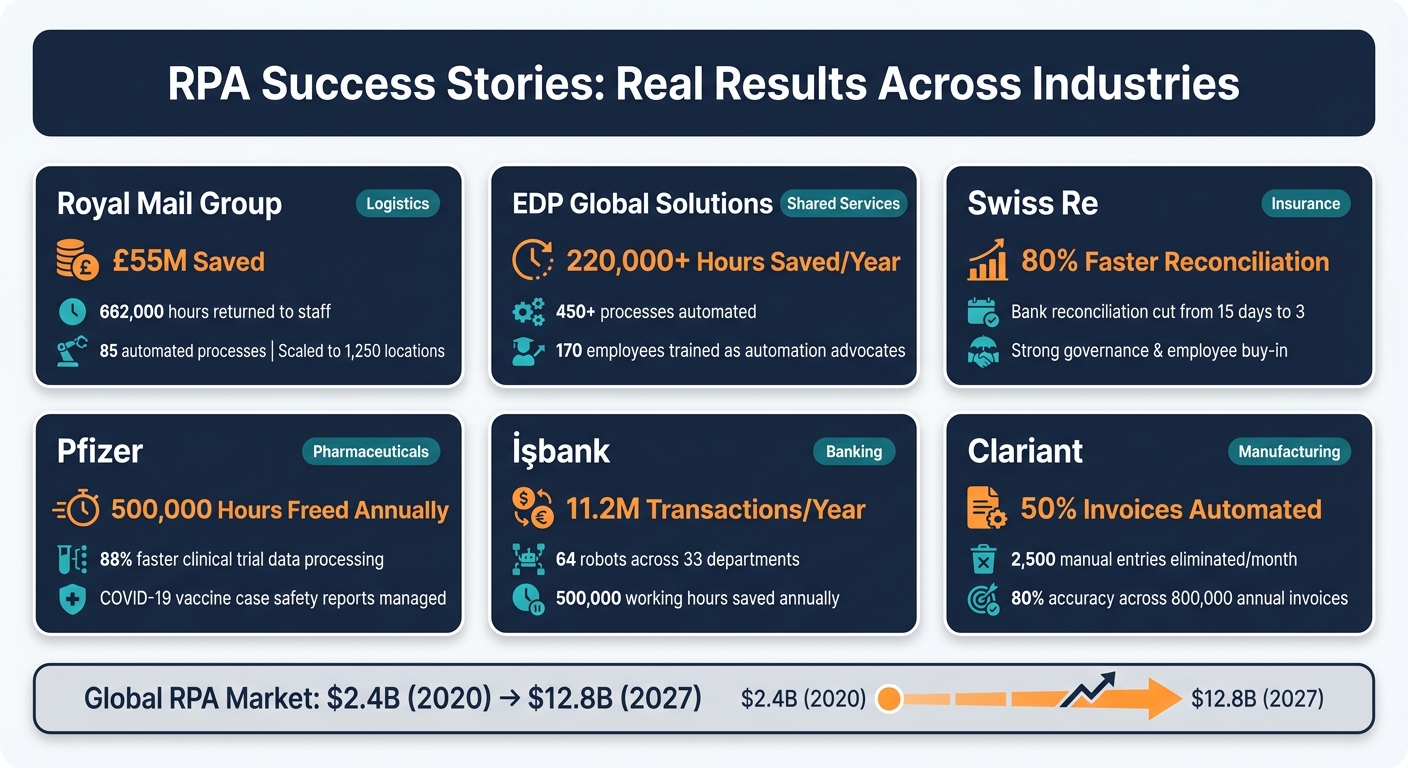
RPA Success Stories: Real Results Across Industries
Common RPA Use Cases Across Industries
When looking at how industries are leveraging Robotic Process Automation (RPA), a few standout use cases emerge as consistent winners. From banking to manufacturing, certain automation strategies prove effective across the board. For instance, financial reconciliation and invoice processing are widely implemented. A great example is Swiss Re, which has successfully extended RPA for financial reconciliation, mirroring efficiency improvements seen in other sectors. Similarly, Clariant, a specialty chemical company, automated 50% of its invoice handling in a pilot region spanning Germany, Australia, Switzerland, and Belgium. This move eliminated 2,500 manual invoice entries every month.
Another popular application is data extraction for reporting. Royal Mail Group showcases this with their nightly data extractions from legacy systems, a scalable approach many industries are now adopting. Lastly, compliance monitoring is a frequent use case. For example, a digital worker named "Homer" processes 100 EPA compliance forms daily, cutting handling time by 95%.
"The robots make it easier to use systems so agents can concentrate on customers, not technology." – Phoebe Woods, Business Analyst, Royal Mail Group
These foundational use cases often act as stepping stones, enabling organizations to layer on more advanced technologies to amplify RPA’s impact.
Technology Combinations That Improve RPA Outcomes
RPA on its own is great for structured, rule-based tasks, but when it comes to messy or unstructured data, it needs a little help. That’s where tools like OCR (Optical Character Recognition) and AI come into play. By combining these technologies with RPA, companies can tackle more complex scenarios. For instance, Clariant uses RPA alongside document ingestion tools to extract details like company names and tax codes directly from PDFs and scanned images. This integration achieves 80% accuracy across 800,000 annual invoices while also eliminating 40,000 paper printouts every quarter.
Royal Mail Group is exploring even more advanced applications, such as using chatbots and intelligent OCR for HR onboarding. This represents a shift from back-office automation to workflows that directly touch employees and customers. Similarly, Swiss Re is evaluating machine learning and document ingestion to handle processes that fall into what José Ordinas-Lewis calls the "middle ground" – tasks too complex for simple macros but not large enough for full IT projects.
"The team is evaluating machine learning, document ingestion, and other emerging technologies to complement the UiPath Platform and power new automations." – José Ordinas-Lewis, Head of Swiss Re’s Robotic Automation Center
By integrating these technologies, companies can navigate data complexities and unlock measurable benefits across various industries.
Benefits That Apply Across Sectors
The advantages of RPA aren’t limited to specific industries – they’re universal. Whether in logistics, insurance, or manufacturing, organizations report similar wins: time savings, cost reductions, improved accuracy, and enhanced employee focus.
| Organization | Industry | Key Outcome |
|---|---|---|
| Royal Mail Group | Logistics | £55M saved; 662,000 hours returned to staff |
| EDP Global Solutions | Shared Services | 220,000+ hours saved across 450+ processes |
| Swiss Re | Insurance | 80% faster bank reconciliation |
| Clariant | Manufacturing | 50% of invoices automated; 10% productivity gain |
| Coke Canada Bottling | Consumer Goods | 95% reduction in compliance form handling time |
These numbers tell part of the story, but there’s also a shift in mindset. Scott Bedows, CIO of Coca-Cola Canada Bottling, summed it up perfectly:
"When we start talking about unlocking the power of our people, these are the same people who were using Excel macros and workflows. We have just taken them to the next level with new tools in the toolbox." – Scott Bedows, CIO, Coca-Cola Canada Bottling Limited
This shift – from seeing automation as merely a cost-cutting measure to recognizing it as a way to empower employees – is what sets apart companies that sustain long-term RPA success from those that struggle after initial pilots.
RPA Success Stories by Industry
Banking and Financial Services
The banking sector has seen notable improvements thanks to RPA, with early adopters achieving impressive results. Eurobank in Poland, for example, collaborated with PwC in 2017 to implement UiPath robots for tasks like loan repayment scheduling, KYC checks, and online product sales. This reduced the time to open a new online product from over a day to just four hours, saving 20 full-time equivalents (FTEs) monthly and cutting 27,500 hours in 2018 alone.
"With online sales, clients want to have products quickly. It used to take one, one and a half days. Now it takes four hours or less." – Wojciech Szremski, Process Automation and Process Optimization Director, eurobank
In Turkey, İşbank established a dedicated automation team in 2016, bringing together business and IT experts alongside RPA developers. The team automated more than 300 tasks across 33 departments. During the COVID-19 pandemic, they deployed 28 robots in a single day, processing 8,700 loan repayment postponements overnight. Today, their 64 robots handle over 11.2 million transactions annually, saving 500,000 working hours each year.
First Abu Dhabi Bank (FAB) took a strategic approach by launching its Intelligent Automation Center of Excellence in 2019. Under the leadership of Group COO Suhail Bin Tarraf, the bank achieved an 88% efficiency boost in reallocating relationship managers, reducing the process from seven days to just one. Additionally, 11 robots were deployed for passport and ID verification, saving 80,000 hours annually while maintaining full compliance with regulations.
These examples highlight how RPA enables banks to achieve substantial efficiency gains, providing a roadmap for other industries to follow.
Healthcare and Pharmaceuticals
The healthcare and pharmaceutical sectors, with their heavy administrative demands, have embraced RPA to streamline operations and meet compliance requirements. Pfizer utilized digital workers between 2018 and 2021 to manage European case safety reports during the COVID-19 vaccine rollout. This initiative freed up 500,000 employee hours annually and accelerated clinical trial data processing by 88%.
"By leveraging digital workers, they were able to expand their bandwidth quickly while ensuring quality at a lower cost." – Namita Pande, Enterprise Automation Team Intake and Portfolio Lead, Pfizer
Merck Life Sciences took RPA to a global scale, deploying 130 Automation Anywhere bots across 23 countries from 2021 to 2022. These bots automated 43 processes, including trade compliance and logistics, saving 121,000 human hours. The initiative is expected to boost product sales significantly over the next five years by speeding up SKU replenishment and resolving blocked orders.
In the healthcare provider space, APDerm, a dermatology network in New England, implemented RPA in April 2024 to automate Tax ID selection for insurance claims. The bot reduced claims processing time from five days to two, resulting in $400,000 in annual savings and cutting Client Days in Accounts Receivable by 80%.
Retail and E-Commerce
Retailers have turned to RPA to tackle challenges like invoice processing and logistics, especially during periods of high demand. Arçelik Global, a consumer electronics company, faced a tenfold surge in digital sales during the pandemic. Led by Chief Strategy and Digital Officer Utku Barış Pazar, the team automated 85 processes, including a finished goods import system that cut invoice entry time by 90%. Overall, Arçelik saves 125,000 working hours annually.
"A critical component of our digital transformation journey is about elimination of clerical activities and diverting the energy and focus of the entire organization to value added & strategic activities." – Utku Barış Pazar, Chief Strategy and Digital Officer, Arçelik Global
Kingfisher, the home improvement retailer behind brands like B&Q and Screwfix, tackled accounts payable in 2021. By automating the indexing of 40,000 invoices monthly across six countries, they reduced processing time from five minutes to just 25 seconds. This resulted in a 60% touchless processing rate and allowed 14 employees to shift to higher-value tasks.
A major U.S. wholesale retailer automated 7,000 invoices monthly using UiPath Document Understanding and machine learning. With a 95% confidence score for data extraction, they reduced processing time per invoice from five minutes to 30 seconds, saving over 160 hours each month.
| Retailer | Process Automated | Time Savings | Key Outcome |
|---|---|---|---|
| Kingfisher | AP Invoice Indexing | 90% reduction | 60% touchless invoices |
| Arçelik | Finished Goods Import | 90% reduction | 125,000 hours saved/year |
| Major U.S. Wholesale Retailer | Freight Invoicing | 85–90% reduction | 95% confidence score |
Turning RPA Success Stories into Action
Common Themes in Successful RPA Projects
When you look at these case studies, a few clear patterns stand out. The best RPA projects don’t jump straight into automation – they begin with process clarity. Teams take the time to map out how a task works, pinpoint exceptions, and establish a baseline. Why? Because automating a broken process only speeds up mistakes. Another key ingredient is early stakeholder involvement. Getting the right people on board from the start ensures that teams pick the right processes and build support across the organization before rolling anything out. These steps lay the groundwork for a structured roadmap and highlight how critical leadership is in keeping RPA efforts on track.
Building a Roadmap for RPA Adoption
The smartest way to start is with a Proof of Value (POV). This means picking one low-risk, high-impact process that can deliver fast results. Once the pilot shows success, the challenge shifts to prioritizing what comes next. Successful organizations often follow a five-phase roadmap to keep their automation goals aligned with business needs and drive lasting improvements:
| Phase | Key Activities | Goal |
|---|---|---|
| Identification | Map and prioritize processes based on ROI and volume | Choose high-impact candidates |
| Design/Development | Model workflows, define rules, and address exceptions | Build strong automation logic |
| Testing | Conduct unit, integration, and user acceptance testing | Deliver error-free performance |
| Implementation | Deploy automation, manage change, and train staff | Ensure a smooth production launch |
| Optimization | Monitor in real time and refine processes | Maximize ongoing benefits |
For example, Valmet, under IT Manager Janne Järvinen, used a "fast-track" program to move from concept to production in just five weeks. Between June 2019 and May 2020, they automated 70 processes, including VAT filing, which went from taking 2–3 days to just 5 minutes.
How Leadership Shapes RPA Success
Once a clear roadmap is in place, leadership becomes the driving force behind scaling and sustaining automation. Surprisingly, the biggest challenges in RPA programs are rarely about technology – they’re about culture. As Janne Järvinen put it:
"Scaling transcends technology and manpower – it hinges on cultivating the right culture." – Janne Järvinen, IT Manager and Head of Software Robotics, Valmet
The most successful leaders focus on empowering their teams rather than just deploying tools. For instance, at Wärtsilä, Solution Architect and Process Automation Leader Nishant Redekar built a community of citizen developers by training over 900 employees and encouraging experimentation. His philosophy was simple:
"Trust your own people – let them try and even let them fail. It’s worth it." – Nishant Redekar, Solution Architect and Process Automation Leader, Wärtsilä
This approach allowed Wärtsilä to scale to more than 400 automated processes, supported by over 100 internal citizen developers. On the other hand, Reckitt’s Prashant Arora, Head of Service Modernization and Automations, emphasized the importance of structure alongside freedom:
"If you keep your automation project loose and distributed you will always face unwelcome surprises, but running through a CoE model provides greater foresight and control of change." – Prashant Arora, Head of Service Modernization and Automations, Reckitt
Reckitt’s structured approach, which included an "Automation Factory" CoE and a tailored playbook, helped them reclaim 10,000 business hours every month. The takeaway? Encourage innovation, but establish guardrails to maintain quality and compliance.
Conclusion
This guide has highlighted how precise metrics, effective leadership, and well-planned pilot programs can drive impressive results. These success stories are more than just examples – they’re valuable lessons to guide your RPA journey.
Key Lessons from RPA Success Stories
The data speaks volumes about RPA’s impact. Case studies from organizations like Royal Mail Group, Skanska, and Australian Unity illustrate a clear path: start small, demonstrate value quickly, and then scale up. Christel Skoog, RPA Lead at Skanska, summed it up perfectly:
"We found that, often, by tackling the simple tasks first then you can deliver 80% of the value quickly without needing to automate a process end-to-end." – Christel Skoog, RPA Lead, Skanska
Long-term success goes beyond tools – it requires a Center of Excellence and a strong focus on developing people. These lessons provide a framework for crafting a customized RPA strategy that delivers ongoing results.
Using Success Stories to Build Your Own RPA Strategy
Use these insights as a roadmap for your next RPA initiative. These case studies aren’t just inspiring; they offer actionable steps. Begin with a high-volume, repetitive process in your organization, launch a pilot, measure the outcomes, and use those results to gain internal support for broader implementation.
Ambrish Kinariwala, RPA Lead at Australian Unity, emphasized how integral RPA has become to modern operations. And if you’re hesitating, consider this advice from Nuno Chung, Executive Board Member at EDP GS, whose team saved 220,000 hours by automating over 450 processes:
"I wish we started our RPA journey sooner. You’ll see significant results so fast that you’ll regret every day that you delayed your decision." – Nuno Chung, Executive Board Member, EDP GS
With the global RPA market predicted to grow from $2.4 billion in 2020 to $12.8 billion by 2027, organizations already embracing RPA are gaining a competitive edge. These success stories prove not only that RPA works but also that they can serve as a practical guide for shaping a strategy tailored to your operations.
FAQs
Which processes should we automate first with RPA?
Start by focusing on tasks that are rule-based, repetitive, high-volume, and rely on digital inputs. Examples include invoice processing, data entry, or account reconciliation. These activities follow straightforward rules, making them ideal candidates for automation. By automating such processes, you can reduce errors, speed up workflows, and allow employees to focus on more strategic responsibilities. Plus, the efficiency and accuracy gains often translate into a quick return on investment.
How do we calculate RPA ROI in dollars?
To figure out the ROI of RPA in dollars, you simply subtract the costs of implementation from the total benefits or savings achieved through automation. These benefits often include things like reduced expenses and improved efficiency. For instance, some companies have seen impressive results, saving $16 million and even $55 million in different automation scenarios. This shows just how much financial value automation can bring when done right.
When do we need a Center of Excellence (CoE) for RPA?
A Center of Excellence (CoE) plays a key role in expanding RPA from small-scale pilot projects to a full-fledged, enterprise-wide initiative. It provides a structured framework to maintain consistency, enforce governance, and apply best practices across all departments. By doing so, it supports long-term success and helps organizations get the most out of their RPA investments. Most companies set up a CoE to shift from scattered automation efforts to a more strategic, scalable model that drives measurable and enduring outcomes.