Balancing creativity and accountability is one of the biggest challenges startups face. Too much freedom can lead to chaos, while excessive structure can stifle new ideas. But research shows that the right balance can boost both innovation and execution. Here’s how startups can achieve it:
- Autonomy vs. Control: Autonomy inspires fresh ideas, but too much can lead to overconfidence. Formal systems like OKRs and KPIs provide structure and direction without limiting flexibility.
- Team Roles and Dynamics: Clearly defined roles reduce confusion and encourage individuals to innovate within their responsibilities.
- Diversity and Collaboration: Diverse teams perform better when they balance differing perspectives with shared goals and clear communication.
- Leadership Styles: Leaders who alternate between encouraging experimentation and enforcing structure (ambidextrous leadership) drive better results.
- Feedback and Iteration: Constructive feedback and short iteration cycles keep teams improving without losing focus.
The key takeaway? Startups thrive when they balance freedom with structure, align team dynamics with goals, and leverage leadership to guide both creativity and execution.
How to Balance Creativity and Structure as a Leader
This video features insights from startup tech leaders who have navigated these leadership challenges.
sbb-itb-772afe6
Organizational Structures: Autonomy, Control, and Innovation Outcomes
Frameworks for Balancing Creativity & Accountability in Startups
The structure of a startup plays a crucial role in shaping innovation. Research suggests that while autonomy can fuel creativity, it’s not always a case of "the more, the better." Strategic use of formal controls can also enhance outcomes in unexpected ways.
How Autonomy Affects Innovation
Autonomy often boosts intrinsic motivation and fosters innovation in teams. For instance, a field experiment involving 939 participants found that teams allowed to choose their own project ideas outperformed those assigned ideas. However, giving teams full autonomy – letting them choose both ideas and team members – led to overconfidence and ultimately reduced performance.
Interestingly, when faced with high performance pressure, autonomy can backfire. It may overwhelm individuals, leading to what Eunmi Jang from Honam University describes as:
"Autonomy under high performance pressure can lead to cognitive overload and diminished intrinsic motivation."
This is where formal controls can step in, offering clear boundaries that help mitigate such challenges.
How Formal Controls Like OKRs and KPIs Affect Creativity
There’s a common fear that formal tools like OKRs (Objectives and Key Results) or KPIs (Key Performance Indicators) might stifle creativity. However, research tells a different story. A structural equation model based on data from 233 business unit managers revealed that using formal control systems intensively can actually enhance both empowerment and creativity. When treated as informational tools rather than micromanagement methods, these systems provide direction without curbing innovation. As Roland F. Spekle of Nyenrode Business University puts it:
"Creativity can flourish in the presence of control."
Further evidence comes from a study of 611 Brazilian startups, which showed that comprehensive performance measurement systems – those combining innovation-focused metrics with traditional financial ones – strongly predict individual creativity and role clarity. By defining clear responsibilities, teams gain the confidence to experiment within established boundaries.
Using Lightweight Structures to Support Both Creativity and Accountability
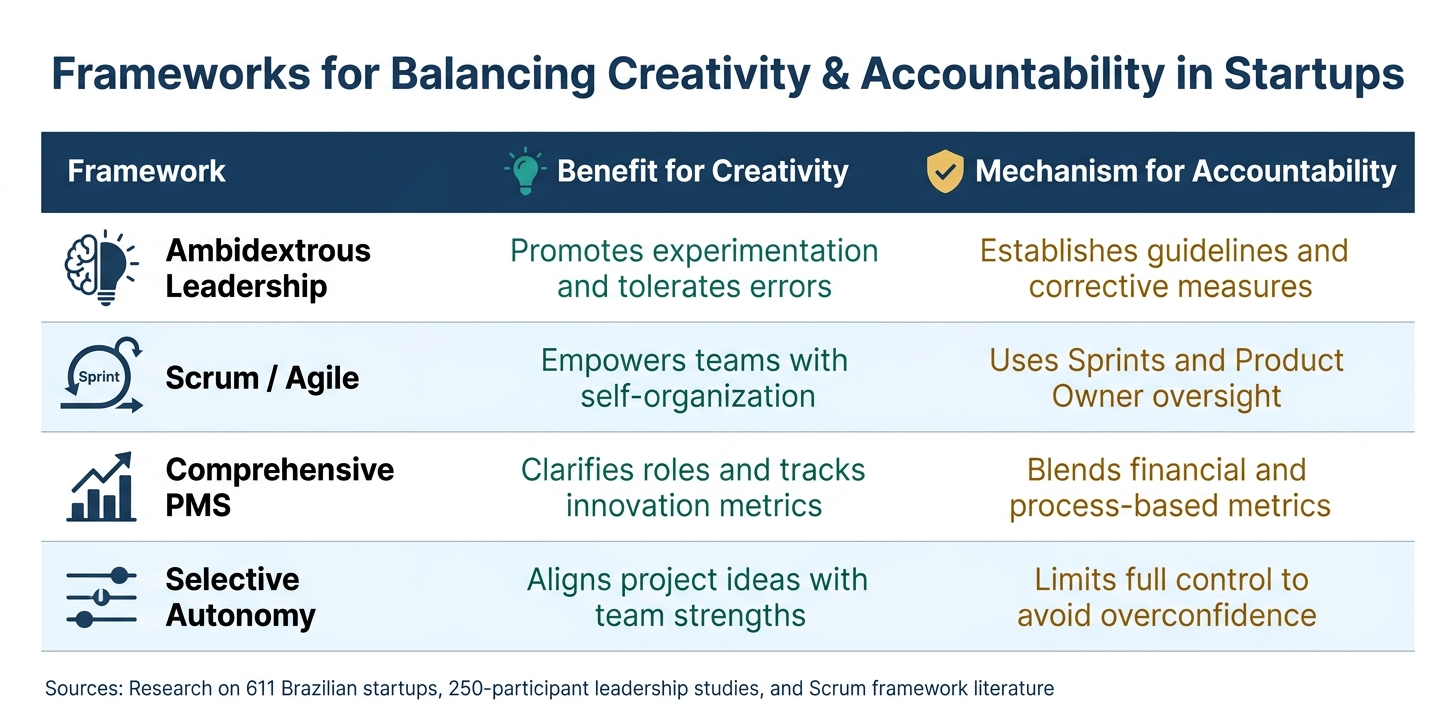
Balancing autonomy and formal controls can be tricky, but lightweight structures offer a middle ground. Frameworks like Scrum illustrate how freedom and accountability can work hand in hand. In Scrum, self-organizing, cross-functional teams decide how to achieve their goals, while Sprints and oversight from a Product Owner ensure accountability for results.
Ambidextrous leadership takes this a step further by alternating between encouraging experimentation and enforcing milestones. This approach helps maintain a balance between creativity and accountability.
| Framework | Benefit for Creativity | Mechanism for Accountability |
|---|---|---|
| Ambidextrous Leadership | Promotes experimentation and tolerates errors | Establishes guidelines and corrective measures |
| Scrum / Agile | Empowers teams with self-organization | Uses Sprints and Product Owner oversight |
| Comprehensive PMS | Clarifies roles and tracks innovation metrics | Blends financial and process-based metrics |
| Selective Autonomy | Aligns project ideas with team strengths | Limits full control to avoid overconfidence |
Team Dynamics: Roles, Diversity, and Collaboration
Dynamic collaboration is the glue that holds teams together, especially when balancing creativity with accountability. Even the most well-thought-out organizational structures can crumble without strong team dynamics. For startups, where innovation often needs to happen at lightning speed, aligning team dynamics with strategic goals is essential. Many startup tech leaders emphasize that these dynamics are the foundation of technical and operational success. Success depends on how a team defines roles, builds trust, and fosters open communication to ensure creativity and accountability thrive.
Why Role Clarity and Ownership Matter
Having clearly defined roles isn’t just about avoiding confusion – it’s also a catalyst for creativity. Studies from Brazilian startups show that when people know their responsibilities, they feel less uncertain and are more inclined to innovate within their areas of expertise.
"Role clarity has a direct effect on creativity and promotes partial mediation between comprehensive PMS and creativity." – Anderson Betti Frare, Graduate Program in Accounting, Federal University of Santa Catarina
This clarity is especially critical in early-stage teams. Research involving 145 startup teams and 434 participants highlights that a shared understanding of roles significantly enhances team creativity. With nearly 95% of entrepreneurs working with or planning to involve collaborators, defining roles early in the process is practically unavoidable. Setting these boundaries during idea generation helps channel creative energy toward ideas that align with the team’s goals.
How Diversity Affects Creativity and Accountability
Diverse skills and perspectives can fuel creative problem-solving, but diversity alone doesn’t automatically lead to success. A meta-analysis of 134 field studies involving 11,353 teams revealed that demographic diversity by itself doesn’t guarantee creativity. The real difference lies in how teams are structured to collaborate. Teams that rely on each member’s unique skills and perspectives tend to unlock the full potential of their diversity.
High-performing teams know how to adjust their approach to diversity. For example, a study of 117 remote software development teams found that successful groups practiced "congruent modulation." They encouraged cognitive divergence during brainstorming to spark fresh ideas, then shifted to shared vocabularies and convergent thinking during execution to maintain accountability. As Katharina Lix from Stanford University explains:
"The performance tradeoff of group cognitive diversity is not inescapable: Groups can navigate it by aligning their levels of discursive diversity to match their task requirements."
Leadership is also a key factor. It’s not enough to invite diverse perspectives to the table; leaders must actively show that these differences are valued. Failing to do so can backfire, as Hannes Leroy from Erasmus University points out: simply gathering diverse viewpoints without fostering a belief in their importance can stifle creativity.
Psychological Safety and Constructive Accountability
Defined roles and diverse perspectives are only part of the equation. To truly succeed, teams need an environment where members feel secure enough to take risks and own their contributions. Psychological safety isn’t about avoiding consequences; it’s about creating a space where people can share ideas, admit mistakes, and experiment without fear of judgment.
"A secure team environment can encourage members to propose new ideas, try new methods, and learn from failures, thereby driving organizational innovation." – Jin H and Peng Y, Researchers
In diverse teams, psychological safety helps manage the tension that can arise from differing perspectives. A study of 313 employees across 62 teams found that practices emphasizing connection and common ground – referred to as "iungens" practices – helped teams navigate conflicts without sacrificing accountability. The result? Diverse teams that not only integrate varying viewpoints but also thrive under pressure.
Mechanisms for Balancing Creativity and Accountability
Startups thrive when they integrate creativity and accountability into their processes. Striking this balance requires thoughtful systems that align team dynamics with structured goals and leadership strategies.
Setting Goals and Processes That Serve Both Objectives
A well-rounded Performance Measurement System (PMS) that tracks both financial outcomes and innovation can encourage creativity within a structured framework. Research involving 611 Brazilian startups found that such systems improved individual creativity, clarified roles, and supported strategic flexibility.
Goals need to match the specific phase of work. For instance, during idea generation, leaders should focus on exploration, while during implementation, execution-focused methods work best. A study with 245 participants showed that tailoring leadership behaviors to these phases significantly improved performance. In contrast, applying a rigid, one-size-fits-all goal structure stifled creativity without boosting results.
Once goals are in place, leadership plays a key role in guiding teams through both creative exploration and disciplined execution.
Leadership Behaviors That Support Creativity and Accountability
Ambidextrous leadership – where leaders shift between fostering creativity and enforcing structure – can help balance risk-taking with delivery. This approach works best when clear roles are already established, giving leaders the flexibility to adapt their style based on the team’s needs.
"Opening leader behavior entails leaders encouraging their followers to take risks and giving opportunities for independent thinking and experimenting with diverse ideas… closing leader behavior involves leader actions such as ensuring rules are followed, establishing routines, and monitoring target attainments." – Friederike Gerlach, Researcher, University of Kassel
During the brainstorming phase, leaders should adopt opening behaviors, such as encouraging unconventional thinking and tolerating failure. In contrast, during execution, closing behaviors like setting clear deadlines and monitoring progress keep teams focused. A study involving 250 participants demonstrated that combining these two styles was more effective than using either one alone.
Another leadership approach, responsible leadership, emphasizes reducing bureaucracy while promoting creative participation. Research with 1,126 participants revealed that this style enhances creativity by empowering employees with a stronger sense of meaning, competence, and influence in their work.
Feedback Loops and Iteration for Continuous Improvement
Feedback is the final piece of the puzzle, ensuring processes evolve and improve over time. Developmental feedback – especially when focused on growth rather than past mistakes – has a positive impact on team creativity. Interestingly, research involving 94 supervisors and 330 employees found that negative developmental feedback often had a stronger effect than positive feedback. It sparked a sense of constructive dissatisfaction, motivating teams to analyze their work more critically.
"Negative feedback makes employees dissatisfied with the current level of creativity. This dissatisfaction in turn encourages feedback recipients to process creativity tasks more carefully." – Yuchun Xiao, Shuwei Liu, and Ting Dai
Incorporating iterative workflows can also boost creativity. Unlike sequential processes, which often trap teams in a cycle of refining initial ideas, iterative workflows encourage frequent task switching and fresh thinking. For startups, adopting short iteration cycles is crucial, though care must be taken with tasks that have strong dependencies to avoid introducing errors.
Conclusion: Key Takeaways for Startup Leaders
Blending creativity with accountability is essential, but it thrives only when supported by effective structures and thoughtful leadership.
The concept of ambidextrous leadership – balancing exploration with execution – emerges as a key driver for innovation. Researchers Kathrin Rosing and Hannes Zacher explain:
"The underlying logic of ambidextrous leadership is that it is unlikely that a single homogeneous leadership style facilitates both creativity and implementation performance of followers."
This approach highlights the importance of setting clear operational priorities. These include defining roles, fostering psychological empowerment to boost innovation, and nurturing a culture that embraces new ideas.
For startup leaders, the message is clear: poorly aligned structures can suppress creativity. On the other hand, well-defined goals, clear roles, and adaptive leadership styles create an environment where innovation can thrive.
BMC Psychology emphasizes the importance of leadership in unlocking creative potential:
"Organizations should prioritize the development of responsible leadership… encouraging creativity, promoting fault-tolerant experimentation, and implementing recognition systems to fully unlock employees’ creative potential."
FAQs
How much autonomy is too much for a startup team?
Excessive freedom in decision-making might actually stifle creativity. When there are no boundaries, teams can fall into a "good enough" mindset, settling for ideas that meet basic requirements instead of pushing for something truly original. Studies indicate that setting clear guidelines and constraints can actually spark innovation. These boundaries encourage teams to think more strategically, leading to fresh ideas while ensuring they stay accountable.
How can OKRs or KPIs support creativity without micromanaging?
OKRs and KPIs can spark creativity when they offer strategic clarity instead of acting as strict guidelines. Studies reveal that maximal goals, which aim for ambitious aspirations, tend to enhance creativity. On the flip side, minimal goals, which focus on meeting basic requirements, can stifle innovative thinking.
To avoid falling into the trap of micromanagement, it’s important to balance financial and non-financial metrics. Use these measures interactively to create a sense of fairness and foster autonomy. When teams feel supported and trusted, they’re more likely to experiment, take risks, and come up with fresh ideas.
What leadership habits best balance experimentation and execution?
To strike the right balance between experimentation and execution, leaders should emphasize feature teams instead of component teams. Why? Feature teams focus on delivering high-value outcomes, cutting down on delays and inefficiencies. On the other hand, component teams often create unnecessary multitasking, which wastes time and resources.
Incorporating practices like continuous integration and test-driven development can further smooth out coordination. These approaches not only promote agility but also ensure accountability within the team. By adopting these strategies, teams can stay innovative while keeping their execution sharp and on track.