
Robotic Process Automation (RPA) is transforming how startups operate by automating repetitive, rules-based tasks. This frees up teams to focus on growth, innovation, and customer satisfaction. The global RPA market is booming, expected to grow from $3.79 billion in 2024 to $30.85 billion by 2030. Here’s how startup leaders are leveraging RPA effectively:
- Key Benefits: Simplifies workflows, reduces costs, and eliminates errors in tasks like invoicing, data entry, and customer service.
- Challenges: Identifying processes to automate, managing employee concerns, and budgeting for infrastructure and scaling.
- Success Stories: UiPath scaled revenue from $1M to $175M in four years, while companies like Tarsus and Sonae Arauco achieved significant time and cost savings.
- Leadership Insights: Focus on customer needs, refine processes before automating, and prioritize team collaboration over technical perfection.
Startup Founder Experiences with RPA
Common Implementation Challenges
When implementing RPA, founders often face the challenge of identifying the right processes to automate. The best candidates are high-volume, repetitive, and rule-based tasks. However, some technical founders get caught up in what Daniel Dines calls the "engineering purity" trap. They aim for perfect, API-driven automation solutions when customers primarily need simple, UI-based tools that just work. As Dines puts it:
"Customers don’t care about purity… If you aim for purity, it’s the wrong way. You need to aim for something that works".
Another hurdle is managing change within the organization. Employees may fear bots will replace their jobs, creating resistance to automation. Founders address this by framing bots as tools to assist employees rather than replace them. Involving staff in the design process and providing opportunities for retraining and upskilling also helps ease concerns.
Budgeting is another common stumbling block. Around 37% of businesses underestimate the true costs of automation. While pilot projects may start at $20,000, enterprise-level solutions can soar past $500,000. Licensing typically accounts for just 25–30% of the overall budget, with the remaining 70–75% going toward infrastructure, integration, and maintenance. Scaling also presents difficulties – only 52% of enterprise RPA initiatives successfully scale beyond 10 bots. Tackling these issues head-on allows founders to focus on practical, effective RPA applications.
Practical RPA Applications
Successful RPA implementations often focus on processes that are impactful yet relatively simple to automate. A great example comes from Antti Karjalainen and his team, who used Robot Framework-based automation for over 10 major clients, including banks and logistics firms, before launching Robocorp. This hands-on experience in delivering "open source RPA as a service" gave them the insights needed to build their own orchestration platform.
Another case involves a multinational manufacturing company that teamed up with V-Soft to automate billing and data entry. In just three months, they saw a 42% boost in productivity, eliminated data errors, and cut operational costs by 64%. These results highlight how effective RPA can be when applied to the right processes.
Founders are also combining RPA with AI to handle more complex tasks. This hybrid approach pairs RPA’s deterministic capabilities with AI’s ability to reason and interpret, making it possible to automate workflows involving unstructured data. These practical advancements showcase the growing potential of RPA in diverse industries.
Founder Success Stories
The journey of Daniel Dines and UiPath offers valuable insights from startup tech leaders into ambition and adaptability. In 2018, Dines set an ambitious goal to grow UiPath’s annual recurring revenue (ARR) from $45 million to $200 million. Despite the board’s recommendation to aim for $70 million, Dines pushed regional sales leaders to commit to $150 million. By year’s end, UiPath achieved $175 million ARR, cementing its market leadership and earning top ratings in Gartner reports.
However, 2019 brought challenges. UiPath’s aggressive $600 million ARR target led to overspending and a 10% workforce reduction before the company recalibrated to achieve $375 million ARR. This experience underscored the importance of balancing bold growth strategies with operational discipline. Reflecting on this, Dines emphasized simplicity in company culture:
"Define culture by one single value. For us, it was humility".
UiPath’s success also stemmed from listening to customer needs. Originally a consumer dictionary tool, the company pivoted to RPA after a banking software firm paid $10,000 for a screen-reading component to automate teller machines.
Similarly, Marchela Georgieva, Co-Founder of Capto, created a solution tailored for small businesses. She explained:
"We created Capto because we wanted to answer to all smaller businesses and those that didn’t want to commit right from the start to an intense and expensive automation project".
These stories illustrate how founders’ experiences and customer feedback shape their strategies, leading to impactful RPA solutions and leadership lessons.
sbb-itb-772afe6
Leadership Lessons from RPA Implementation
Connecting RPA to Business Objectives
The best RPA leaders focus on outcomes that drive business success, rather than getting lost in technical metrics. Instead of obsessing over robot utilization rates or the number of bots deployed, the real focus should be on delivering better customer experiences, faster processes, and strong returns on investment. Param Kahlon, Chief Product Officer at UiPath, puts it clearly:
"Incorporating the ability to measure the impact that automation brings looking at ROI… not from the operational metrics of how many robots or what the utilization of robots is, but from a business metrics".
Before jumping into automation, it’s smart to refine processes first. Using process mining tools to identify inefficiencies ensures that automation solves real problems instead of amplifying existing ones. Skipping this step can lead to wasted time and resources.
UiPath’s growth story highlights this approach. By focusing on delivering measurable value and listening to customer feedback, the company achieved an expansion rate exceeding 140%. They didn’t just chase new features – they prioritized what mattered most to their customers. As Daniel Dines points out:
"Companies are not evaluated by the number of features they have in the product. They are evaluated by the number of happy customers, revenue, and the stickiness of that revenue".
When scaling RPA, it’s tempting to automate everything, but restraint pays off. Focus on consolidating and maximizing the value of your existing automations. With clear business goals in mind, the human element becomes critical to ensuring automation success.
Creating a Change-Ready Team Culture
For startups, a team that’s ready to embrace change is just as important as the technology itself. Building this kind of culture starts with the right mindset. Daniel Dines made humility a cornerstone value at UiPath, encouraging leaders and team members to listen, adapt, and grow together. As Dines explains:
"Humble is very powerful because it makes you listen to others. If you don’t suck all the air in the room, you have to listen to others. Collective intelligence is most of the time better than your own".
When forming your RPA team, prioritize chemistry over credentials. A group of experts who don’t work well together can create more friction than progress. Dines sums it up perfectly:
"Chemistry beats expertise every time. Assembling a team of A-players who are domain experts but don’t gel is a recipe for disaster".
Address concerns about automation head-on. Position RPA as a tool that complements, rather than replaces, human efforts. Automation takes over repetitive tasks, freeing employees to focus on creative and strategic work. Param Kahlon captures this idea:
"We want to take the robot out of the human. It means take the repetitive, mundane, non-value type of activities that we make people do and let robots do that so humans can focus on creativity".
Engage your team in shaping how their roles evolve with automation. This collaborative approach reduces resistance and fosters ownership. One effective strategy is "attended automation", where robots handle routine data tasks, leaving humans to make key decisions.
Monitoring and Improving RPA Performance
To ensure long-term success, monitoring RPA performance is essential. Data shows that fewer than 40% of RPA projects meet expectations for timelines, costs, and analytics. To avoid falling into this group, establish clear metrics for both operational efficiency and business impact, and review them regularly as your startup grows.
Treat RPA as an ongoing journey. Budget for maintenance and process updates to adapt to evolving business needs. Selecting platforms with resilience features, like self-healing capabilities, can minimize downtime by automatically addressing bot failures. As Kahlon advises:
"Understand whether the automation is optimal and meeting expectations. Choose a platform with built-in resilience".
Regular testing is also a must. Develop test plans to ensure your automations stay effective as processes change. Beyond the initial implementation, use process and task mining to continuously find bottlenecks and opportunities for improvement. This data-driven approach ensures your RPA efforts keep delivering value as your business scales.
Essential Qualities for Leaders in Automation & AI
RPA Strategies Across Different Industries
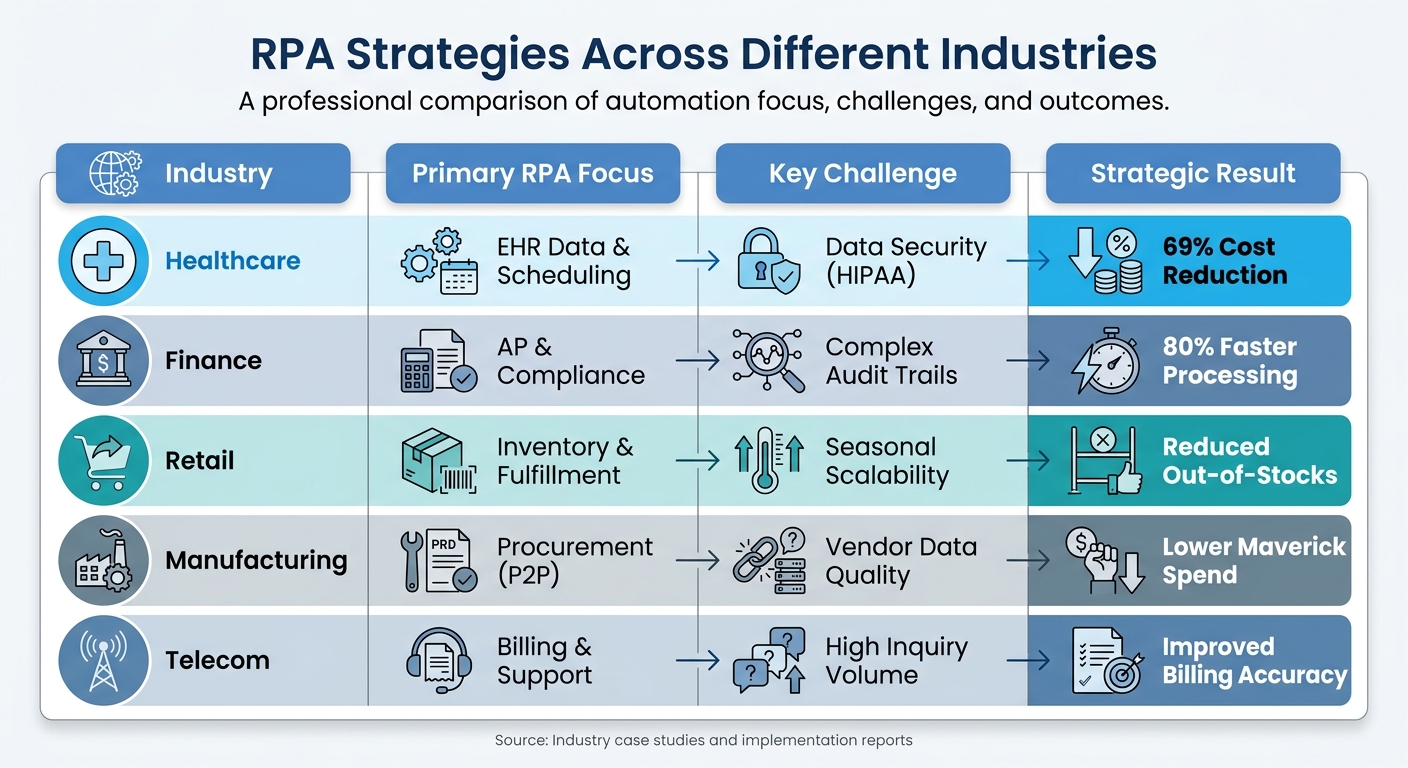
RPA Implementation Strategies Across Five Major Industries
Industries are leveraging Robotic Process Automation (RPA) in tailored ways to tackle their unique challenges, as highlighted by various success stories from startup tech leaders. In healthcare, the focus is on streamlining administrative tasks while navigating legacy systems like Electronic Health Records (EHR). For example, Community Health Choice automated claims processing, saving $9.9 million in labor costs, freeing up 300,000 hours, and reducing costs by 69%. Similarly, Care1st Health Plan Arizona cut claims processing time from 20 seconds to just 3 seconds per claim.
In finance and banking, accuracy and compliance take center stage. BBVA used RPA for tasks like account reconciliation and data verification, reducing processing times by 80%. With strict regulatory requirements such as KYC (Know Your Customer) and AML (Anti-Money Laundering), automation in this sector must also ensure detailed audit trails to meet compliance standards.
The retail industry, on the other hand, focuses on optimizing supply chains. Walmart uses RPA tools for real-time inventory management and purchase order processing, which helps reduce out-of-stock incidents by addressing supply chain issues before they affect customers.
In manufacturing, RPA targets the procure-to-pay (P2P) lifecycle. Sonae Arauco automated over 8,000 hours annually, saving more than €185,000 by improving vendor management and cutting down on "maverick spend" – purchases made outside approved channels. Their treasury team also streamlined monthly report preparation, reducing it from four days to just one, allowing staff to focus on deeper financial analysis.
Meanwhile, telecommunications companies like Telefónica have automated billing and customer inquiries, leading to shorter wait times and more accurate billing.
Industry Strategy Comparison Table
| Industry | Primary RPA Focus | Key Challenge | Strategic Result |
|---|---|---|---|
| Healthcare | EHR Data & Scheduling | Data Security (HIPAA) | 69% Cost Reduction |
| Finance | AP & Compliance | Complex Audit Trails | 80% Faster Processing |
| Retail | Inventory & Fulfillment | Seasonal Scalability | Reduced Out-of-Stocks |
| Manufacturing | Procurement (P2P) | Vendor Data Quality | Lower Maverick Spend |
| Telecom | Billing & Support | High Inquiry Volume | Improved Billing Accuracy |
Successful RPA adoption often begins with high-volume, low-complexity tasks to achieve quick returns. For instance, Tarsus Distribution in South Africa automated vendor invoice data entry, reaching 100% accuracy and processing 76 shipments in just 3 hours – a task that previously took 5 days.
Rosita Jarquín from ICX underscores the importance of RPA in today’s world:
"Understanding the potential of RPA is not just a competitive advantage – it’s a necessity in an increasingly digital world".
Conclusion
Successful founders emphasize the importance of people and processes over technology alone. Time and again, they highlight how strong, unified teams are the backbone of success. This underscores the need for a thoughtful, strategic approach when leveraging automation.
Avoid automating flawed processes. As UiPath’s CPO Param Kahlon wisely points out:
"If the process is ineffective and not optimal and you automate it, you only exacerbate or make the problem worse".
Before deploying automation, take the time to streamline workflows. Start with detailed process mapping and set realistic, achievable goals.
Growth demands discipline. UiPath’s leap from $175 million to $375 million ARR in 2019 came at a cost – a $400 million burn and a 10% workforce reduction. The takeaway? Scale thoughtfully. Implement financial controls, focus on measurable business outcomes, and prioritize cash flow management over unchecked growth.
These insights provide actionable strategies for startup leaders navigating their own journeys.
Final Recommendations for Startup Leaders
Begin with high-volume, low-complexity tasks that can deliver quick, measurable results. Choose flexible, open-source tools to avoid being locked into a single vendor.
Above all, listen to your customers. UiPath achieved a 140% expansion rate by focusing relentlessly on customer feedback rather than chasing technical perfection. Customers don’t care whether you use API-based or UI-based automation – they care that it solves their problems. Focus on addressing real needs, build strong teams, and use RPA to empower your people to focus on strategic, creative work.
FAQs
How do I choose the first processes to automate with RPA?
To begin with RPA (Robotic Process Automation), target tasks that are repetitive, follow clear rules, and occur frequently – think of activities like data entry or processing invoices. Start by reviewing workflows to pinpoint tasks that take up a lot of time or are prone to mistakes. Collaborate with stakeholders to uncover areas where automation could make the most difference. It’s best to start small with straightforward, well-defined processes. This approach helps you gain confidence and demonstrate early wins before expanding automation efforts further.
What should I budget for RPA beyond software licenses?
When planning your budget for RPA, it’s crucial to account for more than just the cost of software licenses. Expenses like IT infrastructure, system integration, continuous maintenance, and tackling implementation challenges can add up quickly. Including these in your financial plan is key to ensuring a smooth and successful RPA rollout.
How can I scale RPA past a few bots without breaking things?
To make RPA growth manageable, aim for a mix of speed and stability. Begin with smaller projects and build up over time, focusing on automating tasks that deliver the most value. Equip your team with the right skills and ensure your infrastructure can handle increased demand. Regularly monitor and fine-tune processes to keep things running smoothly, even as complexity grows. Taking a phased approach with clear planning can help avoid system strain and ensure steady progress.