Struggling to align your tech and business goals? You’re not alone. Misalignment can lead to wasted resources, missed deadlines, and lost revenue. But with a clear tech vision, you can streamline decisions and drive results.
Here’s what you’ll learn:
- How to craft a tech vision that connects daily decisions to long-term business goals.
- The key elements of a strong vision: clarity, focus, and measurable goals.
- Common mistakes to avoid, like vague objectives or chasing trends.
- A step-by-step process to evaluate your current state, identify gaps, and execute effectively.
Quick Stats:
- Only 36.5% of engineering leaders rate their team alignment highly.
- Misalignment can increase deployment rollback rates to 25–30%.
- Aligned organizations reduce downtime by 80% and onboarding timelines by months.
Let’s dive into how you can create a vision that unifies your teams and delivers real business impact.
What Makes a Strong Tech Vision
Understanding Tech Vision
A tech vision acts as a framework connecting technology decisions to business goals, steering daily choices and keeping teams aligned. Think of it as a set of "guardrails" that ensures everyone moves in the same direction without constant oversight.
At its core, a tech vision answers three key questions: Where are we going? (your North Star), Where are we now? (an honest look at your current state), and How do we get there? (a practical roadmap). This structure isn’t just about dreaming big – it’s about staying grounded in reality while charting a clear path forward. Let’s dive into the essential elements that make up this vision.
Core Elements of an Effective Tech Vision
A strong tech vision needs to take a clear stance. It should be opinionated, making deliberate choices – like favoring microservices over monolithic architectures or prioritizing cloud-first solutions. These decisions help avoid endless debates and streamline processes during reviews and design discussions.
It also needs to be memorable and concise. Short, slogan-like statements work best because they stick. For example, when Policygenius crafted their technical vision in 2021, they included goals like "building for 10x scale." This simple benchmark became a practical tool: after a service failed under 100x its normal load, the team used the "10x" guideline to decide whether it was worth making the system more robust.
Equally important is business alignment. A tech vision must tie directly to business objectives, not just follow industry trends. At Opendoor, VP of Engineering Mark Kinsella aligned their 18-month technical roadmap with the goal of modernizing the home-buying process. The result? They expanded their marketplace from 20 to 45 markets in just one year.
Here’s a quick breakdown of the key components:
| Component | Purpose | Key Characteristics |
|---|---|---|
| Vision | The "What" (Destination) | Long-term (2-10 years), stable, aspirational |
| Strategy | The "Action" (Steps) | Addresses trade-offs, updated every 3-6 months |
| Values | The "Behavior" (Culture) | Guides team actions during execution |
A well-balanced roadmap dedicates 50% to immediate wins, 20% to innovation, and 30% to maintenance. However, even the best plans can falter if certain pitfalls aren’t avoided.
Mistakes to Avoid When Creating Your Tech Vision
While understanding the core elements is crucial, it’s equally important to recognize the common mistakes that can undermine your vision. One major misstep? Creating a vision in isolation. Collaboration is key – engineers, product managers, and business leaders all bring unique perspectives that ensure the vision addresses real challenges. Many tech leaders share similar stories of navigating these collaborative hurdles while building disruptive products.
"Never present a strategy that the group hasn’t heard before." – Lee-Jon Ball, CTO, Easol
Another common error is setting vague goals instead of measurable ones. For instance, saying "we’ll be cloud-first" without defining specifics turns the vision into a buzzword-filled document rather than a practical guide. Clear trade-offs and timelines are essential.
Overlooking your current state is another trap. Before planning for the future, conduct a no-blame assessment of where things stand – whether it’s slow testing processes, tangled dependencies, or technical debt. Skipping this step often leads to visions that sound impressive but fail to address actual problems.
Lastly, avoid the temptation of chasing trends. Jumping into AI or blockchain because they’re popular – without understanding how they solve your organization’s challenges – wastes resources and diverts focus from meaningful work. Your tech vision should drive strategy, not follow the latest hype. By avoiding these pitfalls, you can create a vision that aligns technology with business priorities and sets a unified direction for your organization.
sbb-itb-772afe6
Essential Steps to Building an Aligned IT Strategy
How to Align Your Organization Around a Tech Vision
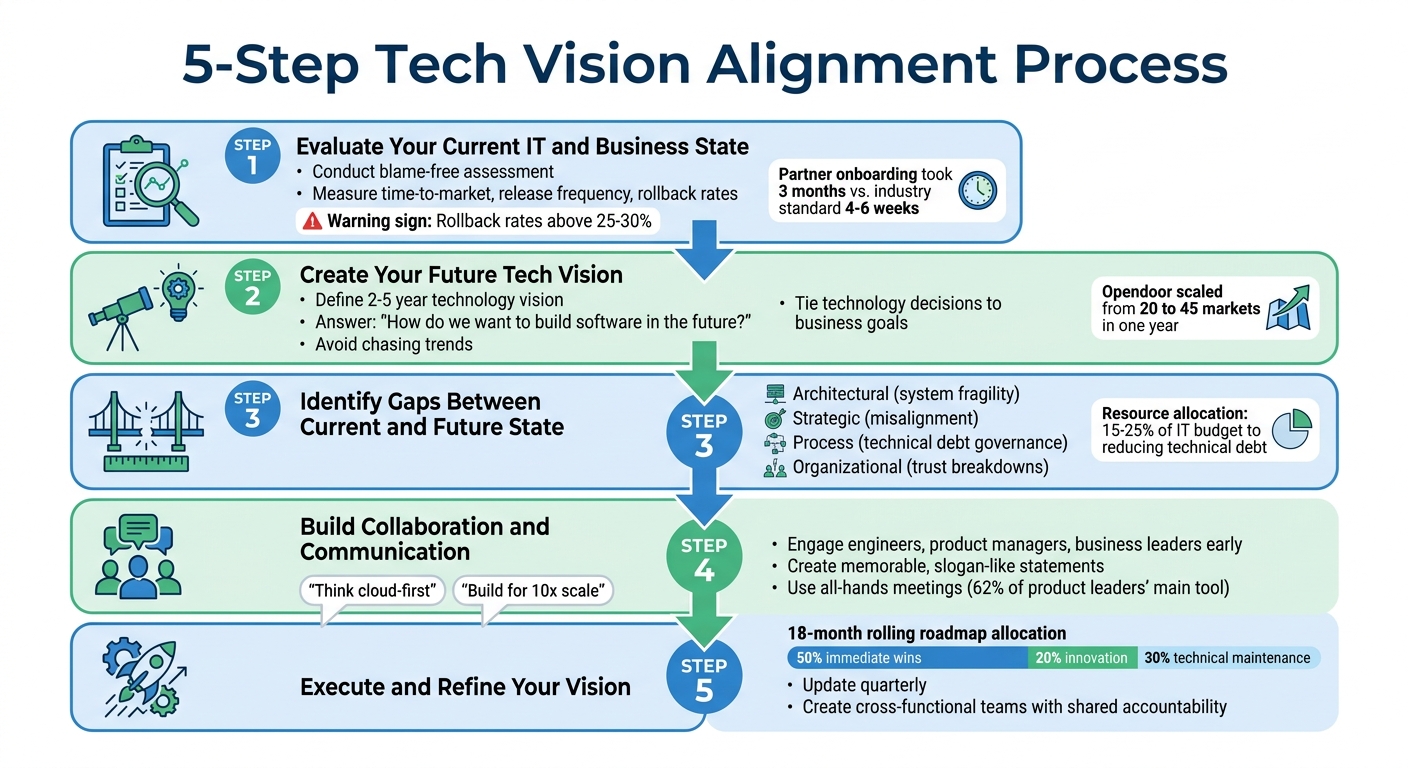
5-Step Tech Vision Alignment Process: From Assessment to Execution
Getting your organization to rally behind a tech vision takes more than just words – it requires thoughtful planning and genuine commitment. Many startup tech leaders emphasize that this alignment is the foundation of scalable growth. Here’s a step-by-step guide to turning that vision into reality.
Step 1: Evaluate Your Current IT and Business State
Start with an honest, blame-free assessment of where things stand. Identify areas where friction exists, such as recurring technical issues or mismatched priorities between teams. Use both numbers and observations to paint a clear picture. For example, measure time-to-market for new features, release frequency, or rollback rates – anything above 25–30% rollback is a warning sign.
Take inspiration from a travel search platform that realized its partner onboarding process took three months, far longer than the 4–6 weeks typical among competitors. By identifying this gap, they set a concrete goal: cut onboarding time to two weeks by the end of 2024 through a technical readiness program.
Step 2: Create Your Future Tech Vision
Using your assessment as a foundation, define a clear vision for how technology will support your business over the next 2–5 years. This vision should answer one key question: How do we want to build software in the future?
Steer clear of chasing trends. Instead, create a framework that ties technology decisions directly to business goals. Be bold and base your vision on proven strategies to guide decision-making when options become overwhelming.
Mark Kinsella, VP of Engineering at Opendoor, developed an 18-month roadmap emphasizing pragmatic automation as a "force multiplier." This approach helped scale their marketplace from 20 to 45 markets in just one year. As Kinsella puts it:
"Your technical vision for the company must stem from the business goals." – Mark Kinsella, Engineering Leader, Opendoor
Step 3: Identify Gaps Between Current and Future State
Break down the gaps between where you are now and where you want to be into four categories:
- Architectural: Issues with system fragility
- Strategic: Misalignment between business objectives and technical capabilities
- Process: Lack of governance over technical debt
- Organizational: Trust breakdowns between departments
Prioritize these gaps using a value-versus-feasibility matrix. Focus on "Quick Wins" that deliver high impact with minimal effort and "Strategic Bets" that, while resource-intensive, offer long-term competitive advantages. Avoid "Passive Investments" that drain resources without meaningful results. High-performing organizations often allocate 15–25% of their IT budgets or sprint time to reducing technical debt.
Once the gaps are clear, shift focus to collaborative strategies that bridge these divides.
Step 4: Build Collaboration and Communication
A vision developed in isolation won’t resonate. Engage engineers, product managers, and business leaders early in the process to ensure the final vision reflects their challenges and goals. Involving stakeholders from the start builds ownership and momentum. Policygenius, for example, engaged "early promoters" during the drafting phase, which helped create buy-in and enthusiasm.
To make your vision stick, craft memorable, slogan-like statements such as "We think cloud-first" or "Build for 10x scale." These serve as daily reminders of the shared mission. Live presentations, like all-hands meetings, are particularly effective – 62% of product leaders use them as their main communication tool for sharing vision. Clear communication ensures alignment across teams and reinforces commitment.
Step 5: Execute and Refine Your Vision
Now it’s time to act. Structure your efforts using an 18-month rolling roadmap. Allocate 50% of resources to immediate wins, 20% to innovation, and 30% to technical maintenance and excellence. Update the roadmap quarterly by retiring completed projects and introducing new priorities.
Create cross-functional teams from Engineering, Product, and Business Development with shared accountability. Breaking down silos is crucial – 54% of organizations cite them as a major obstacle to successful digital transformation.
Track progress with clear metrics. For example, a team at Policygenius faced a 100x load spike that crashed a service. Guided by their "build for 10x scale" principle, they decided not to prioritize reinforcing the service against such an extreme scenario, avoiding unnecessary work.
Case Studies: Tech Vision Alignment in Practice
These case studies showcase how aligning a unified tech vision can produce measurable business outcomes. From startups to large enterprises, the results speak volumes about the power of a shared vision.
Case Study: How a Startup Scaled with a Unified Tech Vision
Sana Labs, led by founder and CEO Joel Hellermark, took a vision-driven approach to develop its AI-powered learning platform. Rather than focusing on small, incremental improvements, the company outlined a long-term goal: creating an AI operating system tailored to personalized learning. To bring this vision to life, Hellermark introduced the "6 years, 6 months, 6 weeks" framework. This method broke down the six-year vision into six-month "big bets", which were then executed in six-week cycles. To test the market before committing significant resources, the team also developed product "trailers" – visual prototypes that encapsulated the full concept.
This strategy paid off. Between 2021 and November 2024, Sana Labs raised $130 million, including a critical $55 million funding round that validated their vision-led approach. Hellermark emphasized the importance of alignment, saying:
"The first goal of a product founder: to align everyone on ‘the cathedral’. And then enable everyone to make those connections to their day-to-day work." – Joel Hellermark, Founder and CEO, Sana Labs
Case Study: Enterprise Tech Vision Alignment
Fujitsu Finland and Estonia faced a different challenge: aligning 2,000 employees around a new strategic vision while boosting operational efficiency. Under the leadership of Chief Strategy and Transformation Officer Mikko Lampinen, the company adopted Objectives and Key Results (OKRs) to link overarching goals with daily tasks. Early on, managers struggled to guide their teams through the transition. To address this, Fujitsu introduced internal "OKR coaches" and focused on simplifying strategic priorities. They also standardized documentation using concise one-pagers for problem statements and value propositions, and six-pagers for technical alignment and launch plans.
The results were striking. Fujitsu saved millions of dollars through automation, improved customer satisfaction scores by 11 points, and saw employee engagement rise in 18 out of 20 areas measured. Reflecting on this journey, Lampinen explained:
"OKRs are more like a mindset shift than a technology project for us." – Mikko Lampinen, Chief Strategy and Transformation Officer, Fujitsu
These examples highlight the impact of a clear, unified tech vision – not only in aligning teams but also in driving tangible business success.
Code Story: Learning from Tech Leaders on Vision Alignment

The Code Story podcast offers a treasure trove of insights from founders, CTOs, and tech leaders who have tackled the complexities of creating and aligning tech visions. Through their experiences, listeners gain practical strategies for overcoming the challenges of organizational alignment.
One key takeaway is the importance of having a clear strategy. Leaders share actionable advice on engaging teams effectively. Dan Lines from LinearB highlights the value of documenting key friction points to design systems and visions that address real bottlenecks. He also underscores the need for clear metrics and OKRs to connect engineering output with business goals.
Bill Vass, CTO at Booz Allen, emphasizes the power of open communication and regular skip-level meetings to maintain alignment as organizations grow. He notes:
"You must also communicate a lot… I do a lot of skip levels, spending time with engineers in charge of specific projects. These creative, ambitious people want to be challenged and inspired by audacious goals."
Another recurring theme is the necessity of making early trade-offs in vision execution. Leaders stress the importance of recognizing when to slow down and redesign system components to prepare for scaling. They also advocate for using storytelling, visual tools, blogs, and social media to engage stakeholders effectively.
Dominic Jacquesson from Index Ventures perfectly captures the balancing act of scaling:
"You want to surf the edge of chaos, with just enough process to stay upright, but not so much that you can’t flex to catch a passing wave."
These perspectives highlight how diverse leadership approaches play a crucial role in maintaining a cohesive and forward-thinking tech vision.
Conclusion
Creating alignment around a shared tech vision isn’t a one-and-done task – it’s an ongoing process of evaluating where you are, building agreement, and executing while keeping an eye on the results. The most effective tech leaders view their vision as a dynamic framework that adapts to changing business needs, not as a static document gathering dust.
A strong vision needs to be both clear and actionable. Instead of lofty, undefined goals, it should outline specific trade-offs to guide day-to-day decisions. For example, a directive like “Build for 10x scale” can help teams prioritize quickly when unexpected challenges arise.
Collaboration plays a key role in creating a vision that sticks. Visions developed in isolation by a single leader often fall flat. On the other hand, those shaped with input from engineers, managers, and other stakeholders from the start are more likely to gain meaningful buy-in. Build on what your teams already do well and expand those successes across the organization. Simple, memorable principles like “Own what you build” can endure through leadership changes and organizational shifts.
It’s also important to connect technical milestones to measurable business outcomes. Every tech goal should directly support a business result – whether that’s cutting downtime during peak traffic by 80% or reducing partner onboarding time from three months to two weeks by the end of 2024. Tech leaders should revisit and fine-tune their vision every five years to ensure it keeps pace with evolving business priorities.
Start with an honest, blameless assessment of your current state, include diverse perspectives, and empower early advocates to champion the vision. These practices will provide the foundation for consistent, forward-looking decisions as your organization grows.
FAQs
Who should own the tech vision?
Senior technical leaders – like CTOs or engineering heads – are typically responsible for shaping the organization’s technology vision. They define the strategic direction for how technology supports business objectives. However, crafting a solid vision isn’t a solo act. It requires close collaboration with key stakeholders, including product managers and business leaders. While the technical leader serves as the main architect of this vision, its success hinges on teamwork and a shared understanding throughout the organization.
What metrics prove tech vision alignment?
Measuring how well your technical direction aligns with strategic business goals is crucial. Key metrics to consider include:
- Clarity of Vision: Does the technical vision serve as a clear framework for making decisions? A well-defined vision helps teams prioritize effectively and stay focused on what matters most.
- Consistency in Decisions: Are organizational choices aligned with the overarching strategy? Consistency reflects how well the vision is integrated into daily operations.
- Team Adherence to Principles: Are teams following the guiding principles laid out in the vision? This shows how deeply the vision is embedded in the company culture.
Other important indicators include:
- Long-Term Scalability: Is the tech direction built to grow with the business over time? Scalability ensures the infrastructure can handle future demands without major overhauls.
- Flexibility with Minimal Interventions: Can the system adapt to changes without requiring constant adjustments? A flexible approach reduces disruptions and keeps things running smoothly.
- Progress on Strategic Goals: Are measurable goals – like infrastructure upgrades or reliability improvements – being achieved? Tracking these milestones highlights how effectively the tech vision supports broader business objectives.
These metrics collectively provide a clear picture of how well the technical strategy aligns with and supports the company’s larger goals.
How often should the tech vision change?
The technology vision needs regular updates throughout its development to stay relevant and aligned with the organization’s objectives. Revisiting and refining drafts ensures it continues to resonate and serves as a strong foundation for growth.