The best founders don’t guess – they listen. Successful product positioning starts with understanding your customers deeply: their problems, workflows, and priorities. This isn’t about features; it’s about solving real pain points. Founders like those featured in startup tech leader interviews at Webflow, Airplane, and Paragon have turned customer research into growth, proving that insights drive results.
Here’s how they do it:
- Talk to customers directly through interviews and surveys to uncover pain points.
- Analyze behavior using product data, beta testing, and social media feedback.
- Refine messaging to match what customers care about most.
- Focus on workflows, not just features, to integrate seamlessly into customers’ lives.
The key? Positioning isn’t static – it evolves with your customers. This continuous feedback loop ensures your product stays relevant and competitive.
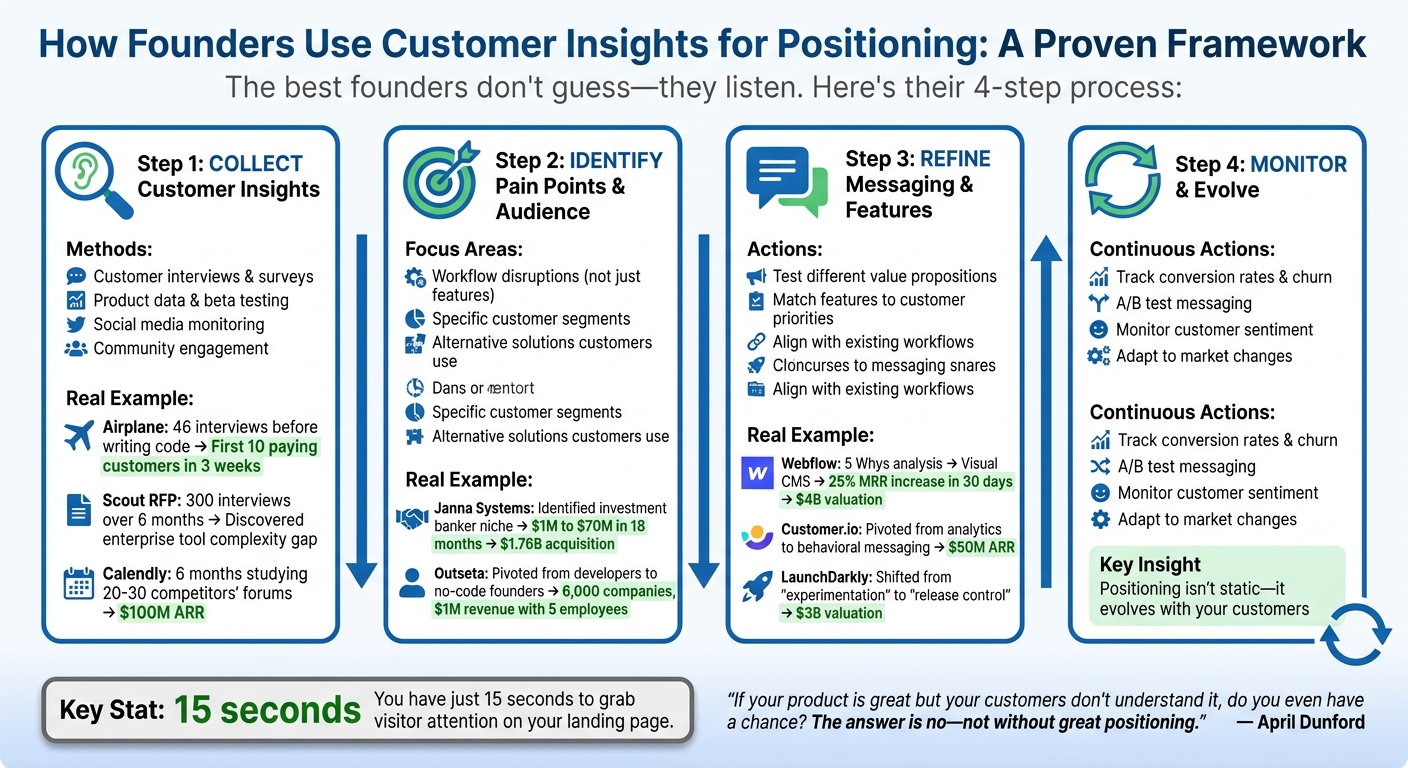
How Founders Use Customer Insights for Product Positioning: 4-Step Framework
B2B Product Positioning: How to Be Certain Your Product Sells
sbb-itb-772afe6
Why Customer Insights Matter for Product Positioning
Customer insights are the backbone of effective product positioning. Positioning is all about defining how your product uniquely addresses a problem that matters to a specific audience. These insights don’t just guide your initial strategy – they also drive ongoing improvements to your product. Without a clear understanding of your customers, you risk creating something no one wants.
The stakes couldn’t be higher. Take Janna Systems, for example. In the early 2000s, this $1M CRM startup was up against industry giant Siebel. By identifying that investment bankers had unique needs for relationship mapping – something general CRMs didn’t address – they repositioned as a "CRM for Investment Bankers." This laser focus on a niche pain point skyrocketed their revenue to $70M in just 18 months and led to a $1.76B acquisition.
Customer insights help founders zero in on the most pressing challenges their buyers face. This understanding also reveals what customers would turn to if your product didn’t exist, allowing you to highlight how your product stands out from the competition.
Finding Customer Needs and Pain Points
Uncovering customer pain points is the difference between guessing and crafting a winning strategy. The best founders, as heard on the Code Story podcast, don’t just gather feedback – they actively search for the most critical problems disrupting their customers’ workflows.
A great example is Airplane. In 2021, founders Josh Ma and Ravi Parikh interviewed 46 engineers and engineering managers before writing a single line of code. They discovered a recurring issue: engineers running scripts from their laptops were causing database outages. This specific problem became the cornerstone of their positioning strategy. By July 2021, they had their first 10 paying customers within three weeks of launching their paid tier. Later, they shifted focus to highly regulated sectors like fintech and healthcare, where compliance-related internal tools were in high demand, eventually reaching 7-figure ARR.
The key is to understand pain points within the context of the customer’s workflow, not just as missing features. Positioning influences everything from pricing to promotional strategies and product placement. When you know what truly frustrates your customers, you can create a message that resonates instantly.
Defining the Target Audience
Customer insights also uncover who truly values your product – and it’s often not who you initially expect. Outseta, for instance, spent a year targeting developers who preferred building their own solutions. But they soon realized that no-code founders appreciated their all-in-one platform much more. This shift unlocked growth to 6,000 companies and nearly $1M in revenue with just five employees.
"SaaS positioning must match buyer capability: Outseta’s all-in-one value proposition fell flat with developers who could build their own stack, but resonated deeply with no-code founders."
– Geoff Roberts, Co-founder, Outseta
Rather than focusing on broad roles, effective audience definition zeroes in on specific traits and behaviors. April Dunford suggests segmenting by characteristics like "small teams with a DIY mindset" instead of generic categories. This level of precision allows you to craft messaging that directly speaks to how these groups operate and what they value.
Building Value Propositions with Customer Feedback
Strong value propositions align your product’s benefits with real customer needs. In 2012, Colin Nederkoorn, co-founder of Customer.io, pivoted the company from a website analytics tool to a behavioral messaging platform. Customer feedback revealed that users were overwhelmed by analytics data but lacked tools to act on it. The new value proposition focused on helping SaaS companies convert free users to paid ones by triggering targeted emails based on user behavior. This pivot helped the company scale to $50M ARR.
The best value propositions integrate seamlessly with existing workflows rather than forcing customers to change how they work. For example, Airplane’s founders realized developers preferred tools that felt familiar, like GitHub or code reviews, over drag-and-drop interfaces. By aligning their product with these preferences, they minimized friction and encouraged adoption.
LaunchDarkly faced a similar challenge. They initially promoted "experimentation", but customer feedback revealed that users were struggling with basic "release process" issues. Refocusing their message on release control helped them connect with their audience, eventually scaling the company to a $3B valuation.
How Founders Collect and Analyze Customer Insights
When it comes to refining product positioning, successful founders rely on startup tech leaders’ stories and solid methods of gathering and analyzing customer data. Instead of making guesses, they systematically collect insights before even starting to build. The techniques they use can be the difference between creating something customers genuinely need or wasting time on unnecessary features. These approaches allow for constant refinement, ensuring decisions are based on real data.
Running Customer Interviews and Surveys
Talking directly to customers often reveals details that data or surveys alone can’t uncover. For example, between 2014 and 2015, Alex Yakubovich from Scout RFP conducted interviews with 300 procurement professionals over six months before writing any code. By analyzing their responses across industries like manufacturing, finance, and government, they discovered that although enterprises had tools like SAP and Oracle, usage was low because of their complexity. This realization led them to launch a simple, one-page MVP priced at $89/month.
The trick to effective interviews is asking the right questions. Avoid vague questions like, “Would you use this?” or “How much would you pay?” People aren’t great at predicting their future actions. Instead, focus on their past experiences with questions such as, “Tell me about the last time X happened,” or “What are you currently paying to solve this problem?”.
"The number 1 rule of customers is that they don’t buy products. Customers buy solutions to problems."
– Justin Wilcox, Founder, Customer Dev Labs
Surveys, on the other hand, work best to validate patterns you’ve already identified through interviews. While they’re quick and quantitative, they can sometimes lead to misleading results, like “false positives,” if respondents rush through or misunderstand questions. Use surveys to confirm insights, not as your starting point.
Using Product Data and Beta Testing
Metrics from product usage show how customers behave, which often differs from what they claim they’ll do. Monitoring your MVP’s performance – through metrics like daily active users (DAU), churn rates, or your “North Star” metric – can help identify whether you’ve hit product-market fit. Tools like Hotjar provide session recordings and heatmaps to study user behavior, while platforms like Intercom can highlight messaging issues through chat logs.
Before committing to new features, founders can test demand using creative approaches. For instance, “Fake Door” experiments involve running ads for features that don’t yet exist to gauge interest. Similarly, “Wizard of Oz” tests allow teams to manually perform tasks that will later be automated. Paragon’s founders, Brandon Foo and Ishmael, conducted over 100 customer interviews, using mockups and pricing experiments (ranging from $30 to $100) to assess pain points before pivoting to their embedded integration platform.
To measure product-market fit, many founders turn to the Sean Ellis question: “How disappointed would you be if you could no longer use this product?”.
Monitoring Social Media and Community Engagement
Online platforms often provide unfiltered insights into customer opinions. Calendly’s founder, Tope Awotona, spent six months studying 20–30 competitors and their user forums. He noticed that most tools were designed for brick-and-mortar businesses like salons, leaving casual schedulers such as sales reps underserved. By focusing on this overlooked group and enhancing the invite recipient’s experience, Calendly grew to approximately $100 million in annual revenue.
"I pay more attention to what people have already done or are doing, than what they say they’ll do. In other words, I care less about interviewing people and asking them, do you want a new scheduling tool? … What I pay more attention to is the fact that… there were products on the market. And that’s the best validation."
– Tope Awotona, Founder, Calendly
AI and Natural Language Processing (NLP) tools can also analyze customer feedback, reviews, and social media discussions to uncover emotional triggers and brand sentiment. Resources like Google Trends or the “People Also Ask” section on Google can reveal customer concerns, such as “is X safe for babies,” helping founders focus on trust and safety. These tools complement direct feedback by capturing what customers are talking about when you’re not in the room.
Using Customer Insights to Refine Product Positioning
Gathering customer data is just the starting point. The real challenge lies in using that information to refine how your product is presented. By continuously analyzing customer insights, founders can adjust their messaging, tweak product features, and shape how the market perceives their offering. Positioning isn’t a one-time task – it’s an evolving process that helps identify what resonates and what doesn’t. The best founders treat every piece of feedback as an opportunity to test, improve, and fine-tune their message.
Testing and Improving Messaging
Great messaging doesn’t happen by accident – it’s the result of deliberate and systematic testing. When customers ask for specific features, their surface-level requests often mask deeper needs. Bryant Chou, co-founder of Webflow, explains:
"Customer feedback is almost superficial. You have to really engage and understand exactly what the customer needs, and really go down to their root pain points before you go into action."
Webflow discovered this firsthand. Using a 5 Whys analysis, they uncovered a demand for a visual CMS. This insight led to a messaging shift that boosted their monthly recurring revenue by 25% within just 30 days of launching the feature in October 2015.
Testing different messaging approaches can reveal what truly connects with your audience. For instance, Airplane refined its pitch to target fintech and healthcare companies, industries where regulatory requirements made internal tools essential. This targeted messaging helped them land their first five major customers, each at a $20,000 annual contract value.
Similarly, Colin Nederkoorn of Customer.io found that while early users felt overwhelmed by data, they were looking for tools to influence customer behavior, not just track it. Reflecting on this, Nederkoorn shared:
"Over the long run, the quality of our product became much greater than the story we were telling about it."
By testing this new narrative with a small group of companies paying $10 per month, Customer.io laid the groundwork to scale to $50 million in annual recurring revenue. Once messaging is validated, founders can align product features with the specific needs they’ve identified.
Matching Features with Customer Priorities
Understanding what customers say they want versus what actually makes an impact is crucial. In September 2025, Typeform’s CPO Aleks Bass tackled this challenge by conducting a MaxDiff survey of 86 potential features. The results showed that about 75% of features were equally desired across customer segments. To address this, he introduced a "Feature Constellation" framework, bundling complementary features – like pairing "Video Answers" with "AI Analysis" – to create complete workflows. This approach delivered outcomes that customers valued five to ten times more than standalone features.
Designing features that align with your audience’s existing workflows is equally important. Airplane’s founders, for example, opted for an IDE-like experience instead of a drag-and-drop builder, appealing to developers familiar with tools like GitHub. Bryant Chou highlights the importance of balancing commercial appeal with product identity:
"The most obvious things to build commercially are not the most obvious things to build from a product brand perspective."
Take Webflow’s decision to develop a visual CMS. While customers frequently requested a WordPress integration, the team realized the real need was for a way to manage dynamic content visually. This insight led to a groundbreaking product that played a key role in Webflow’s $4 billion valuation. By consistently monitoring customer sentiment, founders can ensure their positioning stays relevant.
Monitoring Customer Sentiment Over Time
Positioning isn’t a set-it-and-forget-it exercise. Markets evolve, competitors adapt, and customer expectations shift. Founders who treat positioning as an ongoing process can stay ahead by tracking both quantitative metrics (like conversion rates and churn) and qualitative feedback (such as recurring themes in support tickets).
Steve Blank, entrepreneur and educator, stresses the importance of direct exposure to customer data:
"If you can’t get the leaders outside to hear that data firsthand…then you’re on a sinking ship."
This direct engagement allows leaders to make quick adjustments, often validated through conditional purchase orders where customers commit to buying if specific features are delivered.
Major companies have shown how adapting to customer needs can drive success. Microsoft shifted its focus to cloud computing, emphasizing Azure and Office 365, while Adobe transitioned from packaged software to a subscription model with Creative Cloud. These changes weren’t immediate but were informed by careful monitoring of customer trends. As Ashley Wood, Head of Product Marketing at LANDR Audio, explains:
"Your products are evolving, your competitors are evolving, and more importantly, your users are evolving. It’s possible that you outgrow your messaging."
Founders often use A/B testing to refine their positioning based on real-world responses to website content, ad campaigns, and email messaging. They also distinguish between two types of insights: "evaluative" insights, which test if an idea works, and "generative" insights, which uncover entirely new opportunities. This constant feedback loop ensures their messaging stays sharp as the market landscape changes.
Conclusion
Product positioning isn’t a one-time effort – it’s a continuous process. Markets change, competitors adjust, and customer needs shift over time. Founders who stay connected with their customers are the ones who create products that stand the test of time. As April Dunford aptly states:
"If your product is great but your customers don’t understand it, do you even have a chance? According to April Dunford, the answer is no – not without great positioning."
This highlights a critical truth: consistent customer engagement is the key to effective positioning. Your customers hold the insights you need, but it’s up to you to listen and act on them.
To keep your positioning relevant, use tools like customer interviews, beta testing, and A/B experiments. These methods help you stay aligned with what matters most to your audience. And remember, you’ve got just 15 seconds to grab a visitor’s attention on your landing page. Make those moments count by refining your messaging based on real feedback and conversion data.
Stay proactive – engage with your customers regularly, observe how they interact with your product, and understand their most pressing challenges. This ongoing dialogue ensures your positioning evolves alongside their needs, setting you up for long-term success.
FAQs
How many customer interviews do I need?
Founders often need to conduct hundreds of customer interviews to nail down product-market fit. Take Scout RFP as an example – they connected with over 200 procurement professionals before even starting to build their product. This kind of deep research is key to creating something that truly meets customer needs and expectations.
What questions should I ask in interviews?
When you’re conducting interviews, the goal is to dig deep into your customers’ real needs and challenges. Asking the right questions can make all the difference. Here are a few examples to guide your conversations:
- "Can you describe the challenges with your current solution?"
- "What problems are you trying to solve?"
- "What does an ideal solution look like?"
- "What frustrates you about your current process?"
These kinds of questions help you move beyond surface-level insights, validate your assumptions, and refine your product positioning to align with what your customers truly need.
How do I test positioning fast?
To quickly evaluate your positioning, dive straight into conversations with your target customers. Conduct interviews and gather feedback early and often to identify pain points and fine-tune your messaging. Entrepreneurs like Brandon Foo and Josh Ma highlight the importance of rapid iteration: collect insights, adjust your positioning, and test again. This method allows you to validate your approach efficiently, avoiding the need for large-scale launches while ensuring your product resonates with customer needs.