Tech leaders face constant decision-making challenges, from hiring to product strategy. Without a clear system, this can lead to stress and inefficiency. The key is balancing speed with thoroughness. Here are six frameworks to help you make better decisions:
- Jason Warner Diamond: Balances top-down strategy with team-driven execution. Ideal for scaling or crisis situations.
- Eisenhower Matrix: Categorizes tasks by urgency and impact, helping prioritize effectively.
- 6-P Framework: A structured process for complex, high-stakes decisions involving multiple teams.
- Decision-Guiding Principles (Stripe‘s Approach): Uses clear principles for decentralized, fast decision-making.
- Benefits-Costs-Mitigations Matrix: Focuses on risks and solutions, great for reversible decisions.
- A/B Testing Framework: Data-driven experiments to resolve team disagreements quickly.
Each method fits specific scenarios, from tactical to strategic decisions. The right framework ensures clarity, speed, and alignment across teams.
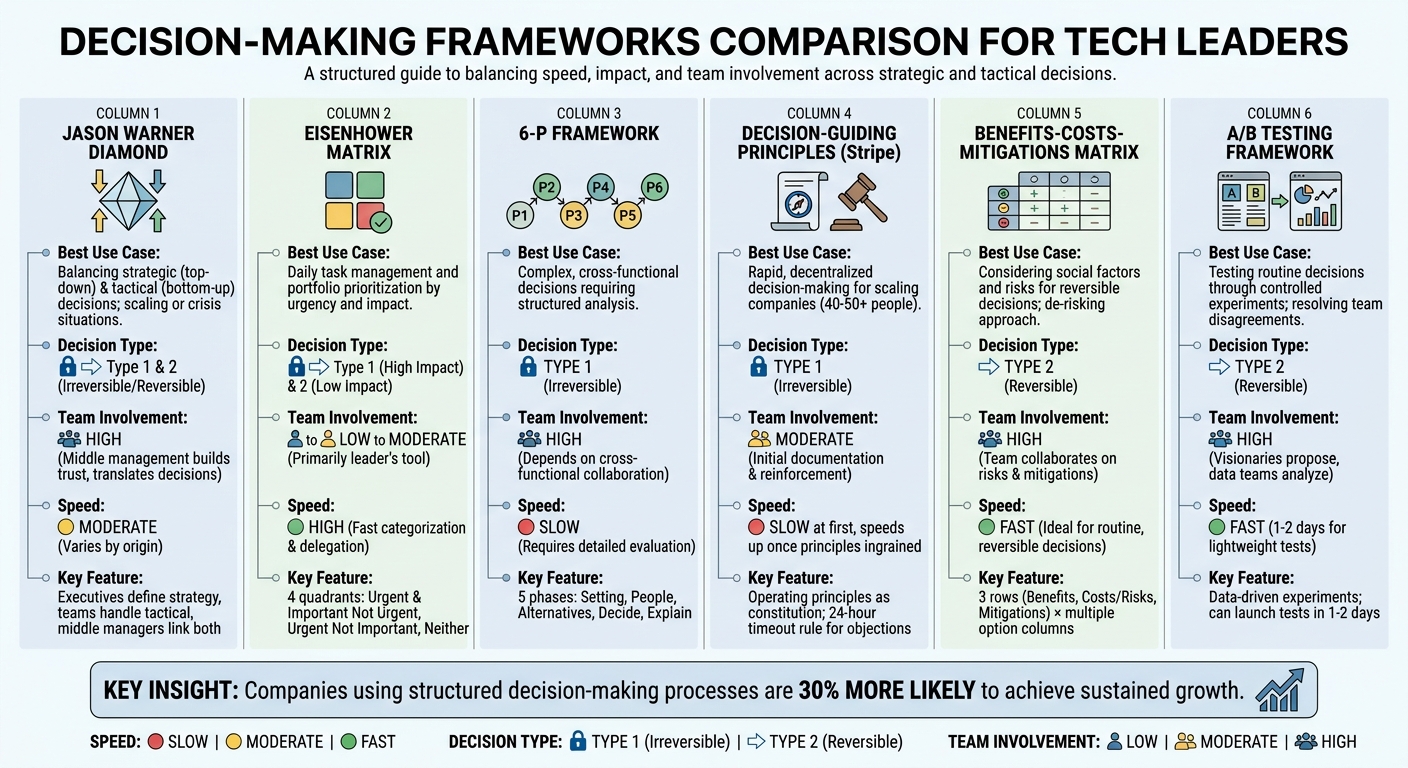
Decision-Making Frameworks for Tech Leaders: Complete Comparison Guide
How Leaders Make Decisions Faster: 4 Simple Frameworks
For more leadership perspectives, explore our startup tech leader interviews.
sbb-itb-772afe6
1. Jason Warner Diamond
The Jason Warner Diamond framework tackles the challenge of balancing centralized control with decentralized flexibility. Instead of forcing leaders to pick between top-down or bottom-up decision-making, it introduces a diamond-shaped authority structure that integrates both approaches.
Here’s how it works: executives define the overall strategy, while teams handle tactical and experimental decisions. Middle managers play a critical role as the link between these layers, turning executive strategies into actionable plans and ensuring team initiatives align with broader company objectives.
"Most decision-making happens in the middle of the org. Embrace this to scale faster." – Jason Warner
This setup avoids executive bottlenecks by clearly defining decision-making responsibilities. Executives focus on high-level strategy, while middle managers and teams handle operational and tactical decisions. The key to making this work? Trust at every level.
Best Use Case
The Diamond framework is particularly useful for companies undergoing rapid growth or navigating a crisis. It’s especially effective for engineering leaders who need to clarify decision-making roles across various levels while ensuring both speed and strategic alignment.
Decision Type
This framework divides decision-making into two main categories:
- Strategic decisions: Handled by executives.
- Tactical and experimental decisions: Managed by teams, with middle managers ensuring alignment.
Team Involvement Level
High involvement across all levels is crucial. Executives must trust middle managers to take the lead on decision-making, while teams need the freedom to experiment and take risks within clearly defined boundaries.
Speed of Application
Designed for fast-paced scenarios like scaling or crisis management, the Diamond framework allows organizations to respond quickly to changes. By decentralizing tactical decisions and empowering middle managers, companies can act with agility while staying strategically aligned.
This structured approach strikes a balance between decisive leadership and flexible execution, making it a powerful tool for navigating complex challenges.
2. Eisenhower Matrix (Reversibility vs Impact)
The Eisenhower Matrix organizes tasks into four quadrants based on urgency and impact. In fast-paced tech settings, this tool helps leaders evaluate whether a decision can be easily reversed or if it carries long-term consequences.
Here’s how the quadrants break down:
- Quadrant 1 (Urgent & Important): Tasks that demand immediate attention, like fixing a production bug affecting 30% of users or preparing a board presentation due tomorrow.
- Quadrant 2 (Important, Not Urgent): Long-term initiatives such as user research or system architecture planning.
- Quadrant 3 (Urgent, Not Important): Routine tasks that can be delegated.
- Quadrant 4 (Neither): Low-value distractions that should be eliminated.
This framework helps leaders separate urgent, short-term fixes from long-term strategic priorities, enabling them to make better decisions under pressure.
The real strength of the matrix lies in carving out time for Quadrant 2 work. Studies show that prioritizing strategic, non-urgent tasks can lead to greater success over time. Dwight D. Eisenhower captured this idea perfectly: “What is important is seldom urgent and what is urgent is seldom important”. Blocking 2–3 hours daily for these high-value tasks allows leaders to avoid falling into a constant firefighting mode.
Best Use Case
The Eisenhower Matrix shines in daily task management and portfolio prioritization. Many companies have used it to streamline workflows and improve efficiency. For example, it’s an excellent tool for sorting through product backlogs and reducing the distractions caused by frequent context-switching. Its ability to combine tactical triage with strategic focus makes it a versatile decision-making aid.
Decision Type
While it’s primarily a tactical tool for managing daily priorities, the matrix also supports strategic planning by preserving time for impactful activities. To apply it effectively, use the Two-Test Rule: ask if a task has a hard deadline within 48 hours (urgency) and whether it directly contributes to one of your top three quarterly OKRs (importance). This approach prevents Quadrant 1 from becoming a catch-all for every seemingly urgent matter.
Team Involvement Level
Although the matrix is a powerful tool for individuals, it works best when entire teams align on priorities. Many tech leaders hold weekly 15-minute “Monday Triage” sessions to collaboratively sort tasks and agree on what’s truly important. For instance, Gil Shklarski, CTO at Flatiron Health, used the matrix to clarify decision-making during the company’s rapid growth from 4 to 135 employees.
Speed of Application
With clear criteria, tasks can be sorted in under 10 seconds. Delegating Quadrant 3 tasks with an 80% completion target frees up senior leaders to focus on critical Quadrant 2 challenges. Limiting each quadrant to fewer than 10 items ensures the matrix remains manageable and effective.
3. 6-P Framework
The 6-P Framework is a structured approach to decision-making that helps teams align on critical choices while scaling effectively. By creating a shared decision-making process, it builds trust and ensures execution stays on track, all while relying on data to guide the way.
What makes this framework stand out is its clear timeline, broken into five phases: Setting (defining the problem), People (assigning decision-making roles), Alternatives (evaluating potential options), Decide (selecting the best path), and Explain (communicating the reasoning behind the decision). It avoids decision paralysis by clarifying who provides input and who has the final say, eliminating the confusion that often stalls progress.
Best Use Case
The 6-P Framework shines in situations where "visionary" and "data-driven" perspectives clash or when reaching consensus feels impossible. It’s particularly effective for decisions that have long-term implications and require buy-in from multiple teams or leadership levels.
Decision Type
This framework is best suited for strategic, high-stakes decisions. For simpler, routine decisions, a less complex approach might be more practical.
Team Involvement Level
For the 6-P Framework to work, roles must be clearly defined. The Driver ensures the process moves forward, the Approver has the final authority, and Contributors bring their specialized expertise to the table. This role clarity keeps the process efficient, avoids bottlenecks, and ensures that every relevant voice is heard without slowing down progress. It complements other methods by reinforcing execution and preventing delays.
Next, we’ll dive into another tool that addresses decision-making urgency and impact.
4. Decision-Guiding Principles (Stripe‘s Approach)
Stripe has a structured decision-making framework that relies on clear operating principles to guide teams. Instead of relying on founders to make every call, these principles translate abstract values into actionable behaviors. For instance, the "Users First" principle ensures that every employee, including engineers, directly engages with users – not just the customer support team.
The framework emphasizes evidence over gut feelings. Teams are encouraged to ask, "What do we know?" before considering, "What do we think?" Strategic decisions are treated as experiments, often validated through A/B testing or pilot programs before full-scale implementation. A real-world example of this was between 2017 and 2018 when Stripe’s enterprise sales team lost eight deals in a row. Despite achieving "technical wins", these losses sparked a data-driven reevaluation of their pricing strategy for mid-market and enterprise clients.
"Operating principles really as the constitution versus the law… they should help [future leaders] decide what to do and what not to do, but most importantly, it will help them decide how to do it."
- Claire Hughes Johnson, Former COO, Stripe
Stripe also uses a binary delegation model to avoid micromanagement, allowing leaders to step in only when absolutely necessary. To maintain balance between speed and collaboration, they apply a "24-hour timeout" rule: if no objections are raised within 24 hours after a plan is proposed, the team moves forward. This method ensures quick, decisive action while keeping everyone aligned in a fast-paced tech environment. These principles allow Stripe to scale effectively while maintaining cohesion across teams.
Best Use Case
This framework works particularly well for scaling companies, especially when a business grows beyond 40–50 people and founders can no longer oversee every decision. It provides decentralized guidance that aligns with long-term objectives, such as Stripe’s mission to "increase the GDP of the internet." It’s especially effective in industries with high technical demands and rapidly changing market dynamics.
Decision Type
The framework supports both strategic and tactical decisions. Strategic decisions focus on long-term alignment, while tactical ones handle daily trade-offs between speed and quality. For reversible decisions – often called "two-way door" choices – the framework encourages quick action. For irreversible "one-way door" decisions, it requires more detailed analysis and evidence to ensure the best outcome.
Team Involvement Level
High levels of team involvement are integral to this approach. Operating principles are collaboratively developed and integrated into processes like hiring and performance reviews. Decisions frequently involve cross-functional teams from departments like Finance, Product Marketing, Product, and Sales. For example, when Stripe entered the Japanese market in late 2014, the company delayed its launch to establish a multi-currency partnership with a local card provider, ensuring the platform met the specific needs of Yen-based transactions.
Speed of Application
The framework accelerates reversible decisions through rapid experimentation while using structured reviews for irreversible ones. This balance between speed and thoroughness allowed Stripe to scale from a 160-person company in 2014 to over 1,500 employees by 2024 – all while maintaining operational efficiency.
Next, let’s dive into a cost-benefit approach that sharpens executive decision-making even further.
5. Benefits-Costs-Mitigations Matrix
The Benefits-Costs-Mitigations Matrix takes decision-making a step further by explicitly addressing risks and their solutions. Instead of debating which option is safer, this framework shifts the focus to a more practical question: "How do we de-risk this?" Gil Shklarski, CTO at Flatiron Health, aptly describes it as "Xanax for decision-making", as it encourages a structured, calmer approach to tough choices.
The matrix breaks down each decision into three key rows: Benefits, Costs/Risks, and Mitigations, while each column represents a different decision option. This setup transforms objections into actionable steps. For instance, if the concern is a lack of engineering resources, solutions like piloting the idea or setting up a rollback plan can address the issue. Instead of "we can’t", the conversation becomes "here’s how we can."
"The exercise allows everyone on the team to put their fears, hopes and concerns into the decision-making process, and see them taken seriously as important factors." – Gil Shklarski, CTO, Flatiron Health
The matrix doesn’t just focus on technical risks; it also considers social dynamics like team morale, visibility across teams, and stakeholder concerns – factors that often get overlooked. To ensure balanced participation and a safe environment for sharing ideas, a facilitator should guide the process. If the analysis uncovers a less risky alternative, it can be added as a new column, avoiding a binary "this or that" decision.
Best Use Case
This tool shines in fast-paced tech environments where decisions need to be made quickly but thoughtfully. It’s ideal for tactical, reversible choices – like deciding on architecture changes or selecting tools – especially when opinions within the team are sharply divided.
Decision Type
The matrix is tailored for Type 2 decisions, which are reversible and should be handled locally without overcomplicating the process. While it can be adapted for more permanent decisions, those situations often require deeper analysis, broader input (like board-level discussions), and a thorough investigation of underlying issues.
Team Involvement Level
Collaboration is key. The matrix thrives on input from multiple perspectives, requiring cross-functional teams to assess costs accurately and brainstorm mitigations. Tools like shared documents or whiteboards help ensure transparency and give everyone a chance to contribute equally.
Speed of Application
This framework is designed for quick alignment, making it perfect for fast-moving environments where time is of the essence. It helps teams avoid getting stuck in endless debates while ensuring that every stakeholder’s voice is heard, striking a balance between swift decisions and thoughtful analysis.
6. A/B Testing Framework
The A/B Testing Framework takes the guesswork out of product decisions by relying on data rather than gut feelings or office politics. It’s especially helpful when visionary thinkers and data-driven team members clash over which direction to take. Instead of choosing sides, leaders can test both ideas and let user feedback determine the winner.
Take, for example, Elliot Shmukler’s experience as VP of Product at LinkedIn in 2014. His team faced a disagreement: visionary product managers wanted to tweak the homepage language, while data-focused managers doubted it would make any difference. Instead of making a judgment call, the team set up a test in just two days and collected data over a month. The results? No measurable impact. This allowed the visionary managers to adjust their approach without causing tension or resentment.
As Shmukler puts it:
"Instead of giving a verdict, test both theories and let data be the judge." – Elliot Shmukler, VP of Product, Instacart
This framework transforms subjective arguments into objective experiments. At Dropbox, for example, the growth team tested removing a single field from the onboarding form. The project took only three days to implement and resulted in an 8% increase in sign-ups. The secret? Quick execution (1–2 days for smaller tests) paired with gathering enough data to ensure reliable results.
Best Use Case
This method shines when teams need to reconcile differing opinions without causing political friction. It’s like saying "yes" to multiple ideas and letting the data decide which one works best. It’s particularly effective when there’s enough user traffic to generate statistically meaningful results.
Decision Type
A/B testing works best for Type 2 decisions – the kind you can easily reverse, like flipping a switch to turn off the "B" version. If you find it hard to design a test or roll back a change, you’re probably dealing with a Type 1 decision, which requires a more careful approach.
Team Involvement Level
Collaboration is key. Visionary team members bring creative ideas and alternative versions to the table, while data-driven members design experiments and analyze the results. This fosters a culture of "strong opinions, held weakly", where decisions are shaped by evidence, not egos. Automated dashboards with clear "red" or "green" indicators ensure everyone interprets the results the same way.
Speed of Application
This framework is built for speed. Lightweight tests can often be launched within 1–2 days, though gathering enough data for reliable results may take weeks, depending on traffic volume. For teams operating in fast-paced environments, this approach provides a quick, data-backed way to resolve disputes and move forward confidently. It’s perfect for leaders who need to make decisions quickly while staying grounded in user insights. Many startup tech leaders use similar data-driven approaches to scale their products.
Framework Comparison Table
The table below provides a side-by-side comparison of different decision-making frameworks, highlighting their best applications, decision types, team involvement, and speed of use. This can help you determine which approach aligns with your needs.
| Framework | Best Use Case | Decision Type | Team Involvement | Speed of Application |
|---|---|---|---|---|
| Jason Warner Diamond | Balancing strategic (top‐down) and tactical (bottom‐up) decisions while empowering the middle to execute actions | Type 1 (irreversible) and Type 2 (reversible) | High – middle management translates decisions and builds trust | Moderate – varies depending on decision origin |
| Eisenhower Matrix (Reversibility vs. Impact) | Prioritizing and categorizing decisions by their impact and reversibility | Type 1 (high impact, hard to reverse) and Type 2 (low impact, easy to reverse) | Low to moderate – primarily a leader’s prioritization tool | High – enables fast categorization and delegation |
| 6-P Framework | Addressing complex, cross-functional decisions that require structured analysis | Type 1 (irreversible) | High – depends on cross-functional collaboration | Slow – requires detailed evaluation |
| Decision-Guiding Principles (Stripe’s Approach) | Developing guiding principles for rapid, decentralized decision-making once internalized | Type 1 (irreversible) | Moderate – involves initial documentation and reinforcement | Slow at first, but speeds up once principles are ingrained |
| Benefits-Costs-Mitigations Matrix | Considering social factors and risks for decisions that can be adjusted later | Type 2 (reversible) | High – team collaborates to identify risks and mitigation strategies | Fast – ideal for routine, reversible decisions |
| A/B Testing Framework | Testing routine decisions through controlled experiments | Type 2 (reversible) | High | Fast |
The right framework depends on the nature of the decision. High-stakes decisions often require a structured, collaborative approach, while routine or reversible decisions benefit from quicker, data-driven methods.
Conclusion
As highlighted earlier, aligning the decision-making tool to the specific challenge at hand is key. The goal isn’t to choose the most popular framework but to select one that addresses the problem effectively. Whether the issue is stakeholder indecision, unclear ownership, or analysis paralysis, the right framework can help break through these obstacles. In fact, companies that use structured decision-making processes are 30% more likely to achieve sustained growth. This method helps streamline decisions across strategic, tactical, and reversible scenarios, especially in fast-moving tech environments.
Knowing when to act quickly versus taking a more deliberate approach is equally important. For reversible decisions, aim to move forward with about 70% of the information – waiting for near-perfect clarity often results in unnecessary delays. On the other hand, irreversible decisions demand more thorough analysis and careful planning.
"The art of decision-making isn’t always about capturing some elusive ‘best’ decision – it’s about making the most of information available, garnering trust across stakeholders and executing with conviction." – First Round Review
To put these ideas into action, start by classifying the decision. Ask yourself: Is this reversible without significant cost? If yes, prioritize speed. If no, assign clear accountability – consider models like DACI or appointing a Directly Responsible Individual to avoid bottlenecks. Lastly, document the reasoning behind your choices to avoid revisiting the same debates in the future.
FAQs
How do I choose the right framework for a decision?
To choose the best decision-making framework, think about how complex the decision is, how quickly it needs to be made, and whether it can be reversed. For instance, Amazon’s "One-Way vs. Two-Way Door" framework is great for determining if a decision allows for quick adjustments or if it has lasting consequences. The OODA Loop is ideal for fast-changing environments, while First Principles Thinking is perfect for dissecting and solving complicated issues. Align the framework with the decision’s scale and potential effects to ensure a clear and flexible approach.
How can I tell if a decision is reversible or irreversible?
A reversible decision is one you can change or adjust without much trouble – think of it like walking through a door that swings both ways. On the other hand, an irreversible decision is much tougher, or even impossible, to undo – more like stepping through a door that only opens in one direction. These one-way decisions demand more thought and deliberation before taking action.
What’s the fastest way to align a team when opinions clash?
A structured decision-making framework can bring much-needed clarity and alignment to teams. Methods like DACI or RAPID assign specific roles – such as Driver, Approver, and Contributor – so everyone knows exactly what part they play in the process. This eliminates confusion and ensures smoother collaboration.
Another helpful strategy is separating decisions into two categories: reversible and irreversible. Amazon’s ‘One-Way vs. Two-Way Door’ method is a great example. It encourages teams to move quickly on low-risk, reversible decisions while taking more time to carefully evaluate choices with long-term consequences. This approach minimizes delays and keeps everyone on the same page.