
Managing domain names has transformed dramatically since the early days of the internet. Here’s the quick takeaway: domain management is about more than just owning a web address – it’s about security, performance, and brand protection.
Key Points:
- Origins: Early internet naming relied on a centralized text file, HOSTS.TXT, which became unmanageable as networks grew.
- DNS Creation (1983): Paul Mockapetris introduced the Domain Name System (DNS), a scalable, distributed system to replace HOSTS.TXT.
- First Domains: The first .com domain, symbolics.com, was registered in 1985. Initially, there were only six top-level domains (TLDs): .com, .org, .net, .edu, .gov, and .mil.
- Public Access: Domain registration opened to the public in 1986, and by 1995, most domains were used for business purposes.
- ICANN (1998): Oversight of DNS shifted to ICANN, a private nonprofit, introducing competition and expanding TLD options.
- Modern Tools: Today, automation, APIs, and cloud-based platforms make domain management faster and scalable.
- Security Measures: DNSSEC, DNS over HTTPS, and multi-factor authentication help protect against cyber threats like phishing and spoofing.
- Brand Protection: Registering variations of your domain and monitoring for misuse are critical steps to prevent cybersquatting.
Why It Matters:
A well-managed domain portfolio ensures your online presence is secure, reliable, and aligned with your business goals. Whether you’re protecting your brand, expanding globally, or managing multiple domains, the right strategy and tools are essential for success.
Read on to learn how domain management evolved and how modern practices can support your needs.
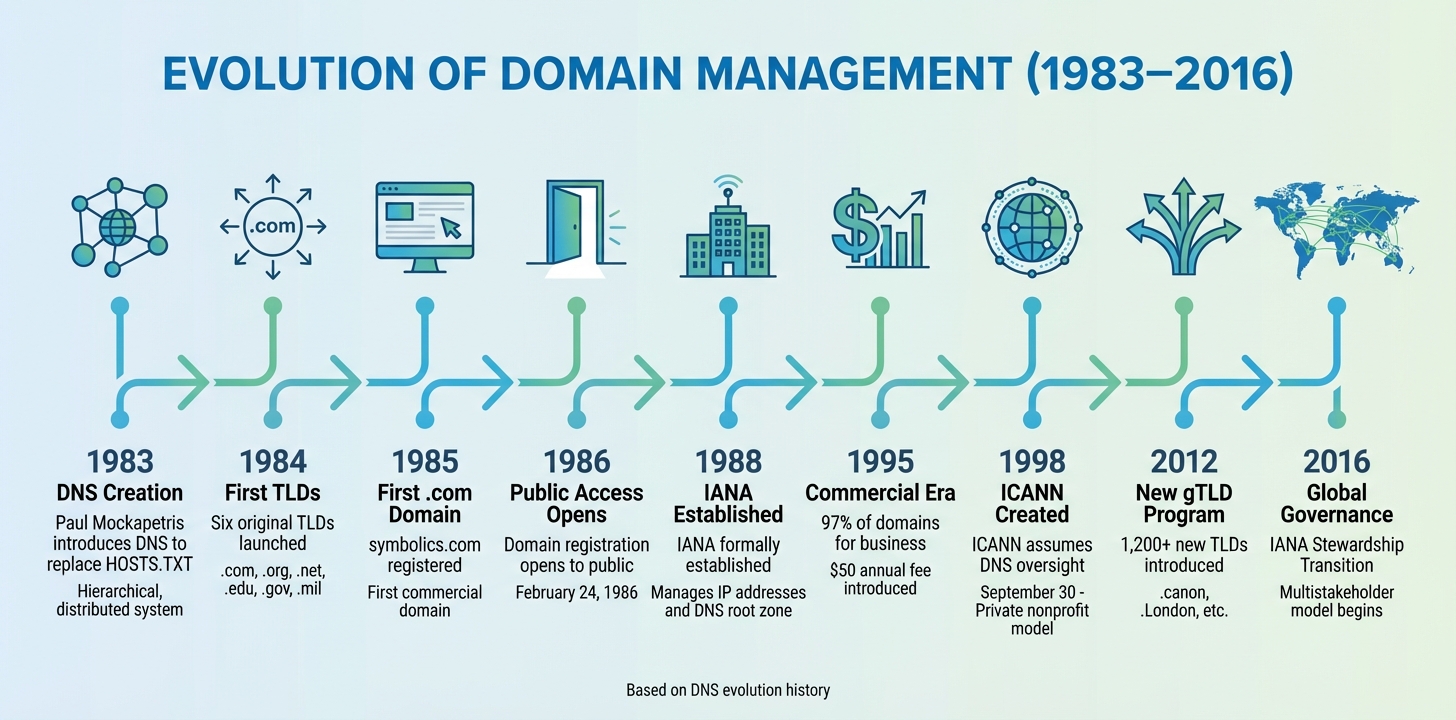
Evolution of Domain Management: From HOSTS.TXT to Modern DNS (1983-2016)
The History and Future of the Domain Name System, Part 1
The Beginnings: HOSTS.TXT and Early Internet Naming
Before the Domain Name System (DNS) transformed how we navigate the internet, the ARPANET relied on a much simpler setup. A single text file called HOSTS.TXT acted as the directory for every computer on the network. This file linked human-readable names – often just short words, acronyms, or abbreviations – to their corresponding IP addresses.
The Network Information Center (NIC) at the Stanford Research Institute was responsible for maintaining this file. Adding a new computer or updating an entry wasn’t as straightforward as it sounds. Administrators had to call the NIC directly to request changes. Once updates were made, every computer on the network had to download the latest version of HOSTS.TXT. As the ARPANET grew, this process quickly became a logistical nightmare.
The system’s flaws became glaringly obvious as more computers joined the network. The NIC staff was swamped with update requests, and the HOSTS.TXT server struggled to keep up. Delays of several days became common, and in one infamous incident, an update to the file accidentally left out the entry for the server hosting HOSTS.TXT itself – effectively halting the update process entirely.
Another major issue was the flat namespace. Every hostname had to be unique across the entire network. Popular or intuitive names were quickly snapped up, forcing administrators to get creative with naming. By the early 1980s, the strain of this system was undeniable. Dr. David Mills noted, "it will not be practicable for every Internet host to include all Internet hosts in its name-address tables. Even now, with over 400 names and nicknames in the combined tables, this has become awkward".
These challenges made it clear that a more scalable and efficient solution was needed. This realization led Paul Mockapetris to design a hierarchical system that distributed the workload across multiple organizations. His work laid the foundation for the modern DNS, solving the problems of scalability and centralization that plagued the early internet.
The Creation of DNS in 1983
In 1983, Paul Mockapetris introduced DNS, a groundbreaking system that replaced the outdated HOSTS.TXT file. This new hierarchical structure gave organizations the ability to manage their own namespaces, addressing the growing limitations of the centralized HOSTS.TXT.
"It enabled the use of human-readable names by organizing and distributing domain management." – Paul Mockapetris
Unlike the rigid, centrally controlled HOSTS.TXT, DNS distributed control to authoritative name servers. This meant that updates were confined to specific segments, allowing universities, companies, and other organizations to manage their subdomains independently and more efficiently.
The rollout of DNS began with the introduction of the first six top-level domains (TLDs) in October 1984: .com, .org, .net, .edu, .gov, and .mil. These domains were defined in RFC 920 as "administrative entities" created to decentralize name management, transferring responsibilities from a central authority to smaller, more manageable sub-administrations. These design principles laid the foundation for both immediate usability and future scalability, as detailed below.
Key Advantages of DNS
DNS brought several practical benefits right from the start. Its distributed structure localized updates, eliminating the need for network-wide changes and enabling seamless scalability. Caching mechanisms were introduced to reduce network traffic by storing frequently accessed data locally. The system also made life easier for users by translating human-readable domain names into numerical IP addresses, simplifying navigation. Additionally, built-in redundancy ensured reliable service, with backups ready to step in if a server went offline.
Public Domain Registration: Opening Access to Everyone
On February 24, 1986, a pivotal change occurred in the digital world: domain registration, once restricted to ARPANET-connected organizations, became available to the public. This shift allowed businesses and individuals to establish their online presence, transforming the internet from a government-focused network into a platform accessible to everyone.
By 1995, the internet had become a commercial hub, with 97% of domain registrations serving business purposes. Initially, registering a domain was free, but this changed in September 1995 when Network Solutions, Inc. (NSI) introduced an annual fee of $50. This move reflected the growing demand for a sustainable system as the internet expanded.
The Internet Assigned Numbers Authority (IANA), formally established in 1988 and funded by DARPA, played a crucial role in organizing the internet’s infrastructure. Operating out of the Information Sciences Institute, IANA managed IP address allocation and the root zone of the DNS. Its centralized coordination was essential as the internet grew, ensuring a functional and scalable system for the increasing number of users.
A major milestone came in 1998 when the U.S. Department of Commerce proposed privatizing DNS management. This led to the creation of ICANN (Internet Corporation for Assigned Names and Numbers) on September 30, 1998. ICANN assumed oversight of DNS management from the federal government, transitioning it to a private nonprofit organization. As the Department of Commerce explained:
"This document sets forth ways to improve technical management of the Internet Domain Name System (DNS). Specifically, it describes the process by which the Federal government will transfer management of the Internet DNS to a private not-for-profit corporation. The document also proposes to open up to competition the administration of top-level domains and the registration of domain names."
This transition not only decentralized DNS oversight but also introduced competition in the domain registration market. It expanded the availability of top-level domains (TLDs), providing users with far more choices than the original six TLDs launched in 1984.
sbb-itb-772afe6
ICANN and Global DNS Governance
The establishment of ICANN marked a turning point in how the Domain Name System (DNS) was managed, transitioning from an informal setup led by individuals like Jon Postel to a more structured, global governance system. As Harvard Law professor Jonathan Zittrain aptly put it:
"As the Internet’s protocols were written up it seemed a little informal to say with a technical document, ‘Well, a guy named Jon performs this function.’"
This shift laid the groundwork for ICANN’s expanded role in shaping global Internet policies.
ICANN’s responsibilities go beyond coordinating the DNS. It develops policies to internationalize domain names, enabling the use of non-Latin scripts, and oversees the allocation of IPv4 and IPv6 address blocks to regional registries. Central to its mission are principles like ensuring Internet stability, fostering competitive openness, and relying on a consensus-driven, bottom-up approach. These efforts have been instrumental in making domain management more inclusive and globally relevant.
In 2012, ICANN launched the New gTLD Program, introducing over 1,200 new generic top-level domains such as .canon and .London. Applying for these domains came with a hefty price tag – $185,000 for the application fee and $25,000 annually for renewal.
A significant milestone occurred on September 30, 2016, with the IANA Stewardship Transition. This move shifted oversight of domain and numbering systems from the U.S. government to a global multistakeholder model, fulfilling the vision outlined in the 1998 White Paper. The transition was guided by four key principles: supporting multistakeholder governance, ensuring DNS security and stability, addressing global user needs, and preserving Internet openness. Notably, the U.S. NTIA rejected proposals for a government-controlled solution.
Today, ICANN’s governance structure reflects its global mission. It operates under the direction of a 16-member board, supported by three key organizations and several advisory committees. Among these is the Governmental Advisory Committee, which includes representatives from 179 states and 38 observer organizations. ICANN’s motto, "One World. One Internet," captures its dedication to unified global Internet governance.
Modern Domain Management: Tools, Security, and Practices
Domain management has come a long way since its early days of manual setups. These days, the focus is on automation, security, and resilience. Modern tools and platforms handle everything from DNS updates to detecting and mitigating cyber threats. For organizations managing large-scale domain portfolios, programmatic control and integrated security are essential to ensure uptime and protect against increasingly advanced attacks. Decades of advancements have shaped today’s systems, making domain management more efficient and secure than ever.
Automated DNS Management Platforms
Gone are the days of manually typing commands into a command-line interface (CLI) or waiting on ticket systems. Modern DNS management platforms leverage APIs and Infrastructure as Code (IaC) to streamline processes. These tools integrate seamlessly with provisioning scripts, hosting control panels like Plesk and cPanel, and configuration tools such as Terraform and Ansible. Automation now covers the full domain lifecycle, including registration, DNS record updates, SSL/TLS certificate management (like DNS-01 challenges for Let’s Encrypt), DNSSEC key rollovers, and failover configurations.
For example, Vercara‘s UltraDNS handles a staggering 41 trillion DNS queries annually, while platforms like TCPWave offer a 99.9999% SLA, even in complex networks. For businesses operating in hybrid or multi-cloud environments, unified management platforms provide centralized oversight and policy enforcement across diverse setups. Infoblox, for instance, supports 70% of Fortune 500 companies, offering scalable and secure DNS management.
The impact of these platforms is clear in real-world applications. Sicredi Bank, for instance, slashed its machine provisioning time from five days to just 15 minutes using Infoblox NIOS DDI and Threat Defense. As Jullano Luz, Infrastructure Analyst at Sicredi Bank, explained:
"Infoblox accelerated delivery of our products to associates and end users. Provisioning a machine previously took five days, on average. Today, we can do it in 15 minutes. It is more flexible and agile."
Domain Security Measures
DNS remains a prime target for cyberattacks, with 92% of malware exploiting it for activities like phishing, command and control, and data theft. To counter these threats, technologies like DNSSEC digitally sign DNS data, protecting against spoofing and cache poisoning. Encryption protocols such as DNS over HTTPS (DoH) and DNS over TLS (DoT) safeguard queries from eavesdropping. Additionally, DMARC with blocking enabled prevents domains from being misused in phishing and spoofing schemes.
Advanced platforms now use machine learning to predict and block threats. For example, Infoblox detects and stops threats an average of 63 days earlier than traditional endpoint or firewall solutions, while also providing complete DNS visibility. Askari Bank’s experience with Infoblox Threat Defense highlights its effectiveness. Chief Information Security Officer Jawad Khalid Mirza shared:
"As we ran the PoC through various scenarios, there was not a single instance of a successful data infiltration or exfiltration event. Seeing Infoblox Threat Defense in action blocking malicious activity in our own environment gave us a lot of confidence in the Infoblox solution."
Another critical layer of protection is phishing-resistant Multi-Factor Authentication (MFA), which uses hardware keys like YubiKeys or Passkeys. These tools significantly reduce the risk of unauthorized access to domain registrar accounts and DNS management systems. To complement these measures, robust load balancing and redundancy strategies further ensure reliability and minimize disruptions.
Load Balancing and Redundancy Planning
Anycast routing is a cornerstone of modern load balancing. It spreads query traffic across multiple servers, ensuring users are directed to the nearest or most efficient server for better performance and reliability. Automated failover systems add another layer of protection, rerouting traffic during outages to maintain service availability.
A strong redundancy plan includes having both primary and backup DNS services. This ensures continuous domain resolution even if one service goes offline. For critical infrastructure like Active Directory, organizations should implement daily system-state backups, maintain cold standby systems that remain offline until needed, and conduct full recovery drills at least twice a year. These drills verify that authentication, Group Policy, and replication processes function as expected. Additionally, recovery accounts, such as the Directory Services Restore Mode (DSRM) account, require strict management, including regular password updates.
Unlike the centralized HOSTS.TXT files of the early internet, today’s distributed systems are built for high availability and swift recovery, ensuring that domain management remains reliable even in the face of challenges.
Planning Domain Strategy for Growth
To support business growth and maintain brand integrity, having a well-thought-out approach to domain management is critical. While advanced tools and security practices lay the groundwork, a strategic domain plan ensures that your digital presence aligns with your business goals.
A solid domain strategy ties your online identity to your company’s objectives and future expansion. As internet access continues to grow and digital branding becomes more vital, your domain portfolio should be equipped to handle everything from protecting your brand to supporting global expansion. Domains are more than just web addresses – they establish authority and visibility. Without a clear plan, you may face inefficiencies, security risks, and brand vulnerabilities.
Smart domain portfolio management involves combining operational efficiency with strong security measures, all while keeping your holdings streamlined. This includes deciding which domains to register, organizing them across various top-level domains (TLDs), and safeguarding against threats like cybersquatting. As your business grows, managing these aspects becomes more complex, requiring a layered approach that incorporates registrar security, DNS protection, email authentication, and continuous brand monitoring. The goal? A domain infrastructure that drives growth without adding unnecessary risks or administrative burdens.
Managing Domains Across Multiple TLDs
The rise of new TLDs has reshaped the way businesses manage their domain portfolios. Beyond the classic .com, companies are now leveraging country-code TLDs (ccTLDs) for regional outreach, industry-specific TLDs for niche branding, and generic TLDs (gTLDs) for differentiation. Managing domains across these diverse TLDs requires a clear strategy to ensure branding consistency while meeting operational demands in various regions and markets.
For example, securing ccTLDs like .de, .fr, or .uk can help establish trust when expanding into European markets. Similarly, tech companies might adopt TLDs like .io, .dev, or .tech to reinforce their industry expertise. The key is consistency – redirecting regional TLDs to localized content, enforcing uniform security policies, and using centralized management platforms to oversee the entire portfolio. This not only prevents fragmentation but also minimizes the risk of leaving domains unmonitored, which can lead to security issues.
Centralized management also simplifies compliance with local regulations. Different countries have unique rules for domain ownership, privacy, and data handling. A unified strategy helps you keep track of renewal dates, update DNS records across TLDs, and apply consistent security measures. As your portfolio expands from a few domains to dozens or even hundreds, this approach ensures smooth operations and reduces administrative headaches.
Brand Protection Through Domain Registration
Cybersquatting remains a significant challenge, with malicious actors registering domains that mimic established brands to mislead users, steal traffic, or demand ransom. Proactively registering domains is an effective first step in protecting your brand. This means securing not only your main domain but also variations, common misspellings, and alternative TLDs that could be exploited for phishing or impersonation.
A robust brand protection strategy involves registering defensive domains across TLDs and variations of your brand name. This includes common typos, alternative extensions, and ccTLDs. Beyond ownership, domain security also involves monitoring for unauthorized registrations that infringe on your trademarks.
Brand monitoring tools can notify you when new domains using your brand name are registered, allowing you to act quickly through legal or dispute resolution channels. Pairing registrar security with DNS protection and email authentication creates a multi-layered defense system. This safeguards not only your domain ownership but also the services tied to those domains. As your business grows, such proactive measures are essential for maintaining control over your online presence and avoiding reputational harm from impersonation attacks.
Conclusion
Domain management has come a long way – from the early days of centralized HOSTS.TXT files to today’s expansive, distributed systems. What began with just six original TLDs has grown into a system offering over 1,500 extensions, reflecting decades of progress and adaptation. This journey offers valuable insights for managing domains in the modern era.
One key takeaway is the importance of scalability and security. Centralized systems often falter under strain, whereas distributed architectures thrive. To address today’s challenges, organizations must adopt proactive measures like advanced security protocols to safeguard infrastructure and user privacy. Strategic planning is just as important. Whether it’s protecting your brand across multiple TLDs, expanding into regional markets, or preparing for future growth, your domain portfolio should align with your broader business goals.
Paul Mockapetris, the mind behind DNS, captured this balance perfectly:
"It was created to let people use names for anything. But we had to figure out how to organize the distribution of domain names and how to ensure the system could accommodate diversity without unnecessary restriction".
This guiding principle still holds true. The challenge today is to maintain operational efficiency while ensuring robust security, all without adding unnecessary complexity.
Looking ahead, innovations like blockchain-based naming systems and advanced privacy measures are set to shape the future of domain management. Staying informed about these developments while relying on proven strategies will keep your organization well-prepared. Domains are more than just technical assets – they’re central to your brand identity, user experience, and the stability of your digital operations.
FAQs
What are the most important security practices for managing domains today?
Modern domain management demands strong security measures to defend against threats and unauthorized access. Some of the most effective practices include:
- Enabling DNSSEC: This ensures the integrity of DNS data by protecting it from tampering.
- Using domain locking: This prevents unauthorized domain transfers, adding an extra layer of security.
- Setting up two-factor authentication (2FA): Adding 2FA to registrar accounts makes it significantly harder for attackers to gain access.
- Deploying DMARC: This helps block email spoofing attempts, safeguarding your brand’s reputation.
- Monitoring DNS and WHOIS changes: Regular checks make it easier to spot and respond to suspicious activity quickly.
By implementing these measures, organizations can better protect their domains and maintain confidence in their online presence.
How has ICANN’s role in managing the global DNS system changed over time?
ICANN has come a long way since it first started. What began as a focus on managing the core DNS infrastructure has expanded into a much broader role. Today, ICANN oversees global domain name policies, coordinates the introduction of new generic top-level domains (gTLDs), and works to maintain the stability and security of the DNS system.
One of its most pivotal moments came in 2016, when ICANN officially transitioned from U.S. government oversight to a multistakeholder international community. This change marked a shift toward a more global and cooperative model for internet governance, emphasizing transparency and inclusivity in how the domain name system is managed.
Why is protecting your brand important in domain management?
Protecting your brand in domain management is a crucial step in preserving your company’s reputation and maintaining the trust of your customers. One major threat it helps address is cybersquatting – when someone registers domains that closely resemble your brand in an attempt to mislead or exploit.
By locking down your domains and adopting solid management practices, you can minimize the chances of fraud, safeguard your intellectual property, and ensure your business has a dependable and trustworthy online presence.