Your domain name is your startup’s online identity. It impacts how people perceive your brand, find you online, and remember you. A strong domain builds trust, boosts visibility, and supports growth. Here’s what you need to know:
- Keep it Simple: Short, clear, and easy to spell or say. Avoid numbers or hyphens.
- Choose the Right Extension:
.comis trusted and widely recognized. Alternatives like.ioor.aican work for tech startups. - Reflect Your Brand: Make sure the domain aligns with your mission and is flexible enough to grow with your business.
- Check Availability: Ensure it’s not trademarked and that matching social media handles are free.
- Secure Variations: Protect your brand by registering common misspellings and other TLDs.
Pro Tip: Use tools like domain generators to brainstorm ideas, and validate your choices with real users before committing. Once you’ve picked the perfect domain, register it quickly, enable privacy protection, and set up auto-renewal to avoid losing it.
Your domain isn’t just a web address – it’s your startup’s first impression online.
What Makes a Strong Startup Domain
Why Your Domain Matters for Your Brand
Your domain name is often the first impression people get of your startup. It’s a digital handshake that signals professionalism and credibility before anyone even interacts with your product or service.
A carefully chosen domain name strengthens your brand image and helps build connections with your audience, making it easier for them to remember and trust you. On the flip side, a poor choice can complicate your marketing efforts, confuse potential customers, and even lead to expensive legal troubles. Think of your domain as more than just a technical requirement – it’s a key component of your overall digital strategy, influencing everything from brand recognition to SEO. A strong domain should reflect your brand while being simple and easy to recall.
Characteristics of an Effective Domain
For your domain to make an impact, it needs to meet a few key criteria. The best domains are short, straightforward, and free of hyphens or numbers, which can make them harder to communicate verbally.
Take Tesla Motors, Inc. as an example. They understood the value of a clear, matching domain when they purchased Tesla.com for $11 million in 2016.
Even though the domain was registered long before Tesla existed, the company realized that owning their exact brand name as a .com was a smart move that reinforced their identity.
Some brands also get creative with their domains. Adobe Acrobat has registered clever domain hacks like edit.ing and sign.ing, Canva owns draw.ing, and ING uses banking.ing. These examples show how the right top-level domain (TLD) can seamlessly integrate into your brand identity.
How TLDs Affect Trust and Perception
The TLD you choose – your domain extension – plays a big role in how your brand is perceived, especially in the U.S. Among all extensions, .com remains the gold standard. As Grant Polachek, VP of Growth & Product at atom.com, explains, customers inherently trust .com domains. Many users instinctively type .com, so opting for a different extension could mean losing valuable traffic.
That said, alternative TLDs can work well in specific contexts. For example, tech startups often use .io or .ai to signal a focus on innovation. Industry-specific TLDs like .app or .fitness can also communicate your niche effectively. A domain like sturdy.construction, for instance, is not only memorable but also delivers a clear message about the business.
If you’re considering a non-.com extension, think about your target audience and industry. While .com domains typically cost $12 to $15 per year, less common extensions are often cheaper. However, if you’re aiming at a U.S. market, securing the .com version – even if you use another TLD – can protect your brand from competitors or domain squatters.
Prepare Before Searching for a Domain
Match Your Startup’s Mission and Audience
Before diving into domain name searches, take a moment to define your startup’s purpose. Your domain name should reflect your mission, vision, and values. Think about your target audience and what makes your business unique.
A well-aligned domain name communicates your value proposition clearly, helping potential customers immediately understand what you offer. This clarity not only builds trust but also helps you stand out in a sea of over 350 million registered domain names worldwide.
Set Your Budget and Constraints
Domain prices can range from free (often included with hosting) to jaw-dropping sums like $872 million for high-profile purchases. Establishing a budget upfront prevents you from falling in love with a domain that’s out of reach and reminds you that this isn’t just a purchase – it’s a key piece of your business strategy.
Treat domain registration as a business expense or, if considered an investment, amortize its cost over 15 years. Beyond price, set additional guidelines: decide on an ideal character length, avoid numbers or hyphens, and ensure the name is easy to spell and share. Having clear financial and design parameters ensures that your domain is not only affordable but also practical for long-term use.
Choose a Domain That Can Grow with You
Steer clear of names that might limit your future growth. As Stripe wisely notes:
"Selecting a name that can grow with your business not only allows for the inevitable evolution and scaling of your startup but also saves you the time, cost, and brand equity loss associated with a potential rebranding down the line".
Overly specific names tied to products or locations can become a problem as your business evolves. For instance, a name like "ChicagoTacos.com" could feel restrictive if you expand to other cities or broaden your menu. Instead, opt for subject-based domains that communicate your core business while leaving room for growth. A flexible name ensures your brand can adapt to new opportunities without confusing your audience or requiring a costly rebrand.
Generate and Narrow Down Domain Ideas
Effective Brainstorming Techniques
Set aside an hour to dive into brainstorming domain ideas. During this time, jot down every word, concept, or phrase that connects to your business. Don’t worry about filtering or judging your ideas yet; the goal is to get as many options on paper as possible.
To keep things moving, use a timer and dedicate 10–15 minutes to each method. Start by listing words that describe your product, mission, or the language your customers use. Then, get creative – combine two ideas, tweak with prefixes or suffixes, or even come up with entirely new terms. Focus on volume at this stage; aim to generate 50–100 potential names before narrowing down your list.
Leverage Domain Name Generators and Search Tools
Domain name generators can be a lifesaver when you’re stuck. These tools not only suggest unique and catchy options but also check their availability instantly, saving you from manual searches. Just plug in your core keywords, and the generator will offer combinations, alternative spellings, and variations you might not have thought of. Many tools also provide pricing information and recommend different TLDs, giving you a broader range of options that align with your brand and budget.
Get Feedback from Real People
Once you’ve whittled your list down to 5–10 strong contenders, it’s time to test them out with real people – preferably those who resemble your target audience. Make sure each name passes the radio test, meaning it’s easy to spell and find when spoken aloud. This is crucial for word-of-mouth marketing and compatibility with voice assistants.
Share your top picks with potential customers and ask for candid feedback. Which names are memorable? Do they clearly reflect what your business offers? Watch for any confusion or hesitation – these could signal issues that need addressing. By validating your options in this way, you’ll feel more confident moving forward. From there, finalize your choice, select the best TLD, and double-check for any potential conflicts.
How to Choose a Business Domain Name in 2025? (New AI Strategy & Tips)
sbb-itb-772afe6
Select Your TLD and Check for Conflicts
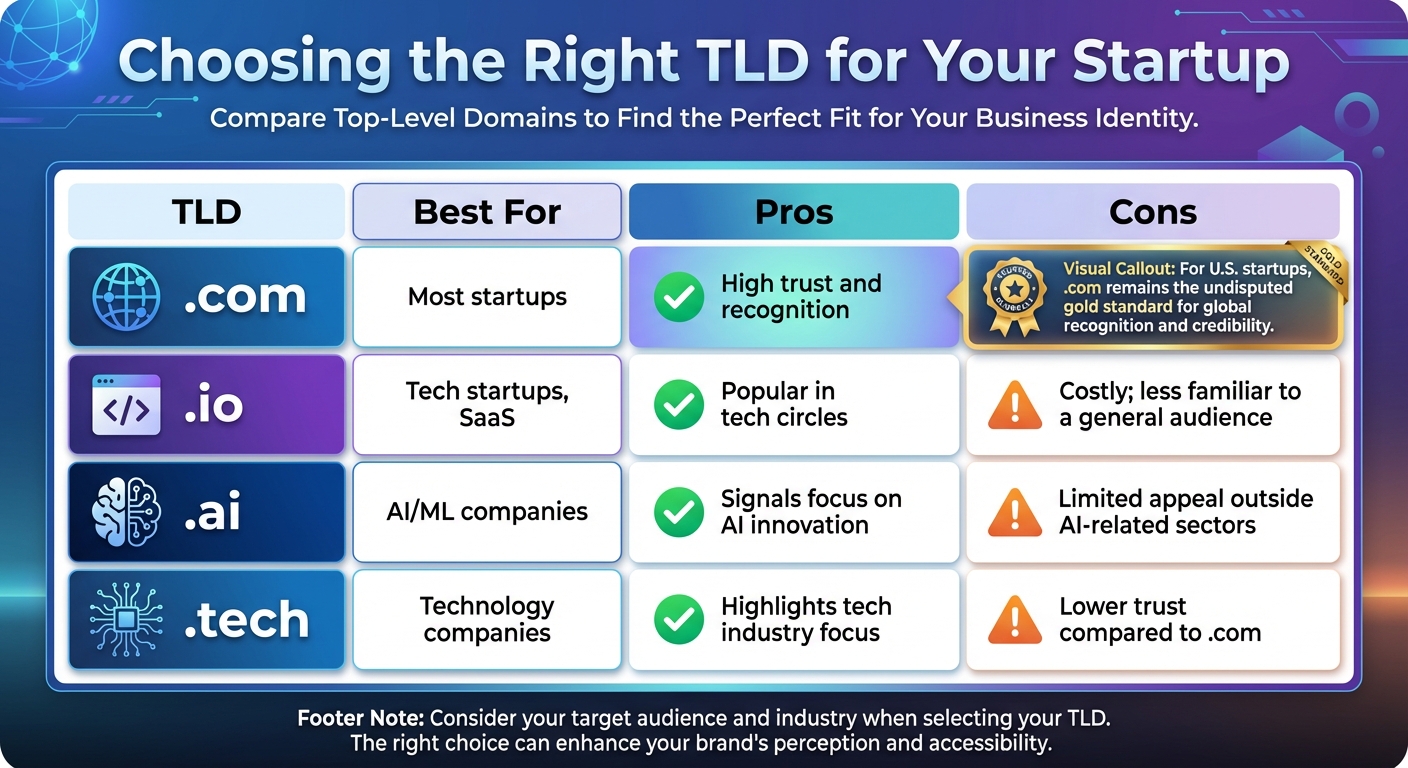
Comparison of Top-Level Domains (TLDs) for Startups
Pick the Right TLD for Your Startup
Your top-level domain (TLD) – the part of your web address that comes after the dot – plays a big role in shaping how people perceive your brand. For U.S. startups, .com is still the go-to choice. It’s widely recognized, trusted, and easy to remember. That said, newer options like .io, .ai, and .tech are gaining popularity, especially among tech-focused businesses.
When deciding on a TLD, think about how visible and relevant it is to your brand. While a .com domain tends to inspire the most trust, don’t dismiss alternatives like .io or .tech if they fit your audience and branding. These options can work well, particularly for tech-savvy users. Keep in mind, though, that some TLDs can be more expensive than others, so factor in your budget.
| TLD | Best For | Pros | Cons |
|---|---|---|---|
| .com | Most startups | High trust and recognition | Highly competitive |
| .io | Tech startups, SaaS | Popular in tech circles | Costly; less familiar to a general audience |
| .ai | AI/ML companies | Signals focus on AI innovation | Limited appeal outside AI-related sectors |
| .tech | Technology companies | Highlights tech industry focus | Lower trust compared to .com |
Check for Trademark and Legal Issues
Once you’ve picked a TLD that fits your brand, it’s time to make sure you’re on solid legal ground.
Before committing to a domain name, conduct a trademark search to avoid any legal headaches. In 2024 alone, trademark owners filed 6,168 disputes over domain names worldwide, winning about 95% of those cases. Losing a dispute could lead to lawsuits, expensive rebranding, and serious harm to your reputation.
Start by searching the United States Patent and Trademark Office (USPTO) database at uspto.gov for registered trademarks that might conflict with your domain. But don’t stop there – search for unregistered, or "common law", trademarks too. A simple Google search and a look through business directories can help you spot potential conflicts. Domain-related trademark disputes have jumped by 68% since 2019. Doing your homework upfront can save you from costly trademark refusals, oppositions, or even lawsuits later on.
Verify Social Media Handle Availability
Once your domain name clears legal checks, make sure it’s available across social media platforms.
A domain name loses impact if matching social handles are already taken. Before buying your domain, check the availability of handles on major platforms. Without consistency, you might end up with awkward alternatives like twitter.com/yourstartup_official.
"A ‘perfect’ domain is useless if it’s already trademarked or if all the matching social media handles are taken. Check these before you buy." – Itamar Haim, Web Creation and Digital Marketing Professional
To save time, use a tool like namechk.com to quickly check your brand name’s availability across hundreds of social platforms and domains. This simple step ensures your brand maintains a unified presence across all digital channels.
Register and Protect Your Domain
Once you’ve chosen the perfect domain name, the next step is all about securing it and protecting your online identity.
Check Availability and Pricing
Before proceeding, make sure your domain clears trademark checks and that matching social media handles are available. Then, confirm the domain’s availability through registrars like GoDaddy, Namecheap, or WordPress.com.
Standard domains typically cost less than $10 per year, but premium ones can range from hundreds to thousands of dollars. Some providers, such as WordPress.com, even offer a free domain for the first year when you purchase an annual hosting plan. For example, MakerStock.com was purchased for about $5,000 via Sedo.com. On the other hand, high-profile domains, like Microsoft’s acquisition of Bing.com, are likely multimillion-dollar deals.
If the .com version of your desired domain isn’t available, consider alternatives like niche or country-specific TLDs (e.g., .io, .tech, or .store). Karl T. Ulrich, a domain strategy expert, emphasizes the importance of owning the right domain:
"I believe you will lose at least 5 percent of the people seeking you out on the web, and probably more, if you do not own the domain name associated with your brand".
To test audience response, you might register multiple potential domains – around ten for approximately $100 – and see which one resonates most.
Register Your Domain and Key Variants
Once you’ve confirmed availability and pricing, act fast – desirable domains don’t stay available for long. Secure your primary domain along with key variations, common misspellings, and other TLDs to protect your brand and ensure visitors can find you even if they mistype your URL. For instance, if you register startup.com, you might also want to grab startup.net and startup.org.
Enable auto-renewal immediately to avoid losing your domain by mistake. Additionally, activate domain privacy protection to keep your personal contact details hidden from the public Whois database. This step not only reduces spam but also safeguards your identity. Domains are typically registered for a minimum of one year, and if you forget to renew, someone else could claim it – potentially leading to lost traffic, customers, or even a costly rebranding effort.
Manage Your Domain Long-Term
Owning a domain is an ongoing responsibility, not a one-time task. Keep your contact details current so you don’t miss renewal reminders or important alerts.
Add a registry lock to prevent unauthorized domain transfers. Make sure your website uses an SSL certificate to secure data exchanges between your site and its visitors.
If you purchase an expired domain, research its history thoroughly – domains with a negative past can hurt your reputation, trigger browser warnings, or harm your search engine rankings. Managing everything through a single registrar simplifies tasks like tracking subscriptions, updating DNS records, and maintaining security settings.
Conclusion
Your domain is more than just a web address – it’s the cornerstone of your startup’s online identity and a critical driver of growth. It shapes how your brand is recognized, impacts SEO efforts, and builds customer trust.
When selecting a domain, aim for one that aligns with your mission and leaves room for future growth. A domain that feels restrictive later on can create unnecessary hurdles and expenses.
Once you’ve narrowed down your options, confirm availability across domain registrars, social media platforms, business directories, and the USPTO. This thorough check helps you avoid legal issues and ensures consistent branding.
Take extra steps to protect your brand by registering common misspellings and variations of your domain. Cybersquatters often target growing brands, and securing these variations early can safeguard your traffic and credibility.
Lastly, prioritize long-term security for your domain. Enable features like auto-renewal, privacy protection, and registry locks to keep your domain safe as your business scales. These proactive measures will help solidify your digital presence and set the stage for sustainable growth.
FAQs
What factors should I consider when picking a domain extension for my startup?
When selecting a domain extension, it’s crucial to prioritize relevance, credibility, and trust. The .com extension remains the most widely recognized and trusted choice, making it an excellent option for startups targeting a broad audience. But if your business caters to a specific region or operates in a particular industry, a country-code TLD (like .us) or a niche extension (such as .tech or .app) might be a better fit.
Steer clear of extensions that are overly trendy, difficult to remember, or obscure. These can confuse users and potentially harm your brand’s image. Always keep your target audience in mind and ensure the extension aligns with your business objectives.
How can I make sure my domain name is legally safe to use?
To make sure your domain name is legally secure, begin with a trademark search using the United States Patent and Trademark Office (USPTO). This helps identify any existing trademarks that could pose a conflict. Next, confirm the domain’s availability and steer clear of names that closely resemble established trademarks to minimize legal risks. For extra security, think about registering your domain name as a trademark. This step can protect your rights and help you avoid disputes. Addressing these concerns early on can save you from costly and time-consuming issues later.
Why should I secure different versions of my domain name?
Securing different versions of your domain name is a smart way to protect your brand and keep your audience’s trust intact. It blocks cybersquatters from taking advantage of similar domains, minimizes confusion caused by common misspellings, and helps maintain a consistent and reliable brand image.
By purchasing variations like frequent typos or alternative domain extensions, you create a safety net for your online presence. This makes it easier for customers to reach you without mistakes and reinforces your credibility. Taking this step is a forward-thinking move that supports your startup’s reputation and long-term growth.