Want to succeed as a founder? Start by rewiring how you think. A growth mindset isn’t just a mindset – it’s the difference between stagnation and progress in the unpredictable world of startup tech leaders. Here’s the core idea: your abilities, intelligence, and skills aren’t fixed – they grow through effort, learning, and persistence.
Key Takeaways:
- Treat failures as lessons, not dead ends.
- Focus on the process, not just results.
- Use feedback as a tool for improvement.
- Regularly reflect to refine your decisions.
From understanding how your brain changes to prioritizing steady effort over raw talent, these steps will help you build resilience, improve decision-making, and create lasting success. Ready to shift your perspective? Let’s dive in.
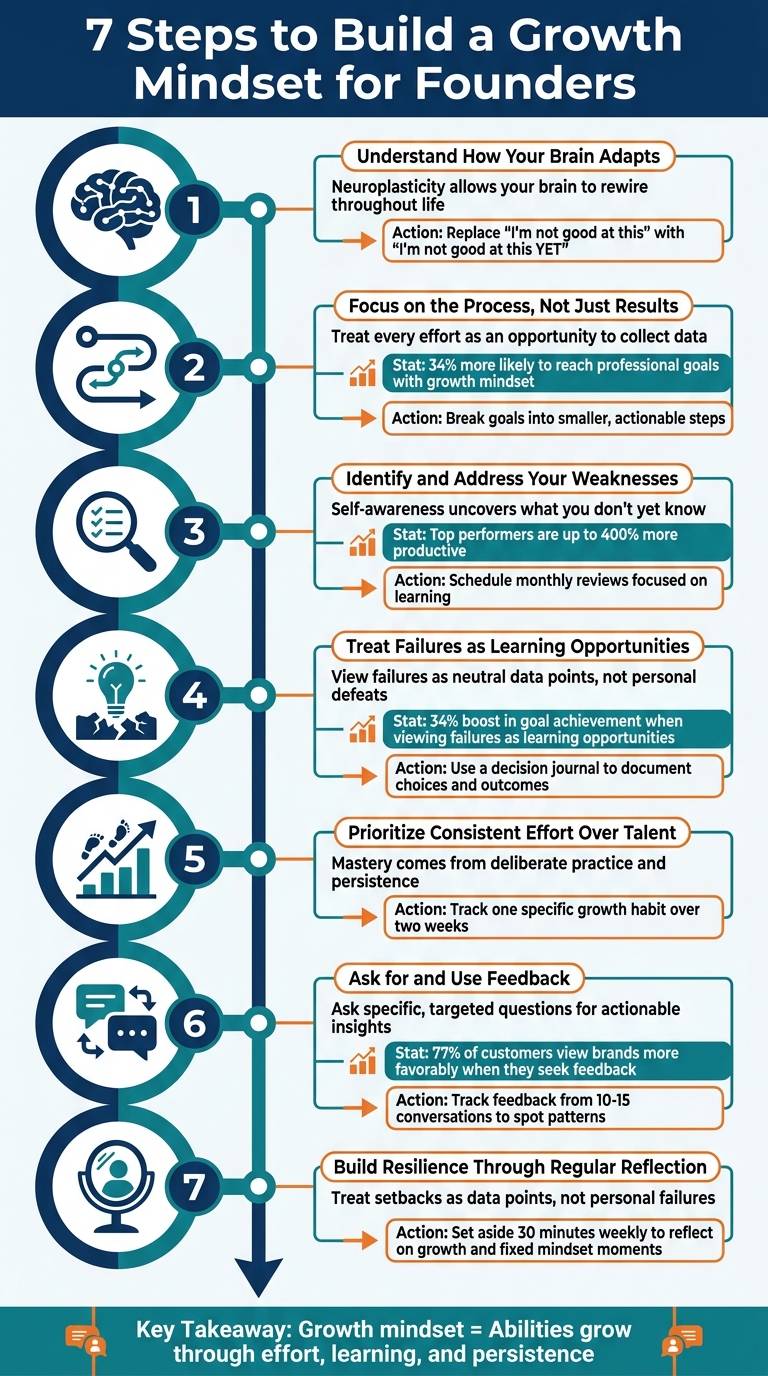
7 Steps to Build a Growth Mindset for Founders
Mindset, Failure and Silicon Valley Founders: An interview with Carol S. Dweck
sbb-itb-772afe6
Step 1: Understand How Your Brain Adapts and Changes
Your brain is constantly reshaping itself based on your experiences. This process, known as neuroplasticity, allows your brain to rewire and adapt throughout your life. As a founder, every time you tackle a new challenge – whether it’s pitching to investors or diving into financial modeling – you’re creating new neural pathways that strengthen your ability to handle those tasks.
A fascinating example comes from a study on London taxi drivers. Researchers discovered that after these drivers mastered "The Knowledge" (memorizing 25,000 streets of London), their brains underwent physical changes. Specifically, there was a redistribution of gray matter in their hippocampus, the area tied to memory and navigation. This shows that your brain literally restructures itself when you push it to absorb new information.
"If the brain map could normalize its structure in response to abnormal input, the prevailing view that we are born with a hardwired system had to be wrong. The brain had to be plastic." – Michael Merzenich, PhD
For founders, this adaptability is a game-changer. Facing challenges like scaling a team or breaking into a new market triggers your brain to develop fresh strategies and solutions. The secret lies in how you talk to yourself. Instead of saying, "I’m not good at this", try adding one small but powerful word: "I’m not good at this yet". That single shift acknowledges your brain’s ability to grow and keeps the door open for learning.
Start by paying attention to your inner dialogue. Replace limiting thoughts like "I’m not naturally good at sales" with statements that highlight effort and progress. For example, "I’m learning how to improve at sales." This isn’t about forcing positivity – it’s about working with your brain’s natural tendencies to adapt and grow. By reframing challenges as opportunities to build new skills, you turn setbacks into stepping stones for success. Recognizing neuroplasticity is the foundation for transforming obstacles into milestones, paving the way for your next growth phase.
Step 2: Focus on the Process, Not Just Results
It’s easy for founders to get caught up in chasing metrics like revenue, user growth, or conversion rates. But when you zero in only on outcomes, you risk overlooking the lessons that fuel sustainable growth. Take Airbnb’s Brian Chesky and Joe Gebbia, for example. Back in 2008, after facing rejection from investors and struggling with bleak numbers, they didn’t give up. Instead, they doubled down on the process of building their platform. They even went door-to-door to photograph listings themselves, learning firsthand what users needed. That hands-on approach turned an air mattress rental idea into a multi-billion-dollar business.
The key here is to shift your perspective: treat every effort as an opportunity to collect data. If a product launch flops or a pitch falls flat, it’s not a personal failure – it’s a chance to gather insights for the next move. SpaceX is a great example of this mindset. When its early rockets failed, Elon Musk’s team didn’t see those failures as the end of the road. Instead, they dissected each incident to understand what went wrong, eventually leading to the first successful private orbital launches.
One way to start adopting this mindset is by reworking your language. Instead of saying, “The market wasn’t ready,” ask, “What did this launch teach us for next time?”. This subtle change helps you extract value from every experience. Netflix embraced this approach in the mid-2000s when it transitioned from its thriving DVD-by-mail model to online streaming. Rather than clinging to perfection, the company prioritized flexibility, staying ahead in an evolving market. By focusing on the process, setbacks become stepping stones for growth.
This philosophy applies to every strategic decision.
"Every day at Amazon is like the first day of a startup, demanding the same level of agility, innovation, and customer obsession." – Jeff Bezos
Break your goals into smaller, actionable steps to gather insights and refine your approach. For instance, instead of setting a lofty revenue target, aim to secure 10 paying customers and document what messaging works best. The first goal measures results, while the second focuses on learning – learning that can shape every future effort. Research shows that individuals with a growth mindset are 34% more likely to reach their professional goals. Why? Because they understand that mastering the process leads to consistent, repeatable success.
Step 3: Identify and Address Your Weaknesses
Being self-aware is a constant journey of uncovering what you don’t yet know. As a founder, traits like independence and relentless ambition often drive success. But if left unchecked, they can also become obstacles. Ignoring your skill gaps doesn’t just hold you back – it can create a ripple effect, leading to stagnation across your entire team. Recognizing these gaps is the first step toward meaningful improvement.
Start by paying attention to how your team talks about challenges. Shift phrases like “We aren’t good at sales” to “We aren’t good at sales yet”. This small change can reinforce the belief that skills are something you can build with effort. You might also consider using scientific tools to evaluate whether you and your team have a fixed or growth-oriented mindset. This mindset directly affects how operational challenges are approached.
Here’s something to think about: top performers in startups can be up to 400% more productive than their average counterparts. That’s why hiring for adaptability and learning agility is so crucial. When interviewing, focus less on static technical skills and more on a candidate’s willingness to consider opposing ideas and their history of adapting to new situations. Anne Sandberg, Chief Learning Officer at the Center for Growth Leadership, emphasizes this point:
"A growth mindset is fundamental for entrepreneurs. It’s not just about seeing opportunities but also about fostering a learning culture within your team."
To push yourself and your team further, set ambitious goals that take you out of your comfort zone. Schedule monthly reviews to focus on what you’re learning, not just what you’ve achieved. Seek out mentors and peers who can provide honest feedback and help you uncover blind spots. Remember, feedback is a tool for improvement – not a personal critique. By embedding these habits into your routine, you encourage a culture where challenges fuel progress. These steps build on earlier efforts to ensure ongoing growth for both you and your team.
Step 4: Treat Failures as Learning Opportunities
Once you’ve built self-awareness and started addressing your weaknesses, the next step is learning to see failure not as a dead end, but as a stepping stone. Every misstep, whether it’s a failed product launch or the loss of a major client, holds lessons. How you react to these setbacks often determines whether you grow or stay stuck. Founders with a growth mindset, often featured on startup tech leader podcasts, treat failures as neutral data points rather than personal defeats. To embrace this approach, structured reflection can help turn setbacks into actionable insights.
Here’s something to consider: research indicates that viewing failures as opportunities to learn can boost your chances of achieving goals by 34%. Yet, despite this, around 20% of new businesses close within their first year, and nearly 50% don’t make it past five years. The difference between those who succeed and those who don’t often lies in how well they extract lessons from what went wrong – not in raw talent or intelligence.
Marie Chevrier Schwartz, CEO of TechTO and Peerscale, captures this mindset perfectly:
"I don’t want my legacy to be a failure without any lessons learned."
To shift your perspective when things go south, try this practical framework. Ask yourself three questions: What’s the worst-case scenario, and can I handle it? Is this decision reversible? What will I learn no matter the outcome?. Interestingly, most failures happen in situations where the risks are reversible, and the cost of hesitation often outweighs the cost of making a mistake.
Another helpful tool is a decision journal. Use it to document major choices, your thought process, and your expectations. Reviewing this regularly can uncover patterns in your decision-making. Before launching new projects, consider running a pre-mortem to identify potential weak spots ahead of time. This isn’t about negativity – it’s about being prepared. And when you catch yourself thinking, "I worked hard but still failed", try reframing it: "I worked hard and discovered what doesn’t work. That’s valuable information". The way you talk to yourself can play a huge role in how quickly you recover and adapt.
Step 5: Prioritize Consistent Effort Over Talent
Once you’ve learned to see failures as opportunities, it’s time to focus on the power of steady effort. Abilities don’t just appear out of nowhere – they grow through deliberate practice, ongoing learning, and persistence. The idea that some people are "naturals" at pitching or developing products is misleading. True mastery comes from consistent effort, not innate talent. Stanford psychologist Carol Dweck’s research highlights this: people with a growth mindset believe intelligence and skills can be developed, while those with a fixed mindset see them as static.
Here’s why this matters: successful founders take action instead of overthinking. Early on, the quickest way to learn is by presenting your product or pitch to customers and paying attention to their feedback, rather than spending endless hours trying to perfect it in isolation. Most startup decisions are low-risk and reversible, so delaying action often costs more than making a mistake. Even if results aren’t immediate, effort generates valuable insights. As Nomad Excel puts it:
"Your effort is never wasted. It’s always generating data".
A helpful way to shift your thinking is by adding the word "yet" to any self-doubt. For example, instead of saying, "I’m not good at team management", say, "I haven’t mastered team management yet". This small change reinforces the idea that improvement is possible. Angie Joens, Founder of DonorRelations.com, uses this approach:
"I’m not yet adept at writing acknowledgments for our President".
To build consistency, try tracking one specific growth habit over two weeks. For example, you could focus on responding to rejection with curiosity instead of defensiveness. This will help you identify patterns and reinforce progress. Ambitious goals, like landing your first 10 customers or cutting development time in half, can also be broken into smaller, actionable milestones. These checkpoints keep you motivated and provide regular opportunities to evaluate what’s working.
Step 6: Ask for and Use Feedback
Once you’ve established consistency in your efforts, it’s time to focus on gathering and applying feedback. But not all feedback is created equal – it’s how you ask for it that makes the difference. Avoid broad, unhelpful questions like, "What do you think?" Instead, ask specific, targeted questions that yield actionable insights. For example, when talking to customers, try asking, "Would you pay $50 for this?" or "If I removed this feature, would it still be valuable to you?" When seeking advice from a mentor, present a clear challenge, such as, "Our pricing page has low conversions – how would you approach fixing this?" This structured approach helps create a culture of openness and growth.
Executive coach Alisa Cohn explains it perfectly:
"You are the expert on your intentions. Everyone around you is the expert on your impact. Leading effectively is about marrying intention with impact".
This means your team, customers, and mentors can provide insights you might miss. Their perspectives refine your strategies and strengthen trust within your team. To encourage honest feedback from your team, start by showing vulnerability. Share your own development goals in one-on-one meetings, then ask a simple but meaningful question, like Jake, a Finance Manager, suggests: "Is there anything I could do differently to support you better?". This small step creates psychological safety, making it easier for others to share candidly.
The most valuable feedback comes from recurring patterns, not isolated comments. Track feedback from 10–15 conversations to spot consistent themes. For instance, if several customers struggle to articulate your value proposition, it may signal that your messaging needs improvement. A simple spreadsheet can help organize feedback on key areas like pricing, features, or user experience. This approach prevents overreacting to one-off opinions and ensures you focus on meaningful trends.
After gathering feedback, the next step is deciding what to act on. Not every piece of input deserves equal attention. Feedback from loyal, long-term customers often carries more weight than comments from free trial users who may not convert. Evaluate each suggestion against your long-term vision and goals. Ask yourself: Does this align with where we want to be in three years? Will it impact enough customers? Does it justify the resources required? Research shows that 77% of customers view brands more favorably when they actively seek feedback, yet only 5% of businesses effectively "close the loop" by following up after changes are made.
Finally, accountability is key. After implementing feedback, communicate the results. If a mentor suggests a new approach to customer acquisition, circle back in a few weeks to share the outcome. This strengthens relationships and shows that their insights are valued. Similarly, when you act on your team’s suggestions, ask if they’ve noticed the improvement. This reinforces a culture of growth and demonstrates your commitment to taking their feedback seriously.
Step 7: Build Resilience Through Regular Reflection
Reflection isn’t just a nice-to-have; it’s a critical tool for separating your decisions from your sense of self. By treating setbacks as data points instead of personal failures, you can ease the emotional burden and focus on learning lessons that sharpen your future decisions. Like feedback and process-focused learning, consistent reflection reinforces a mindset geared toward growth.
One way to start is by using tools like decision journals. These journals help you document and review your key decisions along with the reasoning behind them. Over time, you may uncover recurring patterns – like consistently underestimating timelines – that can guide better planning. This approach takes those vague feelings of "something went wrong" and turns them into actionable insights.
Adopting a weekly reflection routine can help you stay accountable. Set aside 30 minutes each week to identify one instance where you embraced a growth mindset and another where you leaned into fixed thinking. Pay attention to the triggers. For instance, maybe a rejection from an investor makes you think, "I’m not good enough for this", while a product setback encourages you to ask, "What can I learn from this?". Recognizing these patterns equips you to handle similar situations more effectively in the future. This simple practice connects your day-to-day choices with your long-term development.
If journaling doesn’t appeal to you, voice recordings can be an alternative. Briefly recording your reflections on unexpected outcomes or assumptions that didn’t hold up can uncover valuable insights. The aim here is to make learning from every experience second nature.
To take your reflection a step further, consider using pre-mortems before starting new projects. A pre-mortem involves imagining a scenario where your initiative fails and then working backward to figure out what went wrong. This exercise highlights risks you might otherwise overlook and allows you to plan mitigation strategies in advance. As Simon Bowen, a coach, explains:
"Reflection transforms failure into progress. Every experiment – success or failure – is an opportunity to pause, reflect, and refine".
Conclusion: Making Growth Mindset Part of Your Daily Routine
Building a growth mindset takes consistent effort. The seven steps we’ve discussed – embracing neuroplasticity, prioritizing the process over results, addressing weaknesses, learning from failures, valuing effort, leveraging feedback, and regular reflection – offer a clear guide. Now, it’s about incorporating these steps into your daily life.
Start by reframing self-doubt with the word "yet." For example, instead of saying, "I’m not good at fundraising", try, "I’m not good at fundraising yet". Tom Bilyeu, co-founder of Quest Nutrition, attributes much of his success to daily habits. As he explains:
"Habits in general are, in my opinion, the very foundation of success".
Simple changes, like delaying email checks for the first 5–7 hours of your day or using downtime to consume educational content, can help you focus on high-priority tasks while continuing to learn and grow.
For ongoing motivation, consider listening to Code Story (https://codestory.co), a podcast where tech leaders share how they’ve overcome challenges. Surrounding yourself with growth-oriented influences – whether through people or digital media – can help you build the resilience needed for long-term success.
To keep your growth mindset strong, make it a habit to review your progress monthly. Set ambitious "stretch goals" that encourage you to learn new skills rather than simply meeting day-to-day objectives. Sharing these goals with mentors or peers can also help maintain momentum. Ultimately, the path to building a successful business is closely tied to cultivating a resilient and growth-focused mindset.
FAQs
How do I spot my biggest mindset blind spots?
To spot blind spots in your mindset, take a closer look at how you react to challenges, failures, and feedback. Do you notice any recurring tendencies, like resisting change or being overly critical of setbacks? Pay attention to how you deal with unfamiliar situations or conflicting demands. Founders who succeed often approach obstacles differently – they see them as opportunities to learn and grow, using these moments to fuel their development rather than hold them back.
What’s the fastest way to turn a failure into a next step?
The fastest way to bounce back from failure is to embrace a growth mindset. Instead of seeing setbacks as defeats, view them as opportunities to learn. Push yourself by setting bold goals that challenge your limits, and don’t hesitate to lean on mentors or supportive communities for new insights. This mindset not only strengthens your resilience but also encourages constant improvement. It helps you face challenges head-on, transforming obstacles into opportunities to move forward.
How do I ask for feedback that’s actually useful?
To gather helpful feedback, focus on asking specific and open-ended questions that target behaviors or results. For instance, you might ask, "What’s one area where I could improve?" or "How did my contributions affect the project, and what could I approach differently?"
Adopting a growth mindset is key – see feedback as a chance to learn and grow, not as personal criticism. Treat it as valuable input that can guide you toward improvement.