When your startup hits a wall, you have two options: pivot or adapt features. A pivot means radically changing your business direction – like your product, audience, or model. Feature adaptation focuses on improving specific parts of what you already have. Here’s what you need to know:
- Pivot: Best for fixing big issues like no market demand or poor product-market fit. It’s a major shift in strategy.
- Feature Adaptation: Ideal for refining an existing product after confirming customer demand. It’s about improving usability and scaling.
Key Takeaways:
- Pivot before product-market fit to explore new opportunities.
- Adapt features after product-market fit to optimize growth.
- Startups that pivot 1-2 times often grow faster and raise more funding.
- Timing and scope are critical: pivots are broad and risky, while feature tweaks are focused and safer.
Quick Comparison:
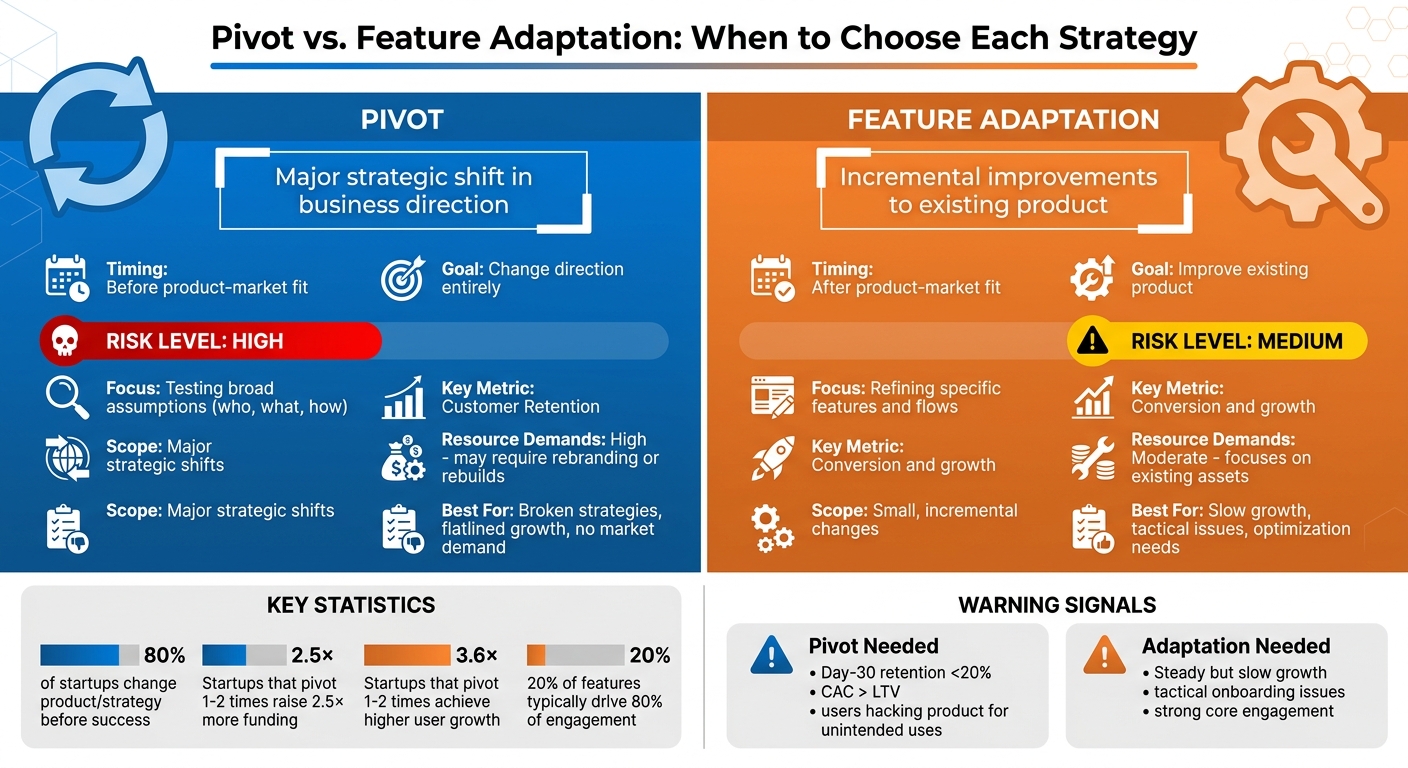
| Dimension | Pivot | Feature Adaptation |
|---|---|---|
| Goal | Change direction | Improve existing product |
| Timing | Before product-market fit | After product-market fit |
| Scope | Major strategic shifts | Small, incremental changes |
| Risk | High | Medium |
| Focus | Testing assumptions | Refining features |
Knowing when to pivot versus adapt can save your startup time, money, and effort. Let’s dive deeper into how to choose the right path by exploring our episode archive of founder journeys.
Pivot vs Feature Adaptation: Strategic Comparison for Startups
What is a Pivot?
A pivot is a major shift in your startup’s direction – a strategic move to test a completely different approach for building a lasting business. It’s not just a minor adjustment; it involves redefining your business model, product, or target audience.
As Eric Ries explains, "A pivot is a change in strategy without a change in vision". You don’t abandon your core vision; instead, you use the lessons learned from your original approach to explore a new path.
Startups often pivot when they can’t achieve product-market fit – when their product fails to solve a real problem for a specific group of customers. Red flags that may signal the need for a pivot include high customer churn, poor acquisition rates, stagnant retention, or unsustainable unit economics where the cost to gain a customer exceeds their lifetime value. In fact, about 80% of startups change their product or strategy before they succeed. Interestingly, startups that pivot one to three times tend to have better survival rates within their first 24 months.
Key Traits of a Pivot
Pivots stand apart from small changes because they involve dramatic shifts rather than minor tweaks. Instead of adjusting small elements like a button’s color, a pivot redefines fundamental aspects like the problem you’re solving, the customers you’re targeting, or your revenue model.
Pivots also require substantial resource reallocation. Take Slack, for example. When the company moved away from its gaming product, Glitch, it redirected 90% of its engineering resources to focus on building a messaging tool. This kind of shift demands full team commitment and often months of effort.
Timing is another critical factor. Early-stage pivots, or "ideation pivots", typically happen within the first three months of launching a product, allowing startups to make sweeping changes quickly. On the other hand, "hard pivots" occur later – around the one-year mark – when a product and user base are more established. These pivots require more precise adjustments while keeping successful elements intact.
Examples of Successful Pivots
Slack is a textbook example of a successful pivot. Between 2009 and 2012, Stewart Butterfield and his team at Tiny Speck worked on a multiplayer game called Glitch. Despite raising $17 million in venture capital and assembling a team of 45, the game failed to gain traction. By 2013, the team pivoted to launch an internal communication tool, Slack. On its first day, the beta attracted 8,000 company signups, and within eight months, Slack hit $1 million in annual recurring revenue – breaking records at the time. Salesforce later acquired Slack in 2021 for $27.7 billion.
Shopify followed a similar path. Originally launched as Snowdevil, an online snowboard store in 2004, founders Tobias Lutke and Scott Lake realized the e-commerce platform they built was more valuable than selling snowboards. By 2006, they pivoted to offer the platform as Shopify. Years later, Shopify’s market cap peaked at over $200 billion in 2021.
PayPal also pivoted its way to success. Founded as Confinity in 1998, it initially focused on security software for Palm Pilots. When that idea failed to gain traction, Max Levchin and Peter Thiel shifted in 1999 to enable email-based money transfers. After noticing heavy adoption by eBay sellers, they refined the platform to better serve that market. In 2002, eBay acquired PayPal for $1.5 billion.
With a solid grasp of what pivoting entails, we can now explore how feature adaptation plays a role in refining product strategies.
sbb-itb-772afe6
What is Feature Adaptation?
Feature adaptation is all about refining your product to better serve customer needs without overhauling your business model. Unlike a pivot, which shifts the entire direction of a startup, feature adaptation focuses on improving specific features to enhance the product’s performance and user experience. It’s less about making radical changes and more about fine-tuning what’s already working.
Ash Maurya, author of Running Lean, puts it this way:
"Pivots are about changing direction, while Optimizations are about going faster".
With feature adaptation, the focus is on execution – improving the "how" rather than questioning the "what" or "why" of your business. It’s about building the product right, not second-guessing if you’re building the right product. This approach relies on measurable data and user feedback, steering clear of gut instincts.
Key Traits of Feature Adaptation
Feature adaptation involves small, iterative changes that reduce risk while improving retention and scaling the product. It leverages your existing user base and strengths to make meaningful, data-driven adjustments.
The primary focus here is retention – ensuring users find enough value to keep coming back. While pivots often aim to grow broad metrics like sign-ups, feature adaptation zeroes in on validating whether the product is delivering value effectively.
A critical principle behind successful adaptations is the 80/20 rule: prioritize the 20% of changes that will benefit 80% of your users. Instead of chasing every feature request, identify patterns in feedback and support tickets to address the most pressing limitations. This ensures that your efforts are both impactful and efficient.
Examples of Feature Adaptation
Buffer is a great example of feature adaptation in action. What started as a simple scheduling tool evolved into a full-fledged social media management platform. Founder Joel Gascoigne listened closely to early users, gradually adding features like analytics and support for multiple social networks – all while staying true to the company’s core focus on content scheduling.
Codeverse also illustrates this concept well. When the company transitioned to virtual tutoring, it initially relied on third-party tools like Zoom and Calendly. Although users were satisfied, feedback revealed frustration with the fragmented setup. Priya Mathew Badger, the company’s SVP of Product, led the charge to integrate video functionality directly into their coding platform. This allowed students to view their instructors in a corner window while coding. As Badger explained:
"The data tells you what happened, but talking to users tells you why it happened" (as discussed in various founder stories).
This change elevated the user experience without altering the company’s core mission of education.
Instagram offers another example. By focusing on its core photo-sharing and filtering features, the app stripped away unnecessary elements, demonstrating how refining what works can drive success.
Main Differences Between Pivot and Feature Adaptation
Timing and scope are two of the biggest factors that set pivoting apart from feature adaptation. While both approaches aim to improve your startup’s chances of success, they operate on entirely different levels. A pivot is a complete shift in direction for your business model, whereas feature adaptation is about fine-tuning an existing model to make it more effective and scalable.
Timing is everything. Pivoting usually happens before reaching product-market fit (PMF), during the stage where you’re still figuring out if your business idea has legs. Once you’ve nailed PMF, that’s when feature adaptation takes the spotlight, helping you refine and optimize what’s already working.
The scope of change also varies significantly. A pivot involves rethinking the big picture – who your customers are, what problem you’re solving, or the way you’re solving it. On the other hand, feature adaptation focuses on smaller, tactical changes like tweaking the user interface, improving user workflows, or enhancing specific features. Think of it this way: a pivot asks, "Are we building the right product?" Feature adaptation asks, "Are we building the product the right way?"
Comparison Table: Pivot vs. Feature Adaptation
Here’s a side-by-side look at how these two approaches differ:
| Dimension | Pivot | Feature Adaptation |
|---|---|---|
| Primary Goal | Course correction for scalability | Boosting efficiency and enabling growth |
| Timing | Before product-market fit | After product-market fit |
| Scope of Change | Major strategic shifts | Incremental improvements |
| Focus | Testing broad assumptions (who, what, how) | Refining specific features and flows |
| Key Metric | Customer Retention | Conversion and growth |
| Risk Level | High – potential for strategic failure | Medium – risk of over-optimization |
| Resource Demands | High – may require rebranding or rebuilds | Moderate – focuses on existing assets |
| Learning Rate | High – bold, rapid experimentation | Low – gradual, steady refinements |
When to Pivot vs. When to Adapt
So, how do you decide which path to take? Here’s a breakdown:
- When to Pivot: If your growth has stalled, acquisition costs are consistently higher than the customer lifetime value, or users are gravitating toward non-core features instead of your main offering, it might be time to pivot. A Day-30 retention rate below 20% is another red flag that your current strategy isn’t working and a pivot could be necessary.
- When to Adapt: Feature adaptation is the better route when your key metrics are improving, but challenges are more tactical than strategic. For example, issues with onboarding or unclear messaging can often be solved without overhauling the entire business. If your power users are still highly engaged and your core value proposition resonates, focus on refining and optimizing.
One thing to watch out for: pivoting too often can signal deeper problems with your overall vision. Research shows that startups that pivot three or more times often don’t perform better than those that stick to a consistent strategy. The key is knowing when to be flexible and when to double down on what’s already working. Many tech leaders and startup founders share similar stories of navigating these critical crossroads. By aligning your approach with your startup’s current stage, you can chart a more effective path toward sustainable growth.
When to Choose a Pivot Over Feature Adaptation
A pivot is a big decision that comes into play when the core assumptions about your market, customers, or product are off track. This isn’t about patching up small issues like a weak onboarding process – it’s about realizing that the very foundation of your business needs a major overhaul.
Signs That a Pivot is Needed
The most obvious clue that it’s time to pivot? Persistent, deep-rooted problems that stick around even when you’re executing everything flawlessly. If you’re shipping updates, running solid marketing campaigns, gathering user feedback, and still seeing flat growth, the problem isn’t operational – it’s foundational. Many startup tech leaders have faced these exact crossroads when scaling their products. For example, if your Day-30 retention rate remains low and users are “hacking” your product to fit needs you didn’t anticipate, it’s a clear sign something isn’t clicking.
Pay close attention to how your users engage with your product. Actions often speak louder than words. When users start using your product in ways you didn’t intend, they might be pointing you toward the real value. Take Instagram’s origin story: Kevin Systrom and Mike Krieger saw that users of their app Burbn were ignoring most features except photo sharing. They stripped everything else, added filters, and rebranded as Instagram. In just three months, they hit 1 million users. Reflecting on this, Systrom said:
"We knew it wasn’t working when we would give it to people and they’d just keep bouncing off".
Financial data can also scream for a pivot. Loom’s founders, for instance, realized something had to change when, after seven months, they had only $600 in revenue. This realization, driven by co-founder Shahed Khan’s analysis, led them to pivot to their now-successful screen-recording platform. Similarly, Segment’s CEO, Peter Reinhardt, noticed their university lecture tool wasn’t holding attention – students spent more time on Facebook during class. This failure spurred their shift to a data integration platform.
When these red flags appear, it’s time to embrace the idea of a pivot and plan your next steps carefully.
Requirements for a Successful Pivot
Once you’ve identified the need to pivot, success depends on a structured and deliberate approach. Start with data-driven hypotheses. Before diving in, perform a thorough analysis to understand market trends, resource allocation, and competitive dynamics. Summarize your findings in a one-page “Pivot Brief” that outlines the changes, what stays the same, and what success should look like in the next 90 days.
Team alignment is critical. When Stewart Butterfield and his team at Tiny Speck realized their multiplayer game Glitch wasn’t scalable – even with $17.2 million in funding – they had to secure full buy-in from co-founders and lead investors before pivoting to create Slack in 2012. As Dalton Caldwell from Y Combinator explains:
"Pivoting is all about opportunity cost… It’s much easier to be lucky when you get half a dozen shots on goal than one".
Equally important is founder conviction. Let go of the sunk cost fallacy – the emotional pull of past investments in time and money. What really matters is how you use your remaining resources to fuel future growth. Set new goals and metrics that reflect your pivot, and let go of outdated KPIs. Engage 10-20 “design partner” customers who can offer weekly feedback during development. Be prepared for some team turnover as not everyone may align with your new direction.
When to Choose Feature Adaptation Over a Pivot
Feature adaptation focuses on fine-tuning how you deliver your product or service while keeping your core mission intact. Unlike a pivot, which involves a major shift in strategy or direction, adaptation is about improving execution. It’s the right choice when the problem lies in how things are being done, not in the fundamental vision of your business.
Scenarios Favoring Feature Adaptation
If your startup’s core mission is solid, but the execution needs tweaking, feature adaptation can be a game-changer. When performance is improving steadily but not as quickly as desired, small but meaningful changes can make a big difference. Jurgen Appelo calls this a "patch" – a targeted redesign that fixes underperforming elements without overhauling the entire system. It’s about replacing what doesn’t work while retaining what does.
Think about the Pareto Principle: around 20% of your features typically generate 80% of user engagement. Walmart, for instance, adopted a mobile-first strategy to address specific user needs. This shift resulted in a 20% boost in conversions and a staggering 98% increase in mobile orders. Similarly, GymShark noticed users leaving the checkout process to look up sizing information. By integrating sizing guidance directly into the checkout flow, they saw an 11% increase in conversions.
For startups with limited resources, adaptation often makes more sense than a full pivot. With nearly 90% of startups failing within five years and a 30% rise in closures in India by 2025 compared to the previous year, a complete overhaul can be too costly. Instead, focusing on existing strengths and infrastructure allows you to make impactful changes without draining your runway. Unlike the dramatic changes of a pivot, adaptation works best when your foundation is already strong. These scenarios highlight why tactical improvements can be the smarter path forward.
Best Practices for Feature Adaptation
Once you’ve identified the need for adaptation, following these best practices can help ensure success. Start by pinpointing your "Core 20%" – the features that drive the most engagement. Use data analytics and A/B testing to confirm which features are worth focusing on before diving into any redesign. For example, Airbnb’s founders, Brian Chesky and Joe Gebbia, noticed hosts spending too much time repeating check-in instructions. They responded by developing a global check-in tool that automated the process, significantly improving the host experience.
Test your changes on a small scale before committing fully. Short-term experiments with clear goals can help you gauge the effectiveness of adaptations. Using feature flags (or canary deployment), you can roll out changes to a limited group of users, minimizing risk while collecting valuable feedback.
Closing the feedback loop is equally important. Dr. Sanjay Arora emphasizes the need for direct follow-ups:
"As a manager, we tend to delegate, but we don’t tend to close the loop. If you delegate, you’re not sure did the problem actually get resolved and the customer also you’re not sure did the manager actually do anything about it?"
Rather than relying solely on delegation, take the time to personally follow up with customers. This approach not only ensures that issues are resolved but also uncovers recurring patterns that might require further refinement. By staying hands-on, you can confirm that your adaptations are hitting the mark and driving meaningful results.
Risks and Implications of Each Approach
Choosing between pivoting and feature adaptation is no small decision. Each path comes with its own set of challenges and rewards, and understanding these trade-offs is crucial for shaping your startup’s future.
Pros and Cons Table: Pivot vs. Feature Adaptation
| Factor | Pivot | Feature Adaptation |
|---|---|---|
| Risk Level | High; may result in technical debt and team turnover | Lower; focuses on improving existing traction |
| Technical Impact | High; often requires major architectural changes or complete rebuilds | Low to Medium; involves tweaking or adding specific functionalities |
| Primary Reward | Discovering product-market fit and tapping into larger opportunities | Incremental improvements and compounding small wins |
| Primary Risk | Loss of momentum and opportunity cost | Falling into the "next feature fallacy" and stagnation |
| Team Impact | Can boost morale or lead to significant emotional strain | Maintains stability but risks creating a "zombie" culture if growth stalls |
| Best For | Addressing broken strategies or flatlined growth | Enhancing metrics that are progressing slowly |
One major pitfall with pivoting is the sunk cost fallacy – founders often hold onto failing ideas because they’ve already invested so much in them. Every month spent on a non-performing direction represents a missed chance to explore something better. Another challenge is the potential for technical debt, as legacy systems may not align with the new direction. Valentina Espina, Customer Success Associate at Capwave, sums it up well:
"A smart pivot keeps your strengths. A sloppy one throws them away".
On the other hand, feature adaptation isn’t without risks. The "next feature fallacy" is a common trap – the misguided belief that adding more features will solve deeper issues with your core strategy. These trade-offs set the stage for deeper considerations around funding, team morale, and competitive positioning.
Long-Term Outcomes to Consider
The long-term implications of pivoting or feature adaptation go beyond the immediate risks. Research indicates that startups that pivot once or twice tend to raise 2.5x more funding and achieve 3.6x higher user growth compared to those that either never pivot or pivot excessively. This "sweet spot" exists because pivoting provides more opportunities to discover product-market fit. As Dalton Caldwell, Managing Director at Y Combinator, puts it:
"[Pivoting] gets more shots on goal to try to find this elusive thing [called product-market fit]. It’s much easier to be lucky when you get half a dozen shots on goal than one."
The effect on team dynamics is equally critical. A well-executed pivot can energize a team by offering a renewed sense of purpose, while prolonged stagnation can lead to burnout. Emmett Shear, Co-founder of Twitch, emphasized this urgency:
"Reigniting growth is almost impossible once it stops. And if you’re not growing on the internet, you’re dying".
Market positioning also shifts depending on the route you choose. Pivoting can help a startup escape tough competitive landscapes or crowded markets by targeting underserved niches or larger opportunities – like transitioning from B2C to B2B. Meanwhile, feature adaptation is ideal for startups that have already found their footing and want to refine their offering to maintain market dominance. Ultimately, the choice between pivoting and feature adaptation depends on where your startup is and what it needs to move forward.
Conclusion
When deciding between a pivot or feature adaptation, it all boils down to your startup’s current situation and the data at hand. A pivot is a bold shift, testing a fresh hypothesis about your product, strategy, or business model. Feature adaptation, on the other hand, focuses on steady, incremental improvements, using validated learning to push your metrics forward.
The key is an honest evaluation of your metrics. If critical indicators – like DAU/MAU below 20%, churn above 10%, or core adoption under 30% after six weeks – are stuck, small adjustments won’t cut it. As Josh Rozin, Co-Founder of Stompers, shared in insights from startup tech leaders wisely puts it:
"Your data won’t lie to you, so don’t use it to lie to yourself".
Be cautious of vanity metrics, like total downloads, which can give a false sense of success. Instead, focus on actionable metrics – retention, unit economics, and other measures that clearly reflect product-market fit.
Use these insights to shape your next steps. Carefully evaluate your core resources – team, technology, and market knowledge – through a structured lens of opportunity, feasibility, and resource requirements. If pivoting seems necessary, start small. Test the waters with experiments or prototypes before fully committing [6,26]. If feature adaptation feels like the right move, concentrate on the "Core 20%" of features driving the majority of engagement, and cut the rest.
Timing matters. Startups that pivot once or twice tend to raise 2.5× more funding and experience 3.6× higher user growth compared to those that avoid pivoting or pivot too often. A poorly timed pivot can waste potential, while waiting too long can drain resources. Regular "Pivot or Persevere" meetings with your leadership team can help ensure decisions are based on objective, validated learning.
Finally, communicate your decision clearly and back it with data when addressing your team and stakeholders [6,26]. A well-executed pivot leverages your strengths and builds on what’s working, while a careless one risks abandoning valuable progress. Feature adaptation works when growth is steady, but if momentum has stalled, no amount of fine-tuning will turn things around. The key is to align your strategy with the reality of your startup’s position – not where you wish it was.
FAQs
How do I know if I’ve hit product-market fit?
You can tell you’ve reached product-market fit when your product consistently meets customer needs. This is often reflected in glowing feedback, fewer objections, and steady growth in user engagement. Key indicators include your core features delivering the majority of value to users and customers naturally incorporating your product into their daily routines.
However, if growth slows down despite your best efforts, it might point to a disconnect with market demands. This could be a sign to reassess your product’s direction or even explore the possibility of a pivot.
What metrics should trigger a pivot vs. feature tweaks?
Metrics that signal it’s time to pivot include recurring objections from users, stagnant growth, or feedback that exposes major flaws in your core assumptions. On the other hand, smaller adjustments – like tweaking features – are better suited for isolated problems, such as low adoption of a specific feature or targeted complaints. If your core value proposition still holds strong, incremental updates might do the trick. The real challenge lies in recognizing whether you’re dealing with a deeper misalignment or just localized issues, as this distinction is crucial for deciding between a full pivot or minor feature changes.
How can I pivot without losing my existing users?
To shift direction without alienating your audience, take calculated steps that rely on data and build upon your existing successes. Zero in on your strengths, tackle pressing challenges, and fine-tune your approach to better meet user demands. Pay attention to indicators like user pushback or stalled growth, and make adjustments carefully to preserve trust, reduce churn, and ensure your updates align with the expectations of your current users.