Cross-functional teams can speed up decision-making and reduce inefficiencies in startups. By bringing together diverse expertise – like engineering, design, and marketing – these teams tackle shared goals directly, without relying on siloed communication. However, most fail due to unclear objectives and poor structure.
Here’s how to make it work:
- Define the purpose and goals: Set a clear mission tied to measurable outcomes (e.g., improving activation rates). Use tools like OKRs and team charters to align everyone.
- Structure the team wisely: Keep teams small (5-9 members), assign clear roles (using frameworks like DACI), and limit decision-making groups to 3-5 people.
- Set up efficient processes: Use weekly syncs, async updates, and tools like Slack or Notion to streamline workflows. Avoid unnecessary meetings.
- Build trust and collaboration: Encourage open feedback, cross-train team members, and maintain psychological safety for better communication.
- Measure and refine: Track metrics like time to resolve blockers and team health scores. Regularly review and improve your team model.
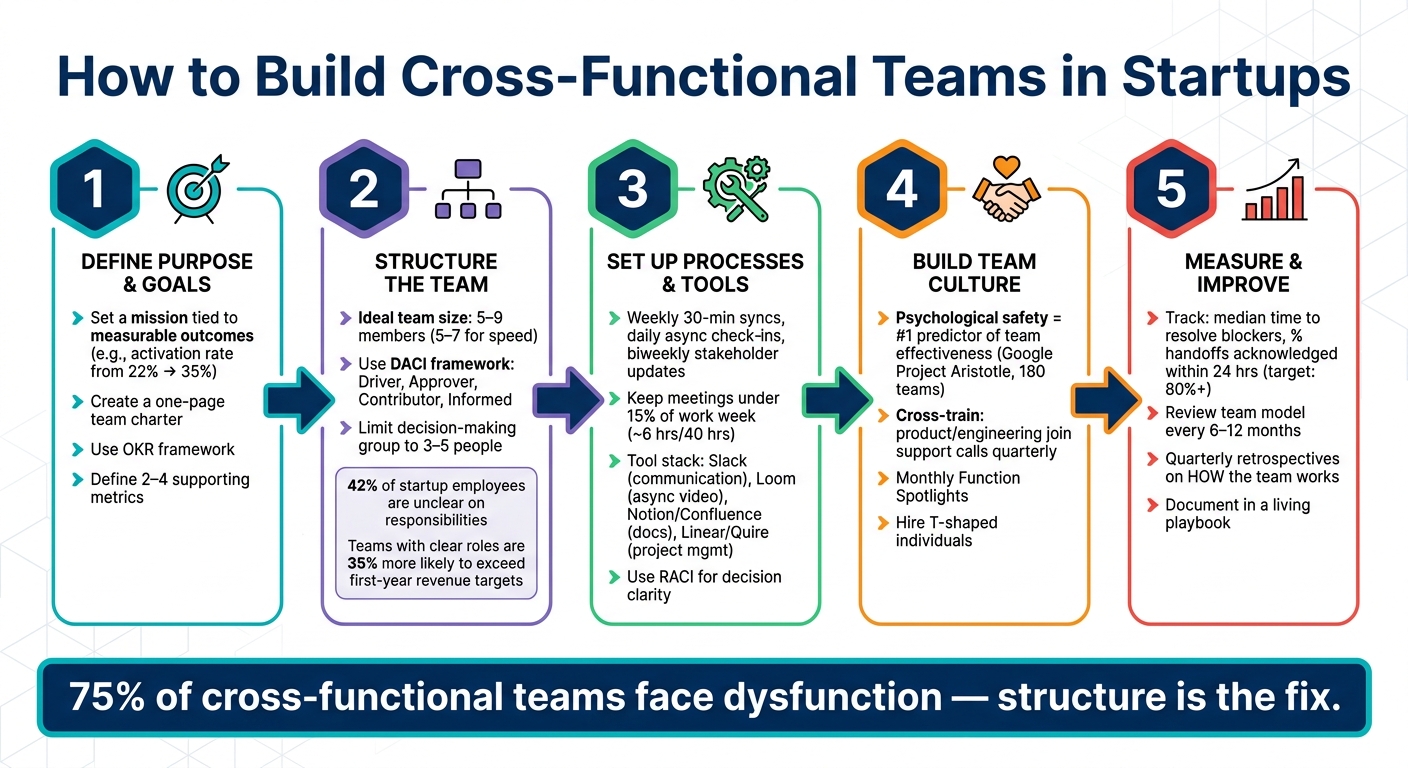
How to Build Cross-Functional Teams in Startups: 5-Step Framework
Cross-Functional Teams Explained: Breaking Silos for Agile Success
sbb-itb-772afe6
Step 1: Define the Purpose and Goals of Your Cross-Functional Team
Defining a clear purpose is the foundation for building an effective cross-functional team. Before assembling the team, ask yourself: What specific outcome is this team expected to achieve? Skipping this step is a common pitfall, often leading to dysfunction. Many cross-functional teams fail because their objectives are unclear from the start.
Set the Team’s Mission and Metrics
Start by translating your company’s broader strategy into a focused, measurable goal. This should be a team-level objective connected directly to customer behavior – think along the lines of increasing the 30-day activation rate from 22% to 35% or reducing churn in a particular customer segment. Indent Technologies sums it up well:
"A clear outcome reduces handoffs and prevents feature bloat."
Once the primary goal is set, identify 2 to 4 supporting metrics to track progress. These metrics should be tied to customer behavior, such as retention, activation rate, or sales velocity. Avoid vague goals like “improve the product experience.” Additionally, define what done looks like before the team begins its work. Misalignment often arises when different departments interpret "done" differently – engineering might think it means code is deployed, while design might expect user testing. Documenting and agreeing on a shared definition early can eliminate this friction.
A practical way to ensure alignment is by creating a one-page team charter. This document outlines the team’s objective, scope, roles, and success metrics, all before execution begins. Pairing this with an OKR (Objectives and Key Results) framework can help the team stay focused on a shared outcome, rather than individual departmental goals.
Know When to Form a Cross-Functional Team
Not every problem calls for a cross-functional team. This structure is most effective when solving challenges that require input from multiple areas – like product, engineering, design, or marketing – and when miscommunication between departments could lead to costly delays. Common scenarios include launching a product, entering a new market, or revamping customer onboarding.
A key indicator that you need a cross-functional team? Silos are slowing you down. If decisions are repeatedly delayed because one team is waiting on another, or if the same misalignment keeps coming up in meetings, it’s time to act. On the other hand, avoid using this structure for routine tasks that fit neatly within a single department – it just adds unnecessary complexity. As Asa Goldstein of QuestWorks puts it:
"Shared ownership almost always means nobody owns the outcome."
The goal is to create focused accountability, not just to ensure every department has a seat at the table. Once you’ve nailed down the purpose, the next step is building a team structure that supports it.
Step 2: Structure Your Cross-Functional Team for Success
Now that your team has a clear mission, the next step is deciding who should be on it and how they’ll work together. With the objective in place, the focus shifts to organizing the team for flexibility and effectiveness.
Choose the Right Team Size and Scope
Start by figuring out the ideal size and scope for your team to ensure it stays nimble. Research suggests that cross-functional teams work best with 5–9 members, with 5–7 being particularly efficient for speed and creativity. For example, in 2017–2018, Airtable had 12 engineers but split them into three smaller, focused groups – Core Product, Collaboration, and Integrations. Each group included a product manager, a designer, and 4–5 engineers. This setup allowed for quicker decisions and faster execution. Many startup tech leaders share similar stories of restructuring for speed.
If your team meetings start dragging on – like standups going over 20 minutes – or if too many people in the room aren’t contributing, it’s a sign your team might be too big. When that happens, consider breaking the group into smaller teams. Organize these smaller teams around customer-focused goals, such as "Checkout Flow" or "Onboarding Experience", rather than technical categories like frontend or backend. This approach keeps the team aligned with what matters most to the customer.
Define Roles and Responsibilities
One of the biggest reasons cross-functional teams struggle is unclear roles. In fact, 42% of startup employees report being unsure about their responsibilities. The solution? Assign clear ownership for every decision.
The DACI framework is a simple way to clarify roles:
| Role | Responsibility |
|---|---|
| Driver | Oversees execution and ensures decisions are made |
| Approver | Has the final say on decisions |
| Contributor | Offers expertise and input |
| Informed | Is updated on the outcome but not involved in the decision |
"The staffing trap is putting too many stakeholders and not enough doers on the team."
Every team member should contribute to progress every week. Stakeholders like department heads or legal and finance teams should stay in the "Contributor" or "Informed" roles – they don’t need to be part of daily standups. Startups that establish this clarity early are 35% more likely to exceed their first-year revenue targets. Once roles are set, make sure the team’s work aligns with the broader goals of the startup.
Connect the Team to the Rest of the Startup
Even the best-structured team needs to stay tied to the larger organization without getting bogged down by constant interruptions. Here’s how to keep them connected:
- Use a shared OKR that links directly to a company-level goal.
- Maintain a visible roadmap, like a Kanban board, to cut down on endless status updates.
- Establish a clear escalation process so the team knows which decisions they can handle independently and which require higher-level approval.
This structure should always reflect the customer priorities defined in Step 1, ensuring that the team stays focused on delivering outcomes that truly matter to your audience.
Step 3: Set Up Team Processes and Tools
Now that your team structure is sorted, the next step is making sure everything runs smoothly. Structure defines roles, but processes show the team how to work together effectively.
Create a Consistent Operating Rhythm
A reliable schedule helps keep everyone on the same page without overloading calendars. For most startup cross-functional teams, a good rhythm might include:
- Weekly 30-minute task-focused syncs: Quick updates to ensure alignment.
- Daily async check-ins: Focused on resolving blockers.
- Biweekly written stakeholder updates: Keeps everyone in the loop without extra meetings.
For individual contributors, aim to keep meeting time under 15% of their week – about 6 hours out of 40.
Here’s a game-changing rule: set a 90-day expiration date on recurring meetings. If a meeting isn’t actively justified after three months, cancel it. This simple practice prevents unnecessary meetings from cluttering calendars.
"If a team needs constant syncing to stay coordinated, the operating model is wrong." – Ali Hajimohamadi
Once you’ve established a rhythm, the next step is finding tools that fit this flow.
Pick Simple Tools for Collaboration
Good processes need the right tools – but simplicity is key. The goal isn’t to have the "best" tools, but to agree as a team on which tool handles what. As Victor Hoang, Co-Founder of Rework, explains:
"Teams that communicate well don’t use better tools than the teams that communicate poorly. They’ve decided, as a group, which tool handles which kind of communication."
Here’s a practical starting toolkit for most startup teams:
| Category | Tool | Purpose |
|---|---|---|
| Communication | Slack | Real-time coordination; keep channels focused |
| Async Video | Loom | Share detailed feedback or walkthroughs without scheduling more meetings |
| Documentation | Notion / Confluence | Store decision logs, wikis, and team charters |
| Project Management | Linear / Quire | Track tasks with a shared, visible status |
One essential rule: task state is the status. If your project management tool reflects real-time progress, there’s no need for separate status reports. Transparency in tools eliminates the need for extra check-ins.
Clarify How Decisions Get Made
Unclear decision-making slows teams down. Every major decision needs a single owner. Without one, accountability doesn’t exist.
The RACI framework can help clarify roles:
- Responsible: Does the work.
- Accountable: Owns the outcome.
- Consulted: Provides input.
- Informed: Kept in the loop.
Limit decision-making groups to 3–5 people. When more than seven people share decision rights, coordination costs often outweigh productivity.
For decisions made in Slack, use a simple format:
Decision: [summary]
Owner: @name
Rationale: [why]
Pin these for easy access. This creates a searchable record and avoids revisiting the same issues in future meetings.
Step 4: Build a Strong Cross-Functional Team Culture
Once you’ve got solid processes and tools in place, the next step is creating a culture where these systems can truly thrive. A clear mission and structured workflows are essential, but they need a supportive culture to deliver lasting success. Trust is the glue that holds it all together – without it, even the best systems fall apart. Here’s how to ensure your team feels secure, understands each other’s roles, and is guided by effective leadership.
Build Psychological Safety
Google’s Project Aristotle analyzed 180 teams over two years and found that psychological safety – the belief that it’s safe to take interpersonal risks – was the top predictor of team effectiveness. For leaders, this starts with showing vulnerability. Be open about your mistakes and approach problems as shared challenges rather than opportunities to assign blame.
A simple yet powerful habit: at the end of a major decision meeting, ask, “What’s the strongest objection to this plan?” This question helps uncover hidden disagreements and prevents the team from falling into a false consensus.
"Psychological safety is a shared belief held by members of a team that the team is safe for interpersonal risk-taking." – Convoy Pod Model Documentation
Don’t just celebrate wins – acknowledge failures too. When you only highlight successes, you discourage the kind of bold, risk-taking ideas that can lead to real breakthroughs.
Help Team Members Understand Each Other’s Work
Cross-functional teams often face roadblocks when roles aren’t clear. Misunderstandings can delay progress, but joint design reviews are a great way to surface feasibility issues early.
Encourage deliberate cross-training. For example, have product and engineering team members join support calls or sales demos at least once a quarter. Run collaborative design reviews with engineering present to clarify the reasoning behind design decisions. Monthly “Function Spotlights” can also help – one department shares its goals, challenges, and metrics with the rest of the team.
Focus on building teams with T-shaped individuals – those who have deep expertise in one area but are curious and willing to contribute in other areas too.
Model the Right Leadership Behaviors
In cross-functional teams, tech leaders often don’t have direct authority over every team member, making influence more critical than hierarchy.
"Authority may get compliance. Influence gets commitment." – Mitch Levinson, Digital Transformation Leader
Strong leaders bridge technical and business priorities, ensuring everyone stays aligned. They keep goals visible, celebrate team-wide achievements, and publicly acknowledge expertise across different functions.
Here’s an example: In February 2026, Ruhani Rabin documented a cross-functional insurance support team struggling to meet retention targets for three straight quarters. A new leader introduced a unified goal framework, linking every weekly plan to a single shared metric – saving at-risk small-business accounts. Within two months, the team hit their target, proving that shared clarity can drive success even without structural changes.
Up next: How to measure and refine your team model.
Step 5: Measure and Improve Your Team Model
Building and maintaining a strong cross-functional team requires ongoing effort. Think of your team model as a product – something that needs regular testing, evaluation, and updates. This mindset helps teams stay effective and avoid slipping into inefficiency or dysfunction over time.
Track Team Outcomes and Health
To gauge your team’s performance, focus on two key areas: outcomes (are you achieving business goals?) and team health (is collaboration smooth and effective?). Some metrics that can help you monitor these include:
- Median time to resolve blockers: How quickly does your team address obstacles?
- Percentage of handoffs acknowledged within 24 hours: If this falls below 80%, it could signal looming delays.
Here’s a breakdown of useful metrics:
| Metric Category | Specific Metric | What It Tells You |
|---|---|---|
| Outcome | Revenue contribution / Retention | Whether the team is driving business progress |
| Execution | Median time to resolve blockers | How efficiently the team overcomes challenges |
| Collaboration | % of handoffs acknowledged within 24 hours | Signs of inter-team friction or delays |
| Efficiency | Async vs. sync decision ratio | The level of coordination effort required |
| Health | Qualitative team health scores | Early indicators of burnout or disengagement |
To make these reviews actionable, pair them with follow-up tasks and assign clear ownership for each item. Without this step, metric reviews risk becoming just another meeting without impact.
Test Changes to How the Team Works
When processes start to break down – like standups dragging on, unclear ownership, or slower progress despite adding more people – it’s a sign to experiment, not to simply push harder. For example, research from 2025 shows that smaller teams of 5–7 engineers tend to outperform larger ones in both speed and quality.
Before making changes, set minimum data thresholds. This ensures you don’t abandon promising adjustments too soon or stick with ineffective ones for too long. Aim to review your team model every 6–12 months to ensure it aligns with your team’s maturity and the complexity of your product.
"Every system is perfectly designed to get the results it gets." – W. Edwards Deming
Consider running quarterly retrospectives focused entirely on how the team operates, rather than what it has delivered. Ask a simple but powerful question: "Did our systems help or hinder us?". Use the insights to refine your team’s processes and update your playbook.
Document and Share What Works
One common pitfall is failing to document process improvements. Without this step, teams often find themselves revisiting the same decisions over and over. Structured team formation processes, combined with proper documentation, can boost productivity for new teams by over 70%.
Create and maintain a concise, living playbook on an internal wiki. This should include:
- Working agreements
- Decision-making frameworks
- Communication norms
- Lessons learned from retrospectives
Keeping this playbook up to date ensures that new team members can hit the ground running without revisiting old questions. The first 90 days of a new team are especially critical for establishing good documentation habits. Patterns set during this period often stick.
Conclusion: How to Build Cross-Functional Teams That Work
Creating a cross-functional team is not a one-time task – it’s a continuous journey. Following the five steps outlined here can set you on the right track: define a clear purpose, design an effective structure, implement straightforward processes, nurture a strong team culture, and consistently measure progress. Regular reviews of goals, periodic audits, and retrospectives are essential to avoid dysfunction and keep the team moving forward.
Here’s a striking fact: 75% of cross-functional teams face dysfunction.
The best-performing teams approach their structure like a product – constantly refining it. They keep teams small (ideally 7 ± 2 members), prioritize outcomes over functions, and ensure decisions have clear ownership. Honest reflection through regular health checks and retrospectives helps identify what’s working and what needs improvement.
In these teams, influence outweighs authority. Success comes when leaders earn trust across disciplines, team members feel comfortable challenging ideas, and everyone shares responsibility for results. Transparent decision-making and shared accountability, as emphasized earlier, are critical to achieving this balance.
Start with small steps, stay consistent, and treat each cycle as a chance to get better.
FAQs
When should a startup avoid a cross-functional team?
Startups should think twice about forming cross-functional teams if the mission isn’t clearly defined. Without specific goals, budgets, timelines, or criteria for success, progress can grind to a halt. It’s also a problem if the team doesn’t have the authority to make decisions independently, as this can lead to frustrating delays. If the primary aim is to cover political bases rather than focus on tangible outcomes, cross-functional teams might end up overstaffed and ineffective. Before moving forward, make sure issues like governance and accountability are fully addressed.
Who should be the decision-maker on a cross-functional team?
In cross-functional teams, assigning decision-making responsibilities is crucial to avoid confusion. Using structured frameworks like RACI, DACI, or RAPID can help clarify roles. These frameworks define who has the authority to make final decisions and who contributes input, ensuring everyone understands their part. Additionally, empowering team members to make decisions within their areas of expertise keeps the process efficient and helps the team maintain momentum.
How do you prevent cross-functional teams from becoming meeting-heavy?
Replace status-update meetings with a clear project management system that shows task progress as the definitive source of truth. Use asynchronous updates for sharing progress and critiques, saving live meetings for urgent, high-stakes decisions. Define clear decision-making guidelines, such as a RACI matrix, so roles and responsibilities are well understood, eliminating the need for consensus-driven meetings.