Crowdfunding success isn’t just about raising money – it’s about managing it wisely. Poor budgeting is one of the main reasons 35% of funded campaigns fail after launch. Here’s what you need to know to avoid common pitfalls and deliver on your promises:
- Set a realistic goal: Base it on actual costs (manufacturing, shipping, marketing, fees, taxes) and add a 10–20% buffer for unexpected expenses.
- Understand hidden costs: Platform fees (5%), payment processing fees (3–5%), and taxes can reduce your funds by 15–20%.
- Plan for cash flow gaps: Funds often arrive 30 days post-campaign, so budget for early expenses like production and marketing.
- Price rewards carefully: Cover all costs, maintain profit margins, and avoid offering too many tiers.
- Track daily metrics: Monitor pledge velocity, conversion rates, and ad performance to adjust your strategy mid-campaign.
A detailed budget ensures you stay on track through pre-launch, the live campaign, and fulfillment. Neglecting this step can lead to financial headaches – even if you hit your funding goal. Let’s dive into the details.
Setting a Realistic Campaign Goal and Financial Plan
How to Calculate Your Total Funding Needs
Many founders make the mistake of setting their fundraising goal based on what they want rather than what they need. A realistic goal starts with a detailed breakdown of every hard cost – things like manufacturing, tooling, packaging, shipping, marketing, platform fees, and taxes.
Once you’ve calculated these hard costs, use that number as your baseline. Keep in mind that platform and payment processing fees generally take up about 8–10% of your total funds raised. To cover these fees, divide your hard costs by a factor between 0.88 and 0.90. For example, if your hard costs add up to $90,000, your public goal should be at least $100,000 ($90,000 ÷ 0.90) to ensure every expense is covered.
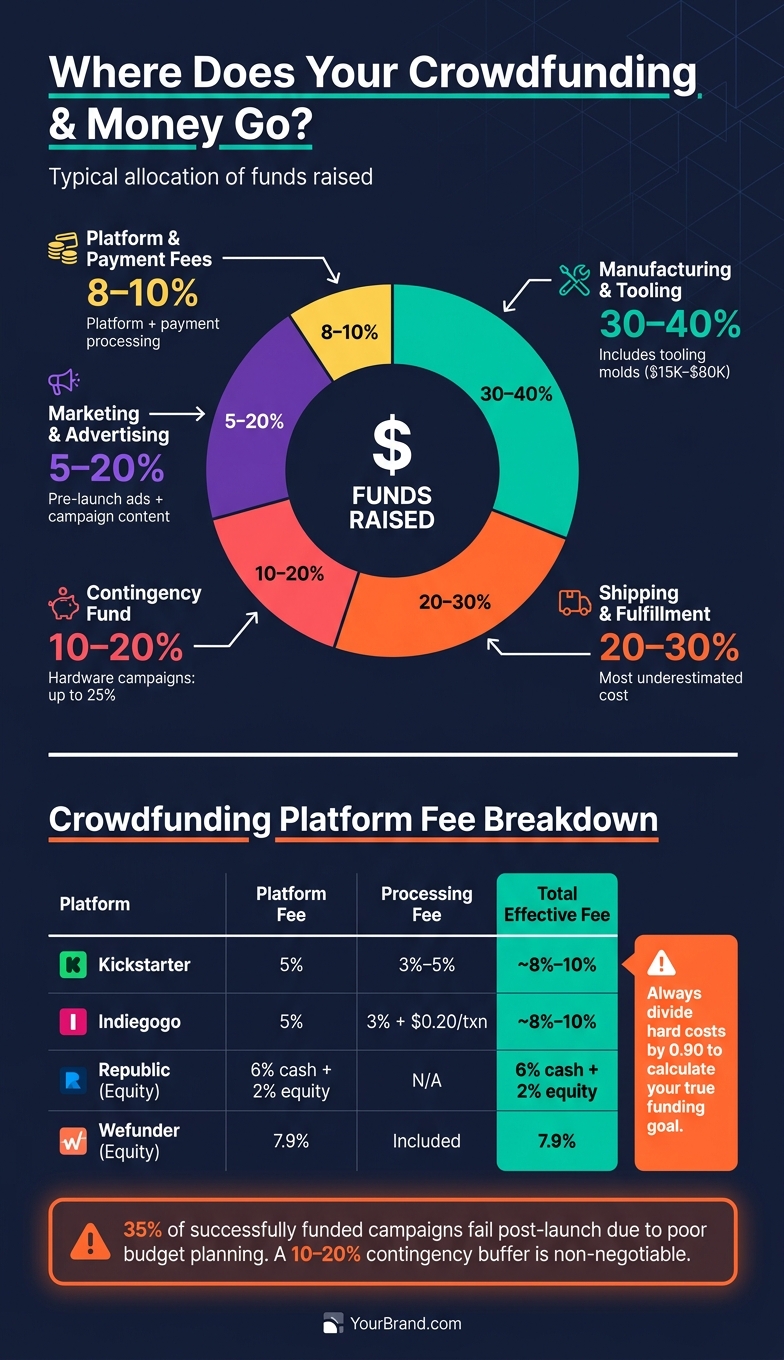
| Budget Category | Typical Allocation | Key Considerations |
|---|---|---|
| Manufacturing & Tooling | 30%–40% | Include one-time mold fees ($15,000–$80,000) and MOQs |
| Shipping & Fulfillment | 20%–30% | This is often underestimated – plan carefully |
| Platform & Payment Fees | 8%–10% | Includes 5% platform fees and 3–5% payment processing |
| Marketing & Advertising | 5%–20% | Covers pre-launch list building and live campaign ads |
| Contingency Fund | 10%–20% | A must-have safety net for unexpected costs |
It’s important to note: don’t include money already spent on prototypes or video production in your funding goal. These are sunk costs – risks you took before launching – and adding them to your goal can make your target seem unnecessarily high, which might scare off potential backers.
Once you’ve nailed down your funding estimates, align them with your audience size to set realistic backer targets.
How to Set Goals You Can Actually Hit
The size of your audience is the best indicator of whether you’ll meet your goal. On average, 20–30% of your pre-launch email list will convert into backers. So, if you need 500 backers on day one, you should aim for 1,700–2,500 email subscribers before launching.
A helpful rule of thumb: for every $20,000–$50,000 in funding needed, build an email list of 200–300 subscribers. Hitting 30% of your goal within the first 48 hours dramatically increases your chances of success. This makes your pre-launch list your safety net for launch day.
To validate interest and build this list, pre-launch ad spend for a campaign goal of $30,000–$100,000 typically falls between $500 and $2,000 – a small investment to test the waters before going live.
"If you set your goal too low, you might not end up raising enough money to cover your expenses. If you set your goal too high, you may not come close to reaching it at all." – LaunchBoom
Once you’ve set realistic backer targets, it’s time to prepare for the unexpected by building in a contingency buffer.
Why You Need a Contingency Buffer
Even with a well-planned budget, surprises are almost inevitable. Shipping rates might fluctuate, suppliers could raise their prices, or some products might need to be replaced due to defects. To handle these uncertainties, set aside a contingency buffer of 10–20% of your budget. For more complex hardware campaigns with international logistics, experts suggest going as high as 25%.
The numbers back this up: 35% of successfully funded campaigns fail post-funding due to cash flow issues, and budget miscalculations average about 40% on failed projects.
"A 15% buffer can be the difference between a minor hiccup and a campaign-ending disaster." – PledgeBox
Treat your contingency fund as a reserved expense from the start. Assign it a specific dollar amount in your budget and only tap into it when all other costs are accounted for. This safety net can mean the difference between a smooth campaign and a financial headache.
How to Plan Your Crowdfunding Timeline and Strategy
How to Build a Detailed Crowdfunding Budget
Crowdfunding Platform Fees & Budget Allocation Guide
Once you’ve set your funding goal and included a contingency buffer, it’s time to allocate every dollar. A well-thought-out crowdfunding budget typically covers three main areas: product and fulfillment, marketing and operations, and platform fees with taxes.
Product and Fulfillment Costs
For campaigns involving physical products, manufacturing and fulfillment often take the largest share of the budget – usually around 30%–40%. These costs can sneak up on founders, especially when it comes to tooling fees and shipping.
Custom injection molds, for example, can range from $15,000 to $80,000 and must be paid upfront before production begins. Additionally, your Minimum Order Quantity (MOQ) plays a big role in your per-unit costs. Smaller orders will have higher per-unit prices, while larger orders can lower costs but may require more storage space. To get accurate pricing, request quotes from 3–5 manufacturers using a detailed technical pack.
Shipping is another major expense that deserves close attention. According to PledgeBox:
"Shipping is the silent campaign killer. It’s notoriously complex and causes more budget blowouts than almost anything else."
Instead of relying on rough estimates, integrate shipping fees into your budget. A pledge manager can help you collect these fees after the campaign, charging backers based on their location and package weight. If you’re offering digital products like software or ebooks, replace manufacturing costs with expenses like editing, quality assurance, licensing, and distribution fees.
Once you’ve outlined product and fulfillment costs, shift your focus to marketing and campaign operations.
Marketing and Campaign Operations Costs
Marketing is another critical piece of your budget, typically accounting for 5%–15% of the total. This includes everything from your campaign page and video to ad spend, all of which help attract backers.
High-quality visuals make a big difference. Professional photography, for instance, can increase funding by 40%–60% compared to amateur shots. Similarly, investing in video production, social media ads, PR, and email campaigns can drive more engagement. For campaigns with funding goals between $30,000 and $100,000, plan to spend $500–$2,000 on pre-launch advertising to build an email list before you go live. Money spent on pre-launch efforts often pays off when the campaign starts.
Once you’ve covered marketing and operations, it’s time to factor in platform fees and taxes.
Platform Fees, Taxes, and Financial Buffers
Platform and processing fees can take a noticeable chunk out of your funds – usually around 8%–10% of your gross raise. It’s important to account for these costs to ensure you can deliver on your promises.
| Platform | Platform Fee | Processing Fee | Total Effective Fee |
|---|---|---|---|
| Kickstarter | 5% | 3%–5% | ~8%–10% |
| Indiegogo | 5% | 3% + $0.20/transaction | ~8%–10% |
| Republic (Equity) | 6% cash + 2% equity | N/A | 6% cash + 2% equity |
| Wefunder (Equity) | 7.9% | Included | 7.9% |
Taxes are another layer to consider. In the U.S., crowdfunding proceeds are generally treated as taxable income at both the state and federal levels. To be safe, set aside at least 10% of your funds for taxes until your accountant provides a final figure. If your campaign involves shipping to multiple states, watch out for economic nexus thresholds – many states require sales tax collection once you hit $100,000 in sales or 200 transactions. For equity crowdfunding under Regulation CF, you’ll also need to budget $10,000–$50,000 for legal fees, audited financials, and Form C filings.
sbb-itb-772afe6
Pricing Rewards and Managing Cash Flow
How to Structure and Price Reward Tiers
When pricing reward tiers, you need to strike a balance: price too low, and you’ll struggle to cover costs; price too high, and backers may hesitate to support you. Start by calculating your full cost stack, which includes the Bill of Materials, tooling, packaging, fulfillment, platform fees (around 10%), and a 15% contingency buffer to handle unexpected expenses.
To avoid overwhelming potential backers, stick to 3–5 tiers. Too many options can confuse people, while too few might leave potential revenue untapped. Here’s a simple example of a tier structure:
| Tier | Discount vs. Retail | Purpose |
|---|---|---|
| Super Early Bird | 30–40% off | Encourages day-one momentum; rewards early supporters like your email list |
| Early Bird | 20–25% off | Drives volume in the campaign’s first week |
| Standard Backer | 10–20% off | Becomes the main revenue driver for most of the campaign |
| Deluxe / Bundle | At or above MSRP | Increases average order value with extras or exclusives |
A key rule: keep all tiers above $10. Lower-priced pledges incur higher payment processing fees – up to 5% + $0.05 per transaction compared to the standard 3% + $0.20. These fees can quietly erode your margins. Eliot Reynolds, Senior Business Analyst, explains it well:
"Set reward tiers above $10 whenever possible. Kickstarter charges higher payment processing fees on pledges under $10… Small pledges eat into your margins fast."
Also, calculate shipping costs separately to avoid inflating platform fees unnecessarily. By pricing your rewards properly, you’ll be better prepared to handle cash flow challenges during and after the campaign.
How to Plan for Cash Flow Gaps
Cash flow in crowdfunding follows three stages: pre-launch (covering production, marketing, and legal expenses), launch (ads and PR), and post-campaign (manufacturing, fulfillment, and reporting). The challenge? Most spending happens early on, but funds from backers won’t hit your account until up to 30 days after the campaign ends.
This delay makes a solid cash flow strategy essential. Alongside detailed budgeting, consider tools like BackerKit or PledgeBox to secure pre-orders during production. You can also negotiate phased billing with vendors to reduce the strain caused by delayed disbursements.
Keep in mind that 3%–5% of pledges may drop off after the campaign due to expired credit cards or insufficient funds. Build this potential loss into your cash flow projections so it doesn’t catch you by surprise.
How to Budget for Stretch Goals Without Overcommitting
Stretch goals can inject energy into your campaign, especially during slower periods like days 7, 14, and 21. However, they can also be financially risky if you don’t plan for them properly. To avoid overcommitting, include the costs of stretch goals – such as production, packaging, shipping, and platform fees – in your initial budget.
A good rule of thumb: keep the production cost of any stretch goal to 10% of the funding differential, which is the gap between your original goal and the stretch target. Russell Nohelty, a USA Today–bestselling author, emphasizes the importance of planning ahead:
"Any stretch goal you decide to offer will need to be paid for, including production and shipping. It’s best to plan out your stretch goals at the budgeting stage – long before you launch your campaign – to make sure you’ve accounted for them fully."
To minimize risks, cap stretch goals at 50% of your base funding goal. If physical add-ons seem too costly to produce at scale, consider digital or experiential stretch goals instead. These are far cheaper to deliver and don’t come with the logistical headaches of physical products.
How to Track and Adjust Your Budget During the Campaign
Key Metrics to Track Every Day
Once your campaign is live, your budget becomes more than just a plan – it’s a scoreboard reflecting your progress. The three most crucial numbers to monitor are pledge velocity, cost per acquisition (CPA), and return on ad spend (ROAS).
- Pledge velocity shows how quickly funds are coming in. If it drops below your daily target, it’s a red flag that action is needed right away.
- CPA and ROAS – available through platforms like Meta, Google, or TikTok – indicate whether your ad spend is delivering results. Typically, successful campaigns allocate 5%–15% of their total goal to marketing. If your CPA increases but pledges don’t follow suit, it’s time to pivot.
Another critical metric is your conversion rate by traffic source. Conversion rates vary by audience type:
- Cold traffic: 1%–3%
- Warm audiences (e.g., your email list): 5%–10%
- Referrals: 15%–25%
If cold traffic is burning through your budget without results, shift funds toward warmer audiences immediately. Also, keep potential payment drop-offs in mind to refine your daily projections.
"The first 48 hours are critical. Algorithm visibility is determined early – slow start = death spiral." – eComCalculators.io
Data shows that campaigns reaching 30% of their goal in the first 48 hours have a 90% success rate. Use this milestone to measure your progress, rather than focusing solely on the final goal. These daily metrics will guide any necessary mid-campaign adjustments.
How to Adjust Your Budget Mid-Campaign
Your campaign budget should be flexible, adapting to real-time performance. If you notice underperformance, act quickly.
For example, if ROAS dips, redirect ad spend from cold traffic to retargeting audiences. Focus on people who visited your pre-launch page but didn’t pledge – they’re already familiar with your product and are less expensive to convert. Conversely, if a particular ad creative is performing well, increase its budget immediately to maximize its impact.
In the final 48–72 hours, consider introducing a surprise stretch goal to reinvigorate your audience. This tactic can boost your total by 15%–20% by encouraging undecided backers to commit. Just be sure the costs for this stretch goal were accounted for in your original budget.
Here’s a practical tip: as your backer count grows, use it as leverage to negotiate better rates with carriers and fulfillment providers. Shipping terms are often finalized closer to the fulfillment stage, so this is a great opportunity to reduce costs.
Staying responsive to real-time data ensures your campaign remains on track.
Post-Campaign Budget Review
Once your campaign ends, the first step is a thorough financial reconciliation. Before spending any of the funds raised, deduct platform fees (5%) and payment processing fees (3%–5%) from your gross total. What remains is your actual working budget.
Next, compare your original budget to actual expenses. This will help you spot areas of overspending or unexpected savings. On average, budgeting errors for unsuccessful tech and hardware campaigns amount to 40%. Even successful campaigns can reveal gaps worth addressing. Document these discrepancies in a simple spreadsheet, noting the reasons for each. This record will be invaluable for planning future campaigns.
Finally, use tools like BackerKit or PledgeBox to collect accurate shipping fees and taxes after the campaign ends. Charging backers real-time rates – rather than relying on outdated estimates – helps protect your margins from unexpected cost fluctuations.
"A budget planner… turns the planner from a one-time setup document into a daily strategic dashboard." – Shark Ponds
Conclusion: Key Takeaways for Crowdfunding Budgeting
A strong budget is the backbone of any successful crowdfunding campaign. With only 38% of Kickstarter projects meeting their funding goals and 35% of funded campaigns failing later due to cash flow problems, careful financial planning is non-negotiable.
Think of your budget as a flexible roadmap. It should evolve across the three critical phases: pre-launch, the live campaign, and post-campaign fulfillment. Each phase comes with its own costs, and overlooking expenses – like shipping or international taxes – can eat into your profits before production even begins.
Here are some key points to keep in mind:
- Platform fees will take about 8–10% of your total funds raised.
- A contingency buffer of 10–20% is a must to handle unexpected costs.
- Reward tiers should be designed to generate at least a 50% profit margin to cover early expenses.
The Coolest Cooler campaign serves as a cautionary tale. Despite raising over $13 million, underestimated production and fulfillment costs left many backers disappointed. The takeaway? A realistic, well-thought-out budget – complete with accurate cost estimates and a clear post-campaign revenue strategy – can mean the difference between fulfilling your promises or falling short. Use these strategies to ensure your campaign not only meets its goals but delivers on them, too.
FAQs
How do I estimate shipping costs before launch?
When figuring out shipping costs, it’s essential to consider the entire package. This means factoring in not just the product itself but also the box, inserts, and protective materials. Shipping carriers calculate costs based on either the actual weight or the dimensional weight – which is determined using the formula: (Length x Width x Height) / DIM Divisor.
To get a clear picture of costs, research shipping rates for all the regions you plan to serve. Don’t overlook additional expenses like fuel surcharges, handling fees, insurance, and taxes or duties (such as VAT) for international shipments. For the most precise estimates, use online shipping calculators or reach out to carriers directly for quotes.
What should I do if my funding goal is too high or too low?
Setting an overly ambitious goal can backfire if you lack the necessary support, leading to failure. Instead, aim for a realistic target that accounts for manufacturing costs, a 15–30% contingency, platform fees, and shipping expenses. To boost your chances of success, try securing early commitments that cover 20–25% of your funding goal.
On the flip side, setting a goal that’s too low can leave you scrambling to fulfill orders. Always make sure your target fully covers 100% of production and delivery costs. If you need additional funding, consider using stretch goals to address those needs without jeopardizing your project’s feasibility.
How can I avoid running out of cash before funds are paid out?
Think of your budget as something you can adjust, not a rigid plan set in stone. To cover surprises, aim to include a 10–20% buffer in your funding target. This cushion can help you handle unexpected costs without scrambling.
Make a detailed list of all your expenses. Don’t forget to include things like platform fees, shipping costs, and payment processing charges, and note when each payment is due. Staying organized here will save you a lot of headaches.
If cash flow feels tight, there are a few steps you can take:
- Invoice backers promptly (if your platform allows it) to get funds flowing.
- Reconcile your finances daily to stay on top of where your money is going.
- Prioritize critical payments – like those that keep your project moving forward.
- Negotiate phased billing with vendors or providers to spread out large payments.
And if you’re in a pinch, consider offering small perks to encourage early payments. Sometimes a little incentive can go a long way in smoothing out your cash flow.